 By
By  November 2nd, 2021
Image shows the night side of Venus glowing in thermal infrared, captured by Japan’s Akatsuki spacecraft.
Credit: JAXA/ISAS/DARTS/Damia Bouic
Like the swirl of Venus clouds, there is a whirlwind of ongoing discussion centered on the claimed detection of phosphine in the planet’s atmosphere – a possible finding that might be produced by life.
Indeed, phosphine on Venus sparks a constant buzz that the acidic clouds of that hellish globe could be an extraterrestrial address for life. The claimed detection of phosphine, a biomarker in an oxidizing environment, would be an enticing argument in favor of life – if it can be confirmed.
But how best to tackle the controversy about possible life in the Venusian cloud deck?

Venus in ultraviolet taken by NASA’s Pioneer-Venus Orbiter in 1979 indicating that an unknown absorber is operating in the planet’s top cloud layer.
Credit: NASA
Extreme conditions
Astrobiologist Dirk Schulze-Makuch has outlined the next steps to gather further insights on the life on Venus question. The research scientist is from the Technical University Berlin and the School of the Environment at Washington State University.
“While many in the scientific community are convinced that the environmental conditions are too harsh for life to exist, others point to the assertion that early Venus was habitable and that microbial life on Venus could have adapted to the currently extreme conditions by natural selection,” Schulze-Makuch explains in a paper to be presented at an upcoming 19th Venus Exploration Analysis Group (VEXAG) meeting.
Favorable/unfavorable arguments
Schulze-Makuch outlines arguments in favor of and against possible life in the Venusian clouds.
Arguments on the favorable side:
- habitable temperatures and pressures exist in a continuous, stable cloud environment
- there is sufficiently available energy that makes photosynthesis in the clouds possible as a metabolic strategy
- life could have evolved from a early surface habitat (ocean) to a cloud habitat, and
- critical elements such as carbon, nitrogen, sulfur, and phosphorus are thought to be available in the atmosphere
Arguments against life include:
- the extremely low water activity which appears to require unknown biochemical pathways to overcome
- sulfuric acid concentrations that are extrapolated to be in a range that life on Earth could not cope with, and
- the likely lack of trace metals and hydrogen
Next steps
Schulze-Makuch points to next steps and questions to be answered.
“The first question to be answered is whether the phosphine detection is real or whether perhaps sulfur dioxide was misidentified as phosphine. To test, we should try to detect phosphine in the infrared range and confirming it by Large Probe Neutral Mass Spectrometer (LNMS) mass spectra. We should also search for diphosphine, because it would be an expected intermediate in the photolysis reaction of phosphine to phosphorus and hydrogen,” he suggests.
Another step is to investigate what kind of mechanisms could be envisioned as an adaptation to hyperacidity and extreme lack of liquid water?
“For example, in some hyperarid environments on Earth,” Schulze-Makuch adds, “life can obtain all of its needed water through deliquescence. Could there be similar ‘tricks’ to meet the challenge of living in an hyperarid environment like the Venusian atmosphere?”

A composite image of the planet Venus as seen by the Japanese probe Akatsuki. The clouds of Venus could have environmental conditions conducive to microbial life.
Credit: JAXA
Adaptation mechanisms
The astrobiologist notes that while there is no organism on Earth that could live in the Venusian clouds, “that may not mean that possible adaptation mechanisms cannot exist.”
Hyperacidic low-water activity environments are rare on Earth, says Schulze-Makuch, and there may have not been enough selection pressure on Earth to develop adaptations to these conditions.
Complimentary to the proposed theoretical work, Schulze-Makuch emphasizes that laboratory experiments should be conducted to test selected acidophilic microorganisms on their limit to sulfuric acid concentrations.
“Can this limit be enhanced from generation to generation as was shown for the gradual adaptation of microbes to perchlorates? Trace metals are critical for life on our planet as well,” Schulze-Makuch explains. “How could putative life at Venus compensate for the lack of important trace metals?”
Laboratory experiments to find out should ideally be conducted in very acidic environments.
“This is not only important for possible life on Venus but would also be useful information to have when exploring other extraterrestrial locations,” Schulze-Makuch says.

NASA’s DAVINCI+ will send a probe to brave the high temperatures and pressures near Venus’ surface to explore the atmosphere from above the clouds.
Credits: NASA GSFC visualization by CI Labs Michael Lentz and others
Exploration target
Lastly, Venus as the “go to” exploration target is on the horizon.
Three missions to Venus have been green-lighted: two by NASA — DAVINCI+ and VERITAS — and EnVision, led by the European Space Agency.
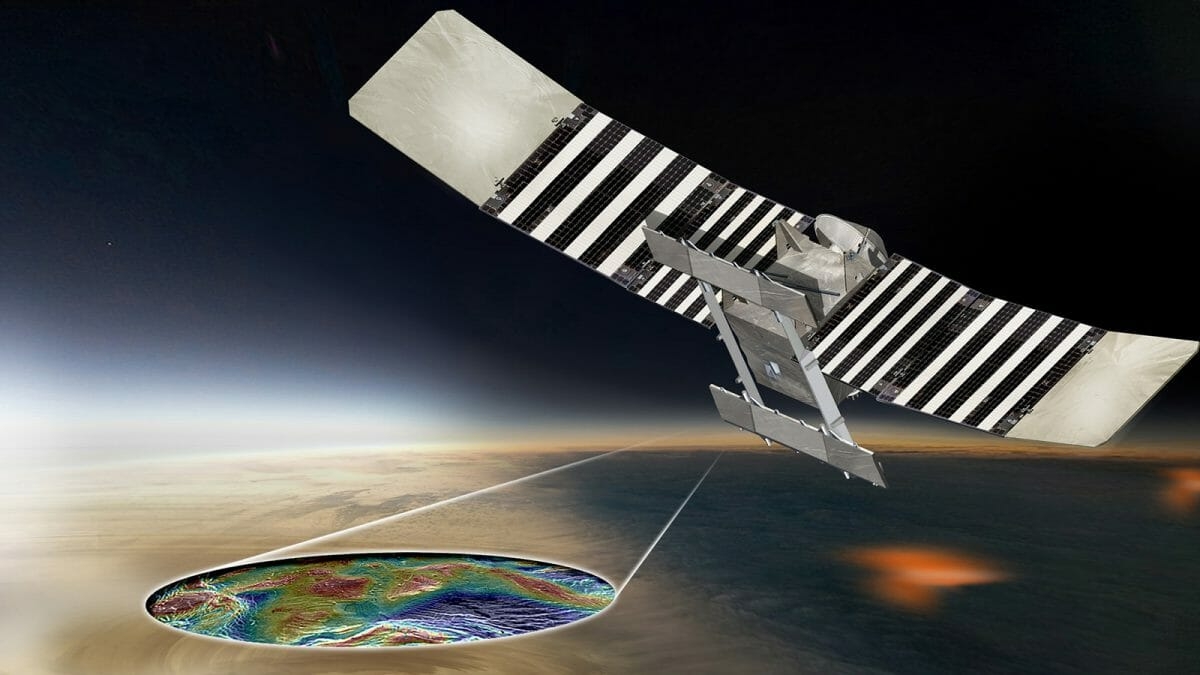
VERITAS Credit: NASA/JPL-Caltech
“These missions are well-suited to find answers to some critical questions,” Schulze-Makuch says, “especially how Venus became the planet it is today. Did Venus have plate tectonics during its natural history and are there still active volcanoes on Venus, which may release water vapor and influence its habitability?”
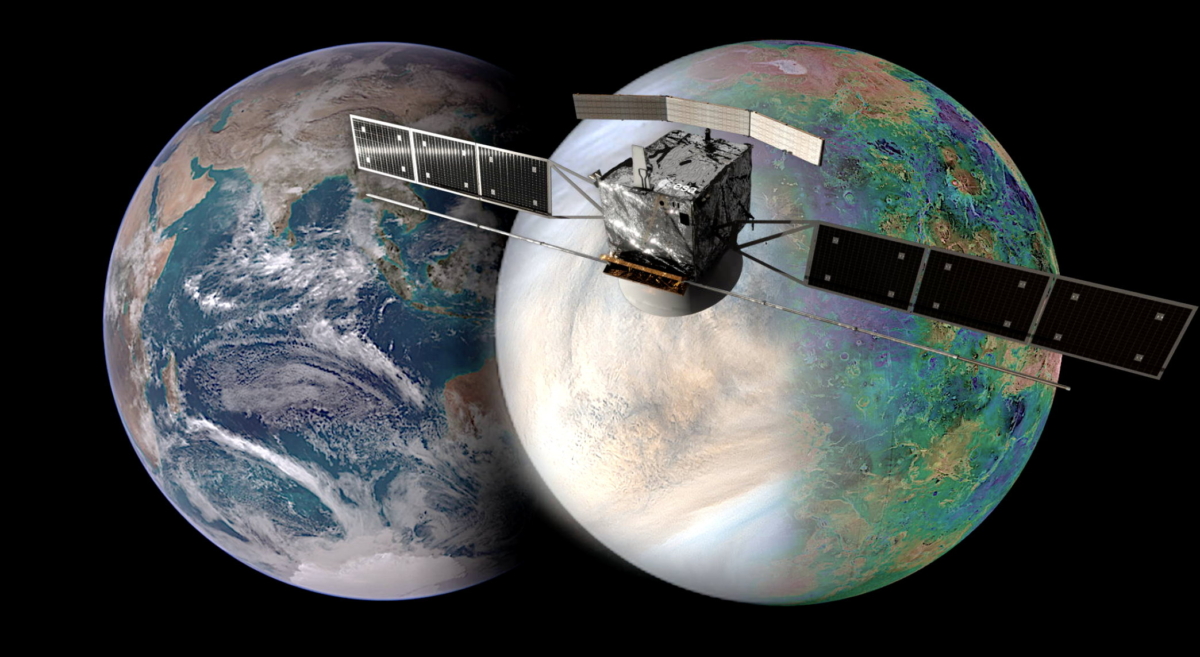
EnVision, led by the European Space Agency.
Credit: NASA/JAXA/ISAS/DARTS/ Damia Bouic/VR2Planets
Upcoming spacecraft missions will advance our knowledge of the Venusian environment tremendously. Without understanding the planet’s environment, researchers cannot possibly hope to understand any life thriving in it. Even if there is no current nor past life on Venus, it is still critical to appreciate the extreme greenhouse effect that encompassed Venus, Schulze-Makuch concludes. “Earth may have a very similar fate in the future.”
 Posted in Space News

