 By
By  November 24th, 2025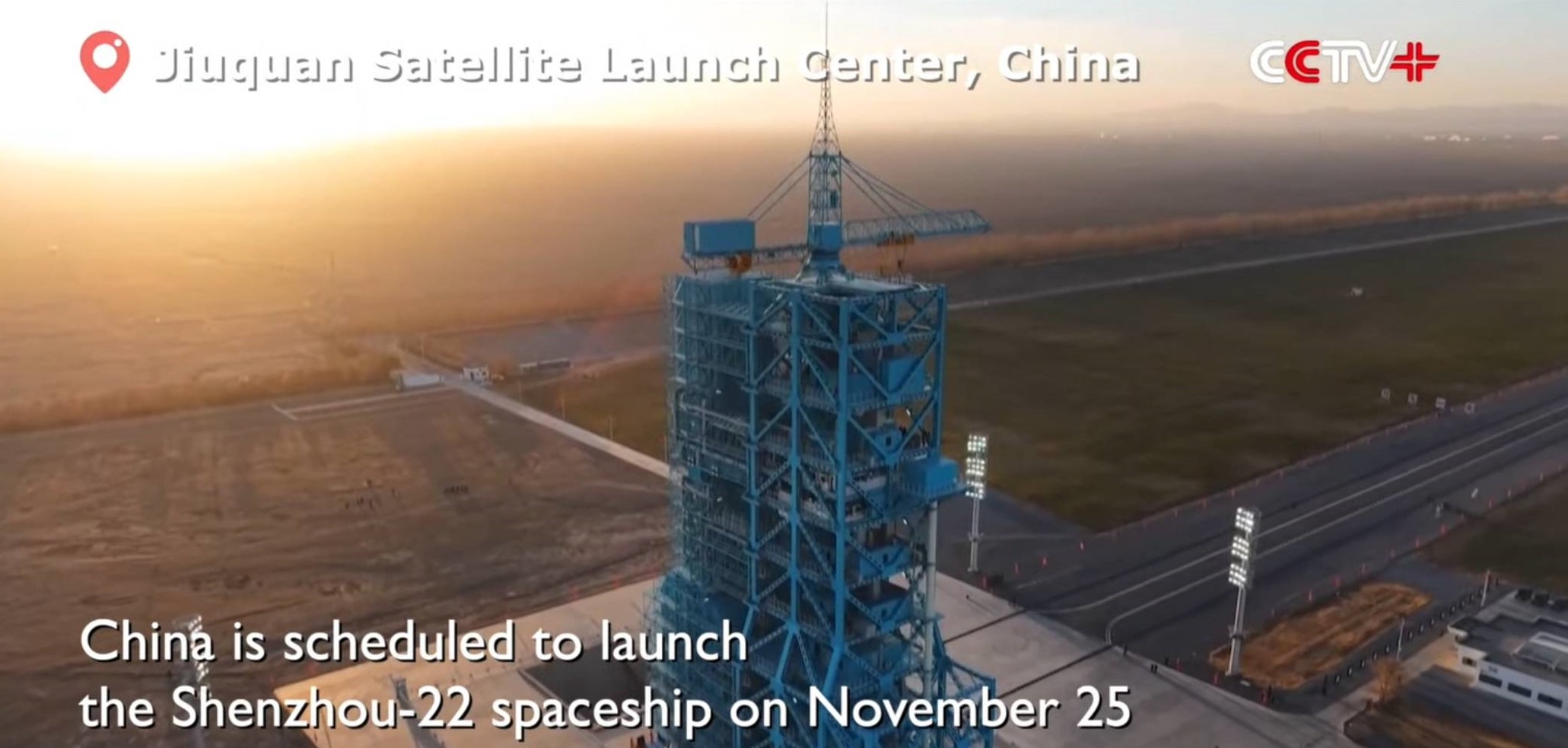
Image credit: CCTV/Inside Outer Space screengrab
Word today from the China Manned Space Agency (CMSA): The launch of the Shenzhou-22 spaceship is set for November 25 Beijing time from the Jiuquan Satellite Launch Center in the northwest.
Currently, the Long March 2F Y22 carrier rocket has completed propellant loading.
The now in orbit Shenzhou-21 astronaut crew is working normally and in good condition in orbit, adds the China Manned Space Engineering (CMSE) office.

Image credit: CCTV/Inside Outer Space screengrab
Space debris hit
China purposely delayed the return of its Shenzhou–20 crew for roughly a week due to a suspected impact of space debris that compromised the crew’s return vessel’s window.
The trio of taikonauts did return to Earth in a fresh but “borrowed” Shenzhou-21 spacecraft on November 14. But doing so left the current on-orbit, three-person space station crew with a damaged and docked vehicle that has been deemed unsafe for re-entry.

Image credit: CCTV/Inside Outer Space screengrab
Space officials in that country labeled the November 5 wave-off of the crew’s return to Earth as the first successful implementation of an “alternative return procedure” in China’s space station program history.
Cargo supplies
The use of the Shenzhou-22 spacecraft and launcher were in standby mode, originally manifested for launch in 2026.
In an earlier statement, Zhou Yaqiang, an official with the China CMSA, told China Central Television (CCTV) that the mission for launching the Shenzhou-22 spacecraft “has been initiated, with preparations for all systems in full swing, including testing the spacecraft and rocket components and preparing the cargo.

Image credit: CCTV/Inside Outer Space screengrab
“The Shenzhou-22 spacecraft is sure to carry supplies. The spacecraft’s cargo-carrying capacity is a highly valuable resource for the manned space program,” Zhou said, “so we will make full use of every opportunity. The Shenzhou-22 spacecraft will mainly deliver food supplies for the astronauts and some equipment for the space station.”
Logo embodies safety of astronauts
With the launch of Shenzhou-22 imminent, CMSE also released the mission logo.
“The Shenzhou-22 mission logo blends Chinese aerospace elements with traditional cultural symbols. Based on the Great Wall, it embodies the solemn commitment to the safety of astronauts,” the CMSE reports.

Image credit: CMSE office
The bow and arrow shape, along with the Long March 2F carrier rocket and the Shenzhou spacecraft, forms the visual core, showcasing a sense of “ready to launch” and a steadfast belief in “mission accomplished.”
Twenty-two arrows surround the logo, precisely corresponding to the mission number.
Swiftness of emergency rescue
In the color scheme, blue represents the foundation of aerospace technology, red represents mission responsibility, and orange “highlights the swiftness of emergency rescue,” notes the CMSE.
The overall design not only continues the aesthetic heritage of Chinese aerospace logos but also innovatively incorporates “emergency rescue elements,” perfectly interpreting the core value of “protecting life with aerospace power” and demonstrating China’s technological strength and humanistic care in the aerospace field, explains the CMSE.
For a short video, go to:
https://www.facebook.com/share/v/17nxoKJ9FT/
Additionally, go to my recent Space.com story – “Space junk strike on China’s astronaut capsule highlights need for a space rescue service, experts say” – at:
 Posted in Space News

