 By
By  June 18th, 2026
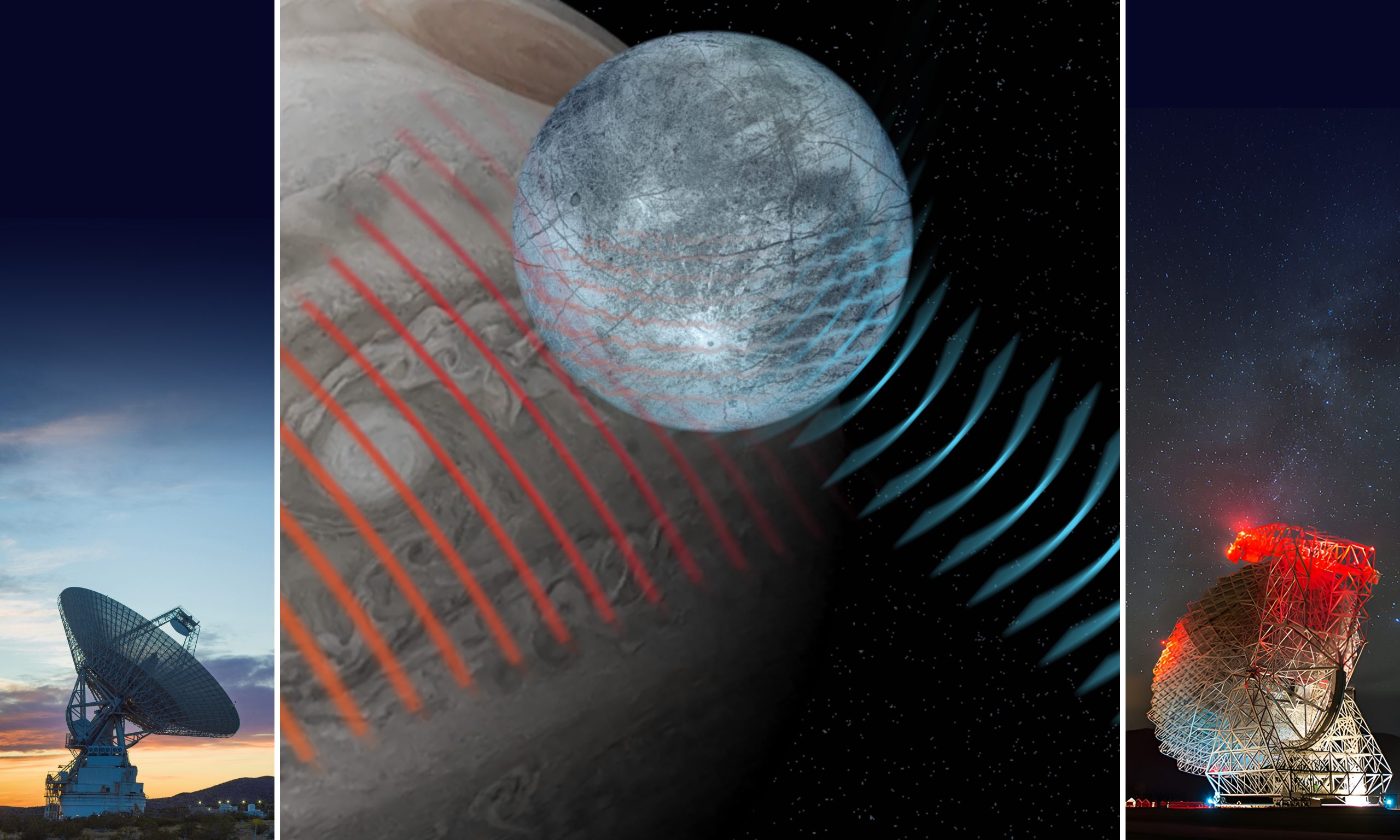
This artist’s impression shows radar waves from the NASA Goldstone Solar System Radar pinging one of Jupiter’s moons, Europa. The radar waves penetrate Europa’s icy surface before bouncing back to be collected by the NSF Green Bank Telescope on Earth.
Credit: NSF/AUI/NSF NRAO/P.Vosteen
Europa, a moon of Jupiter, has been “pinged” by powerful radar on Earth reflecting radio waves in an odd, strong, and complex way not seen on rocky worldsNASA’s Goldstone Solar System Radar and the U.S. National Science Foundation Green Bank Telescope carried out the most extensive radar study to date of the ocean world between 2011 and 2024.
Europa is a prime target in the search for habitable environments beyond Earth.
Internal structure and purity
Tunhui (Tina) Xie, a graduate student at the University of California Los Angeles, states that “radar delves below what is easily seen, because radio waves can penetrate into the ice, and carry information about its internal structure and purity.”

This 2022 view of Jovian moon Europa was created by processing an image from JunoCam captured during the Juno spacecraft’s close flyby on Sept. 29.
Image credits: NASA/JPL-Caltech/SwRI/MSSS Image processing by Björn Jónsson CC BY-NC-SA 2.0
These new observations show that Europa’s radar “albedo”—a measure of how bright it appears to radar—is much higher than that of typical planets and asteroids.
This depth limit using radar offers a new constraint on how transparent Europa’s ice is, and will help scientists interpret upcoming ice‑penetrating radar data from NASA’s Europa spacecraft now en route to study this moon in more detail. It arrives in April 2030.
This radar news is featured in a press conference held at the American Astronomical Society’s 248th meeting on Tuesday, June 16th
Go to 12:35 at:
https://www.youtube.com/watch?v=-38ah-bRjs4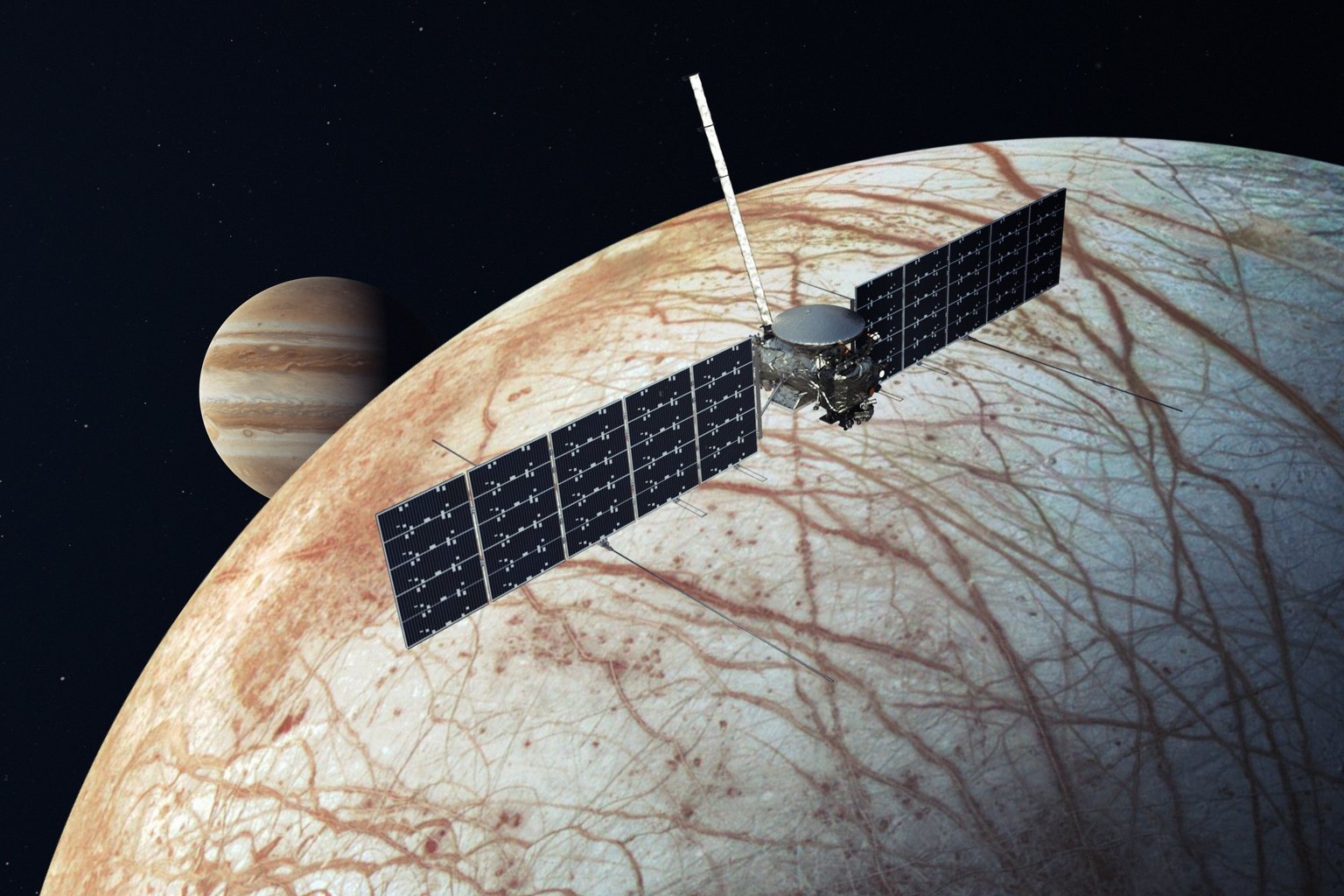
En route to Jupiter, the Europa Clipper.
Image credit: NASA/JPL-Caltech
 Posted in Space News

