 By
By  March 1st, 2019
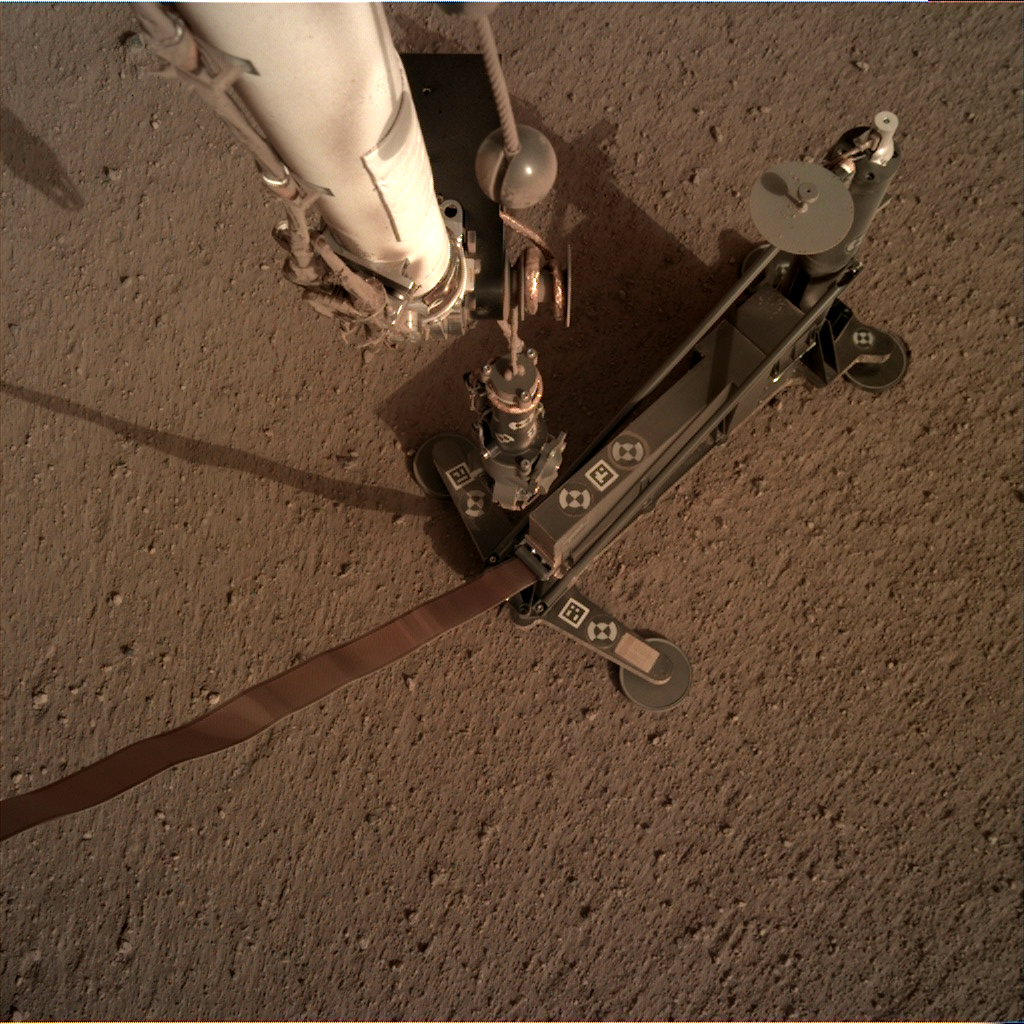
Mole on Mars begins digging.
Credit: NASA/JPL-Caltech
On February 28, 2019, the German Aerospace Center (Deutsches Zentrum für Luft- und Raumfahrt; DLR) ‘Mole’ fully automatically hammered its way into the Martian subsurface for the first time.
The device has been deployed by NASA’s InSight Mars lander.
First step
In a first step, it penetrated to a depth between 18 and 50 centimeters into the Martian soil with 4,000 hammer blows over a period of four hours.
“On its way into the depths, the mole seems to have hit a stone, tilted about 15 degrees and pushed it aside or passed it,” reports Tilman Spohn, Principal Investigator of the Heat Flow and Physical Properties Package (HP3) experiment.
“The Mole then worked its way up against another stone at an advanced depth until the planned four-hour operating time of the first sequence expired,” Spohn said. “Tests on Earth showed that the rod-shaped penetrometer is able to push smaller stones to the side, which is very time-consuming.”

Components of the HP3 heat flow probe. Top left: the radiometer (RAD), which is used to measure the radiation temperature (roughly equivalent to the ground temperature) of the surface. Right: the casing with the mole penetrometer, the temperature measuring cable (TEM-P) and the data cable (ET) connected to the lander. In addition, the casing contains an optical length meter for determining the length of the temperature measuring cable that has been pulled from the casing. The mole contains the TEM-A active thermal conductivity sensor and the STATIL tiltmeter. Bottom left: the electronic control unit, known as the back end electronics (BEE), which remains on the lander and is connected to the probe via the ET.
Credit: DLR.
Target depth
DLR’s HP³ is a rod-shaped penetrometer that uses a fully automatic, electrically powered hammer mechanism to drive itself into the subsurface.
The target depth of 16 feet (five meters) will be achieved in 10 intervals, ideally in early April.
At least 10 feet (three meters) are required to perform heat-flow measurements.
 Posted in Space News

