 By
By  September 5th, 2025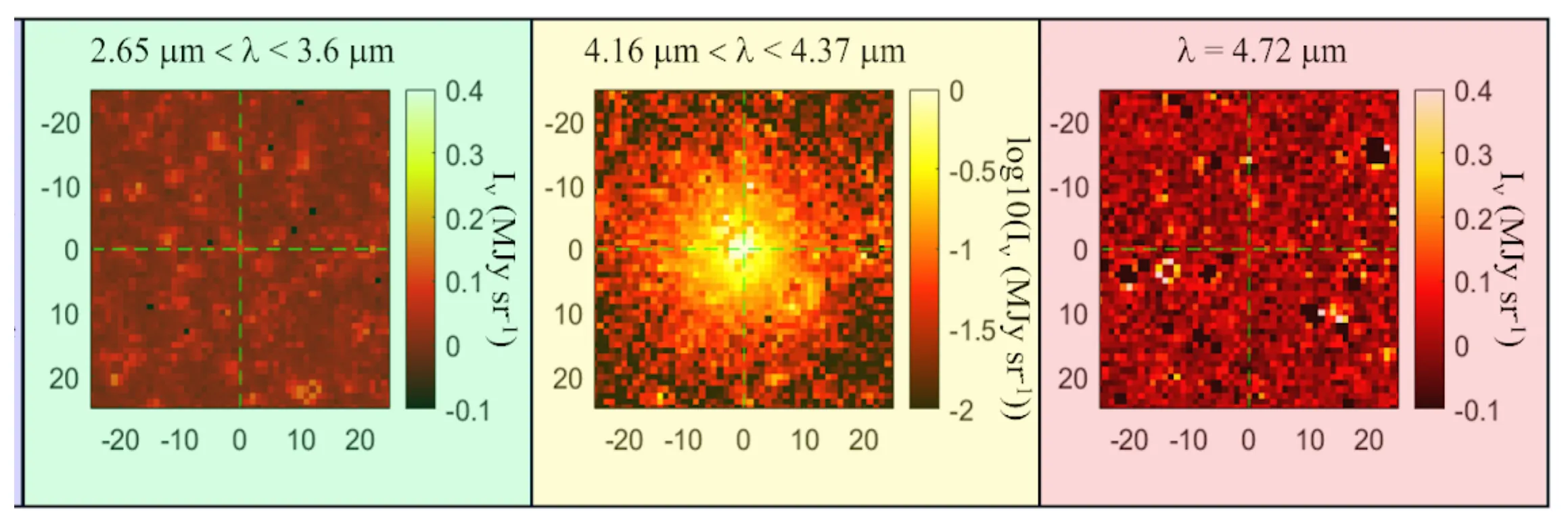
Images of 3I/ATLAS taken by the NASA SPHEREx Space Observatory.
Image credit: C.M. Lisse et al, 2025
That third confirmed interstellar interloper — 31/ATLAS – is getting serious attention as a possible “technosignature” – perhaps a celestial calling card sent our way by extraterrestrials.
These interstellar objects (ISO’s) deserve our attention suggests James R. A. Davenport, Director of the Institute for Data Intensive Research in Astrophysics & Cosmology (DiRAC) at the University of Washington.
Davenport and colleagues have outlined broad classes of technosignatures that are well suited for ISO follow-up, the type of data needed, as well as the best timing for study.

This image of interstellar comet 3I/ATLAS was captured by the Hubble Space Telescope’s Wide Field Camera on July 21, 2025.
Image credit: NASA, ESA, D. Jewitt (UCLA); Image Processing: J. DePasquale (STScI)
Care must be taken
“Given the limitations in the current understanding of ISOs, we show that care must be taken in identifying technosignatures based primarily on comparison to objects in the Solar System,” a Davenport-led research paper reports.
A roadmap has been blueprinted for “careful and consistent study” of the population of ISOs in the hope of identifying technosignatures, the research team adds.
Objects with likely interstellar origins are particularly noteworthy for such investigation.
Wanted: Stringent and detailed confirmation
“As technosignatures are possibly one of the most unambiguous and longest lived signals for the detection of life, these observations allow facilities like the Rubin Observatory to play a critical role in astrobiology over the coming decade,” Davenport suggests.
Anomalies from technosignatures could arise across many axes.
“Any potential detection of technosignatures from an ISO will require the most stringent and detailed confirmation possible. This includes validation of the raw data, analysis methodology, and if possible independent observation of the signal.”
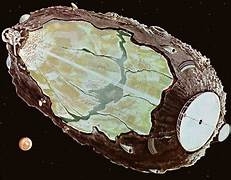
Image credit Roy Scarfo
Modified natural objects
Davenport and colleagues note that, to date, no credible evidence for technosignature signals has been found from the three known ISOs.
That said, the team’s research paper points out that several of the proposed scenarios for interstellar probes in the literature highlight the possibility of technology being connected to natural objects such as asteroids or comets, for example buried in, or sitting on, the surface.
“These natural objects may have even been modified in a number of ways, such as hollowed-out asteroids with stable rotation to generate an interior surface and spin gravity for habitation,” the research paper explains. “In addition, since we can detect very low power communication systems from objects within a few AU, it is important to continue observing ISOs throughout their passage, and with many wavelengths and facilities.”

The Vera C. Rubin Observatory, previously referred to as the Large Synoptic Survey Telescope (LSST).
Credit: The LSST Corporation (LSSTC)
Look more than once
Davenport and his fellow researchers state that the presence of “normal” behavior, such as natural cometary activity, or surface colors consistent with bare asteroids, should not deter follow-up observations aimed at identifying technosignatures.
“As with all technosignature searches, if we only look once, we may simply miss an incredibly obvious transmission or signal,” concludes the research paper.
To access the draft research paper – “Technosignature Searches of Interstellar Objects” – go to:
 Posted in Space News

