 By
By  August 25th, 2025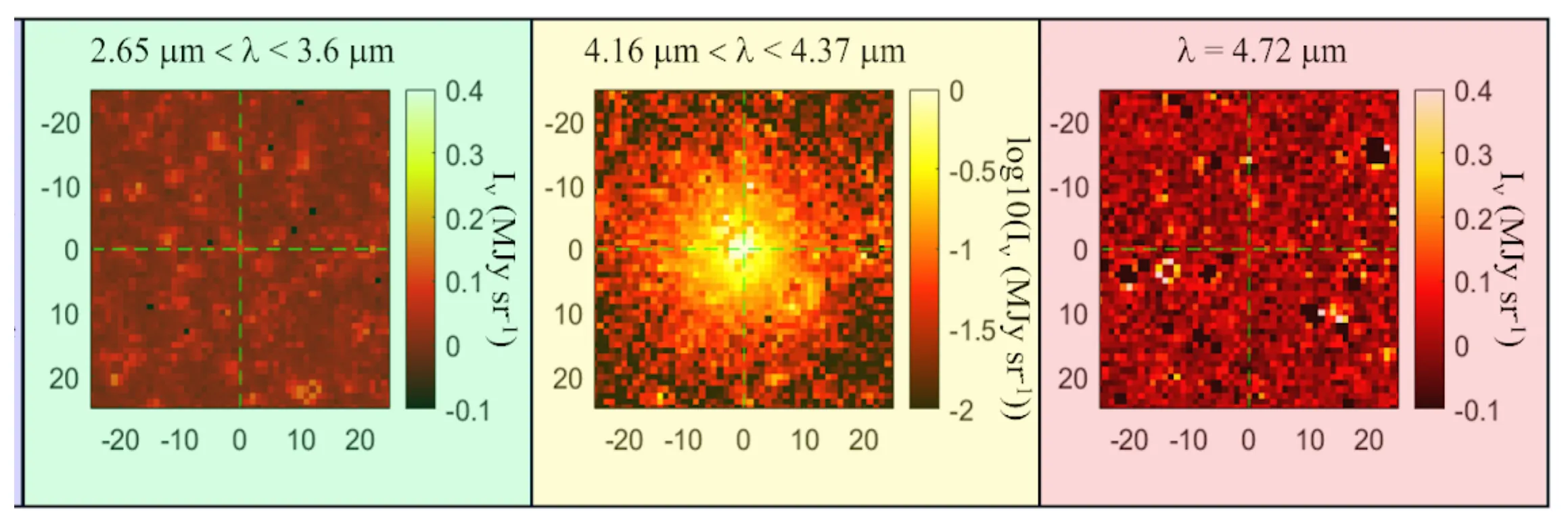
Images of 3I/ATLAS taken by the NASA SPHEREx Space Observatory.
Image credit: C.M. Lisse et al, 2025
Launched a few months ago, NASA’s SPHEREx space-based observatory has focused in on that interstellar intruder, object 3I/ATLAS.
The spacecraft has found strong water ice absorption and an extended carbon dioxide coma.
SPHEREx is short-speak for, get ready and steady – Spectro-Photometer for the History of the Universe, Epoch of Reionization and Ices Explorer.
Sent spaceward on March 11, 2025, SPHEREx is to conduct over a two-year planned mission gathering data on more than 450 million galaxies along with more than 100 million stars in the Milky Way in order to explore the origins of the universe. It will create an all-sky map of the universe.

This artist’s concept shows the spacecraft and its distinctive conical photon shields, which protect SPHEREx’s telescope from infrared light and heat from the Sun and Earth.
Image credit: NASA
Puzzling observation
From August 8 to August 12 the SPHEREx team observed interstellar object 3I/ATLAS.
In a newly released SPHEREx report, they note that the strong reflectance signature of water ice can be explained by the presence of abundant water ice in 3I’s nucleus and coma dust particles.
“The lack of a bright water gas coma is puzzling as 3I was not too far outside the Solar system’s “water ice line” at 2.5 AU during the observations.” Most likely, they add, 3I is so carbon dioxide rich that its evaporative cooling is pinning the solid’s temperature at roughly 120 Kelvin and suppressing the water ice’s vapor pressure.
Future work to observe the object is on tap as 3I/ATLAS will also pass through SPHEREx’s planned survey pattern again in November-December 2025.

Avi Loeb
Image credit: Chris Michel, National Academy of Sciences, 2023)
True nature?
The new findings are of great interest to Avi Loeb, head of the Galileo Project, and founding director of Harvard University’s Black Hole Initiative.
Loeb suggests that 3I/ATLAS may not be a water-rich comet as envisioned by comet experts when it was discovered.
“Alternatively, 3I/ATLAS may have targeted the inner solar system by technological design,” Loeb suggests. “This possibility is consistent with the alignment of its trajectory with the orbital plane of the planets around the Sun.”
Admittedly a controversial view, Loeb adds: “Here’s hoping that as the Sun turns on the heat on 3I/ATLAS in the coming months, it will reveal its true nature.”
 Posted in Space News

