 By
By  April 14th, 2017
Credit: NASA
The Office of Inspector General (OIG) at NASA evaluated the space agency’s plans for deep space exploration and crewed missions to Mars.
The April 13, 2017 OIG report notes:
NASA’s initial exploration missions on its Journey to Mars – EM-1 and EM-2 – face multiple cost and technical challenges that likely will affect their planned launch dates.
Although the Agency’s combined investment for development of the SLS, Orion, and Ground Systems Development and Operations (GSDO) programs will reach approximately $23 billion by the end of fiscal year 2018, the programs’ average monetary reserves for the years leading up to EM-1 are much lower than the 10 to 30 percent recommended by Marshall Space Flight Center guidance.
Credit: NASA/OIG
Low monetary reserves
Low monetary reserves limit the programs’ flexibility to cover increased costs or delays resulting from unexpected design complexity, incomplete requirements, or technology uncertainties. Moreover, software development and verification efforts for all three programs are behind schedule to meet a November 2018 EM-1 launch.
NASA does not have a life-cycle cost estimate or integrated schedule for EM-2, which makes it difficult for Agency officials and external stakeholders to understand the full costs of EM-2 or gauge the validity of launch date assumptions.

International Space Station.
Credit: NASA
International Space Station: implications
NASA’s decision whether to continue spending $3 to $4 billion annually to maintain the International Space Station after 2024 will affect its funding profile for human exploration efforts in the 2020s, and therefore has implications for the Agency’s Mars plans.

Credit: NASA/OIG
Wanted: more rigorous cost and schedule estimates
To increase the fidelity, accountability, and transparency of NASA’s human exploration goals beyond low Earth orbit, the report recommends the Associate Administrator for Human Exploration and Operations:
(1) complete an integrated master schedule for the SLS, Orion, and GSDO programs for the EM-2 mission;
(2) establish more rigorous cost and schedule estimates for the SLS and associated GSDO infrastructure for EM-2;
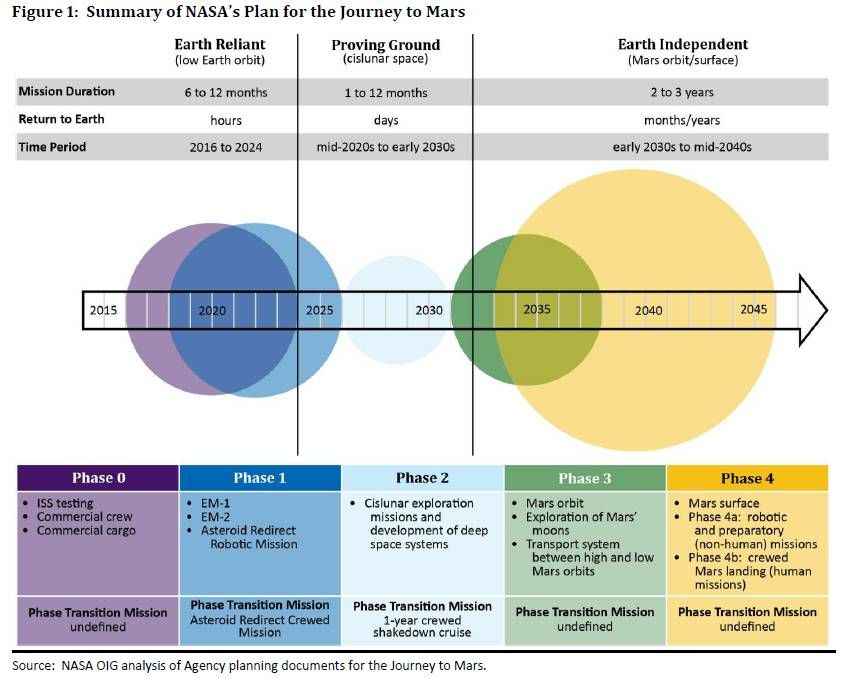
(3) establish objectives, need-by dates for key systems, and phase transition mission dates to flesh out its Journey to Mars framework; and
(4) include cost as a factor in NASA’s Journey to Mars feasibility studies when assessing various potential missions and systems.
Resources:
To read the full report — NASA’s Plans for Human Exploration Beyond Low Earth Orbit – go to:
https://oig.nasa.gov/audits/reports/FY17/IG-17-017.pdf
A video detailing the report can be viewed at:
 Posted in Space News

