 By
By  March 8th, 2017
Credit: Bob Sauls – XP4D/Explore Mars, Inc. (used with permission)
Between the close of the Cold War and the more recent retirement of the U.S. shuttle fleet, we’ve long since left the first space age behind. But now it seems there’s a new space race brewing—one that may take humans out of our planet’s orbit.
At the height of the Cold War, the first space age was a geopolitical race between superpowers eager to outreach each other.
Today’s space race is a more complex interplay of networked nations and private players alternatively competing against, and collaborating with, each other.
New global players
Once the exclusive provenance of old power nations, space exploration has increasingly opened to new global players with India, China, Nigeria, Japan, the EU, and the UAE getting in the race.
Private enterprises are also playing an increasingly prominent role in our interplanetary yearnings, as evidenced by the ventures backed by Jeff Bezos, Elon Musk, and Richard Branson.
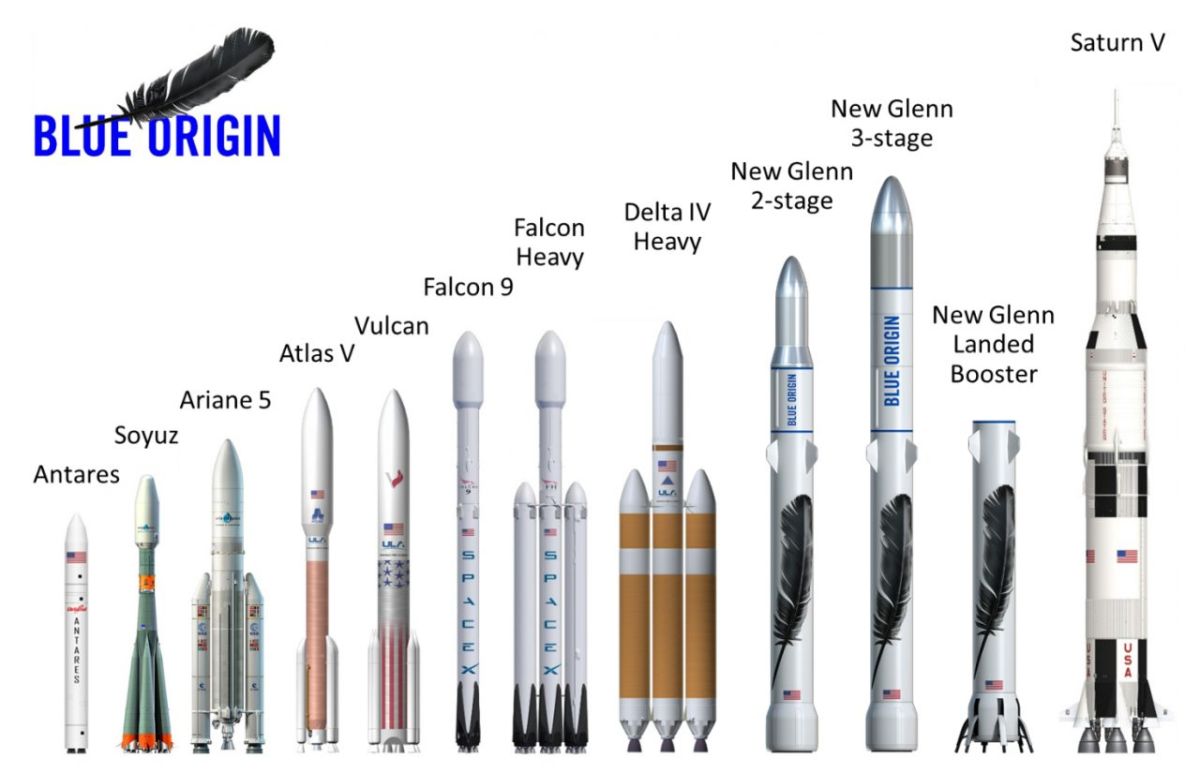
Credit: Blue Origin
NASA is still very much in the game but without a moonshot-like commitment for Mars, their projected 2040 piloted mission seems far off. A start-up company, or an upstart country, may beat us there—or perhaps help us all get there together as partners.
Check out this Wednesday, March 8th discussion sponsored by New America in Washington, D.C. to consider whether it will be competition or cooperation that finally gets us to Mars and beyond.
Check out this video of today’s gathering at:
https://www.youtube.com/watch?v=Z4Q2OOADaTc
 Posted in Space News


Everything can be done in the USA at a low cost. Just a matter of making an integration. Your question is whether it should be commercial space or collaboration. It must be like two things. In fact, a NASA must have a project ready to reach Mars. As it has Then a standard volume of charge is admitted for each rocket launched to Mars and divides between competitors. The launches, the capsules, the cargoes, the costumes, the base, the parts of the base, maintenance of people on Mars, and auction between interested, even if they are international. The flag will be American at first, and all mechanisms will be made primarily in the US, but where there is better price / quality. Thus, Nasa can auction launches to Mars, and pay for those who offer the lowest price. No matter who. It does not matter which country. And so on. You auction the person who will make the capsules, the habitats, who will provide the communication system, who will provide food, who will do the integration. You divide every exploration of Mars and every part of the activities and mechanisms, inputs, of the venture, you auction among competitors around the world. NASA could even create a kind of “super start-up” to manage the project and sell the shares in the market, so that the contract will be paid by investors. NASA only manages. Foster, Organize. Get ready. NASA does not have to do everything, and in fact, maybe, if you just do the project, the integration and having control is enough. Everything can be outsourced. Sold to the lots by auction.
Continuing …
Imagine making a budget for exploring Mars at $ 50 billion over the next 5 years. NASA can finance half, and the rest financed by partners, for example, 12.5% for ESA, the same for JAXA, the same for Roskosmos, and the same, for example, for INSA. Nasa does a basic preliminary project, shares with partners to study, makes a definite joint project, makes the budget, complete, divides the obligations and is auctioned among the interested parties. Among the partners. It does launches auction, spaceship, among other things. An international partnership would be great!
Continuing …
If, for example, five international partners are involved in financing the operation, there will be an auction of the parts of the project between companies in the partner countries up to the limit of collaboration in the financing. So, for example, if Russia finances 12.5% of the project, Russia will have a limit of being able to participate in the auction up to 12.5% of the budget. And, for example, the US, if it funds 50%, will have the right to participate in the auction up to 50% of the budget. So there is no danger that a single country will win everything in the auction. By auction, the final cost may be lower than the 100% budgeted. It could happen, for example, that US companies offer such a low price that before they reach 50% of the budget, every project is already “commissioned”. It’s difficult. But the fact is that even if you pay 50% of the installment, it does not mean that US companies will build 50% of the mechanisms or will do 50% of the services. They can do more or more, but never more than 50% of the budget. In short, a apportionment between the parties. Financing and project execution.
escuse me… “they can do more or “less”, but never more than 50% of the budget”
I’ll try to explain better …
Imagine that there is an agreement between five countries and that each will finance 20% of an exploration project to Mars. It is a joint project. Each part of the project will be executed by private companies from partner countries, at the lowest auction price, up to a limit of 20% of the budget. So, for example, Russia offers the lowest price per launch. But the quantity of launches for the price exceeds 20% of the budget, so that a second auction should occur to define a lower price without Russia’s participation in the number of launches that exceed 20% of the budget. Or, on the contrary, the Russian company offers such a low price that even though it earns all the launches, it does not reach 20% of the budget. In this way Russia can participate in the auctions for other parts of the project, such as the construction of habitats, for example. Up to 20% of the budget. It can happen that some partner finances 20% of the project, but the companies of this country do not take out a part of the project. Understood?