 By
By  July 13th, 2024
Mars beckons. Human explorers can maximize the science output for unraveling the complex nature of the Red Planet.
Image credit: NASA/Pat Rawlings
In charting the actions of future foot soldiers on Mars, the Committee on Space Research (COSPAR) has been busily addressing knowledge gaps for planetary protection of the Red Planet.
Established in 1958, COSPAR is a prestigious scientific confab of international researchers, anchored in tackling problems that may affect space exploration.
A COSPAR Principles and Guidelines for Human Missions to Mars has been scripted by a top-tier panel of experts on planetary protection.

Image credit: NASA
Back contamination
“The intent of this planetary protection policy is the same whether a mission to Mars is conducted robotically or with human explorers,” the document explains.
As such, planetary protection goals should not be relaxed to accommodate a human mission to Mars, the document notes. “Rather, they become even more directly relevant to such missions—even if specific implementation requirements must differ.”
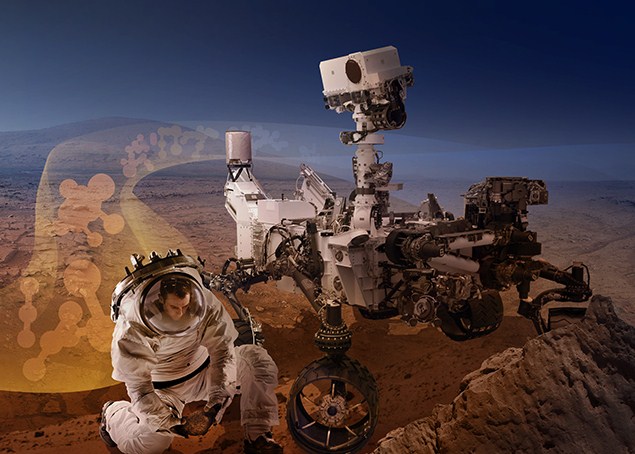
Humans and robots on Mars are likely to team up to augment the types of exploration avenues that can be done on the Red Planet.
Credit: NASA/Ames Research Center
General principles include:
— Safeguarding the Earth from potential back contamination is the highest planetary protection priority in Mars exploration.
— The greater capability of human explorers can contribute to the astrobiological exploration of Mars only if human associated contamination is controlled and understood.
— For a landed mission conducting surface operations, it will not be possible for all human-associated processes and mission operations to be conducted within entirely closed systems.
— Crewmembers exploring Mars, or their support systems, will inevitably be exposed to martian materials.
Monitoring of microbes
The COSPAR panel has made specific implementation guidelines for human missions to the Red Planet.
For instance, human missions will carry microbial populations that will vary in both kind and quantity, and it will not be practicable to specify all aspects of an allowable microbial population or potential contaminants at launch of an expeditionary crew to Mars.

Artist’s concept depicts astronauts and human habitats on Mars.
Image credit: NASA
Once any baseline conditions for launch are established and met, continued monitoring and evaluation of microbes carried by human missions will be required to address both forward and backward contamination concerns.
Quarantine
Akin to steps taken by early Apollo moon landings in that program, a quarantine capability for both the entire crew and for individual crewmembers shall be provided during and after the mission, “in case potential contact with a martian life-form occurs,” the COSPAR document adds.

On Earth recovery, Apollo 11 crew donned Biological Isolation Garments to protect Earth from possible Moon bugs.
Credit: NASA
A comprehensive planetary protection protocol for human missions to Mars should be developed, one that encompasses both forward and backward contamination concerns, and addresses the combined human and robotic aspects of the mission, including subsurface exploration, sample handling, and the return of the samples and crew to Earth.
Special regions
Neither robotic systems nor human activities should contaminate “Special Regions” on Mars, as defined by the COSPAR policy.
A Special Region is defined as a region within which terrestrial organisms brought from Earth are likely to replicate.
Any region which is interpreted to have a high potential for the existence of extant martian life forms is also defined as a Special Region, explains the COSPAR panel.
Regions like gullies, bright streaks associated with gullies, subsurface cavities, the subsurface below roughly 16 feet (5 meters) are called out in the document.

Artwork depicts many of the potential “Special Regions” in or near which proliferation of terrestrial microorganisms is a possibility.
Image credit: Carol Stoker, et al./Julie Fletcher.
So too are those perplexing Recurrent Slope Lineae, or RSL for short.
RSL’s are observed simultaneous incremental growth of flows on a warm slope, fading, and recurrence of this sequence in multiple Mars years.
Over the years, RSLs have been suggested by some experts to be a product of salty water flows occurring during the warmest months on Mars. On the other hand, other Mars scientists believe they are dry grains that stream down slopes.
Send in the robots
The COSPAR panel points out that any uncharacterized martian site should be evaluated first by robotic means prior to human crews gaining access.

Robotic exploration supervised by human expeditionary crew on Mars.
Image credit: NASA
Furthermore, any pristine samples or sampling components from any uncharacterized sites or Special Regions on Mars should be treated as restricted Earth return, with the proper handling and testing protocols.
That is, there’s need to rigorously preclude backward contamination of Earth by extraterrestrial life to prevent potentially harmful consequences for humans and the Earth’s biosphere.
Conservative approach
As for who gives the planetary protection orders on Mars, the COSPAR document says a crewmember should be given primary responsibility for the implementation of planetary protection provisions affecting the crew during the expedition.
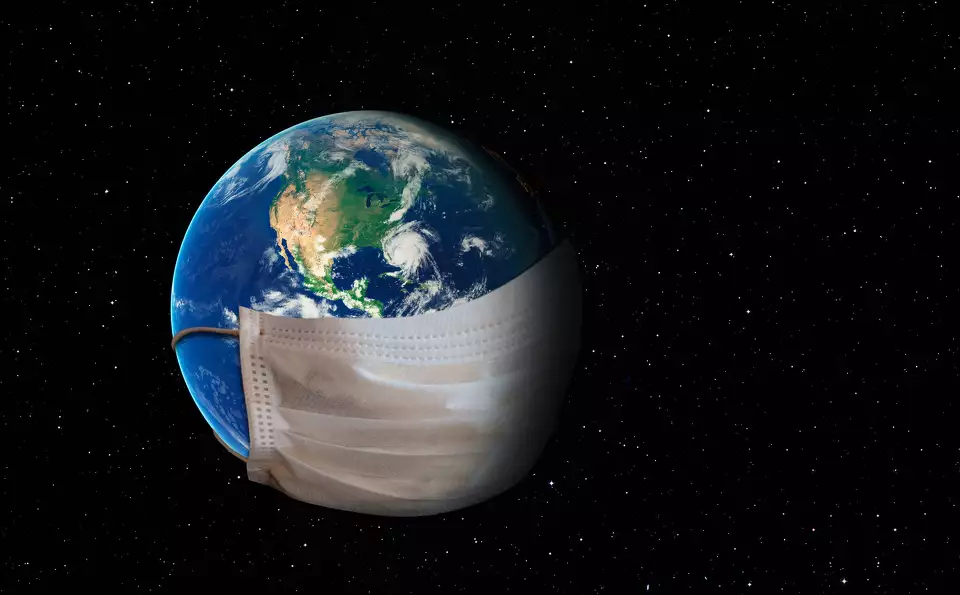
Image credit: Bipartisan Commission on Biodefense
The COSPAR thinking is that planetary protection requirements for initial human missions “should be based on a conservative approach consistent with a lack of knowledge of martian environments and possible life, as well as the performance of human support systems in those environments.”
For later human sojourns to Mars, planetary protection rules of the road “should not be relaxed without scientific review, justification, and consensus,” the COSPAR document says.
For detailed information regarding COSPAR and its work, go to:
 Posted in Space News


It’s dead, Jim.
Git them scientists away from that planet and USE it!