 By
By  December 15th, 2021
A volunteer spent three nights in a high-tech sleeping bag that unloads pressure in the brain by suctioning fluids into the lower body. NASA hopes the sack can be used by astronauts in space to alleviate the vision problems they commonly endure during longer missions.
Credit: UT Southwestern
A specially designed sleeping bag may prevent vision problems astronauts endure in space, where fluids float into the head and continually push and reshape the back of the eyeball.
The phenomenon has plagued scientists for more than a decade. It remains one of the biggest health dilemmas of human space exploration.
But new research by the University of Texas Southwestern Medical Center – which NASA enlisted to seek answers to astronauts’ vision problems – suggest the high-tech sacks may provide a solution. The sleeping bag prototype is the culmination of several phases of research carried out at UT Southwestern to help NASA better understand the disorder.
NASA hopes the sleeping bag can address a disorder called spaceflight-associated neuro-ocular syndrome, or SANS.

Body fluids in zero gravity apply constant pressure behind the eyes, causing progressive flattening of the eyeball, swelling of the optic nerve, and vision impairment.
Credit: UT Southwestern
Vision problems
SANS is not a problem on Earth, where gravity pulls fluids down into the body each time a person gets out of bed. However, in space, the lack of gravity prevents this daily unloading process, allowing more than half a gallon of body fluids to gather in the head and apply pressure to the eyeball.
NASA has documented vision problems in more than half of the astronauts who served for at least six months on the International Space Station. Some became farsighted, had difficulty reading, and sometimes needed crewmates to assist in experiments.
Severe impairments
“We don’t know how bad the effects might be on a longer flight, like a two-year Mars operation,” said Benjamin Levine, M.D., a UT Southwestern cardiologist who is helping NASA address the health risks of brain pressure and abnormal blood flow in space. “It would be a disaster if astronauts had such severe impairments that they couldn’t see what they’re doing and it compromised the mission.”
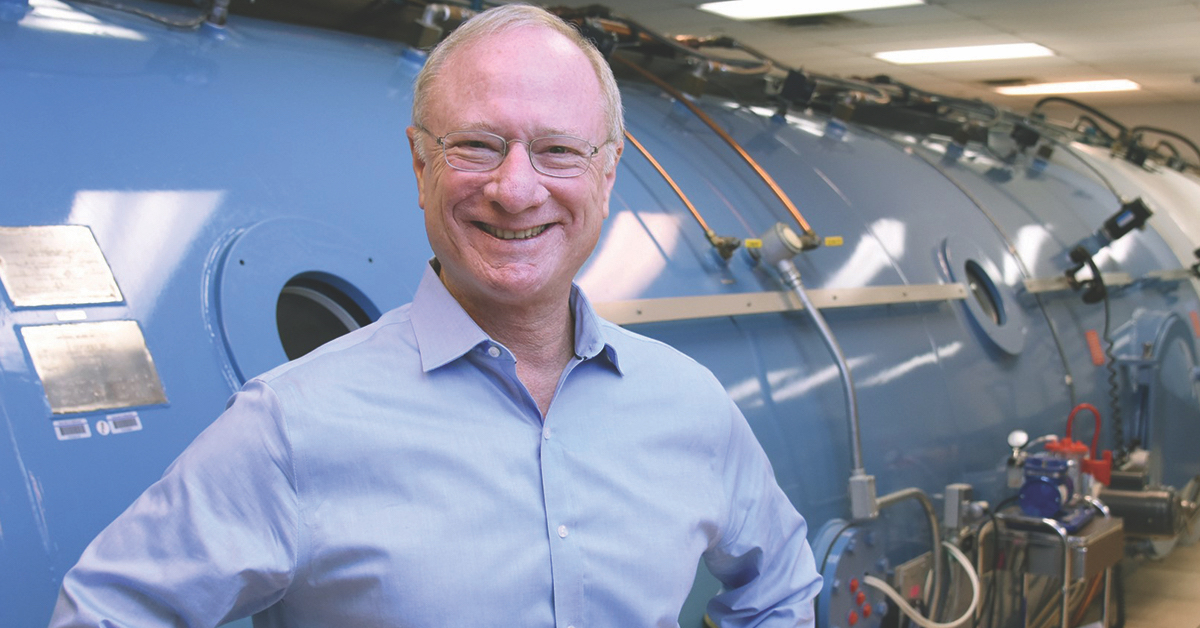
Dr. Benjamin Levine of UT Southwestern has researched the effects of space travel since the early 1990s, when he implanted the first catheter to monitor the heart pressure of an astronaut in space.
Credit: UT Southwestern
Levine said his latest findings indicate SANS, hopefully, won’t be a health risk by the time the space agency is ready to launch humans to the Red Planet.
Levine’s team started working with the outdoors equipment retailer REI to develop a high-tech sleeping bag that could be used by astronauts each night to unload pressure in the brain. The bag has a solid frame – aptly shaped like a space capsule – and is designed to fit over a person from the waist down.
About a dozen people volunteered to test the technology.
For more information on the research, go to “Effect of Nightly Lower Body Negative Pressure on Choroid Engorgement in a Model of Spaceflight-Associated Neuro-ocular Syndrome A Randomized Crossover Trial” at:
https://jamanetwork.com/journals/jamaophthalmology/article-abstract/2787146
Also, go to this informative UT Southwestern research posting at:
https://utsouthwestern.edu/newsroom/articles/year-2021/high-tech-sleeping-bag.html
 Posted in Space News

