 By
By  May 20th, 2023
Image credit: Axiom Space
The upcoming liftoff of a SpaceX Falcon 9 rocket, with the Dragon Freedom crew of four private astronauts headed for the International Space Station, also makes possible technology testing of an array of new-to-space hardware.
The Axiom Mission-2 crew is led by former NASA astronaut and Ax-2 commander Peggy Whitson, also Axiom Space’s Director of Human Spaceflight. She leads first-time space flyers pilot John Shoffner of Knoxville, Tennessee and mission specialists Ali Alqarni and Rayyanah Barnawi from the Kingdom of Saudi Arabia.

AX-2 crew.
Image credit: Axiom Space
The multinational AX-2 astronaut crew will conduct more than 20 different experiments while aboard the space station.
Axiom Space is a private company eyeing expanded access to the International Space Station and low-Earth orbit. The organization’s intent is to lay the groundwork and establish the key capabilities needed to build out and operate Axiom Station – the world’s first commercial space station.
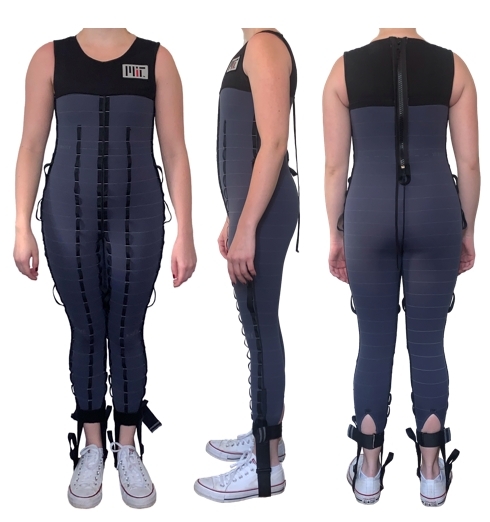
Image credit:
Rachel Frances Bellisle
Intravehicular apparel
One item for testing is the Gravity Loading Countermeasure Skinsuit. This intravehicular (inside habitable volume) activity suit is sponsored by the Massachusetts Institute of Technology’s (MIT) Media Lab’s Space Exploration Initiative in Cambridge.
The suit has been developed to simulate some effects of Earth’s gravity and help mitigate certain physiological impacts from microgravity, including spinal elongation, muscle atrophy, and sensorimotor changes.
“This wearable system is intended to supplement exercise during future missions to the Moon and Mars and to further attenuate microgravity induced physiological effects in future low-Earth orbit mission scenarios. The purpose of this study is to characterize the Skinsuit and its physiological effects on a short-duration low-Earth orbit mission,” explains an Axiom posting about the Skinsuit.

The Skinsuit Team. (left to right:) Rachel Bellisle (Project Lead), Allison Porter, Ciarra Ortiz, Dava Newman (Principal Investigator).
Image credit: Rachel Bellisle
Form and function
The goal of this project: Can the Skinsuit restore sensorimotor functions that are typically altered in microgravity?
The Skinsuit produces a static load from the shoulders to the feet with elastic material in the form of a skin-tight wearable suit.
This wearable system is intended to supplement exercise during future missions to the Moon and Mars. Exercise equipment at those locations may be too large and bulky, so the Skinsuit is a hoped-for way to further attenuate microgravity-induced physiological effects.
The Skinsuit was tested during a 2021 Zero-G parabolic flight, during which the participant performed arm movements with and without the Skinsuit for comparison to typical 1-G muscle activation patterns and postural control strategies.

Rachel Bellisle tests the Gravity Loading Countermeasure Skinsuit, an intravehicular activity suit for astronauts that has been developed to simulate the effects of Earth gravity.
Image credit: Steve Boxall/ZERO-G
Tech demo
The Skinsuit team is sponsored by the MIT Media Lab’s Space Exploration Initiative and led by Rachel Bellisle, PhD candidate in the Harvard-MIT Program in Health Sciences and Technology. Dava Newman, director of the MIT Media Lab is the principal investigator of the Skinsuit.
“Anytime we can get something into space as a technology demonstration, it’s an advantage,” Newman told Inside Outer Space. Having academia engaged means developing experiments in months, not years or decades, she added.
“We have the technology. Let’s demonstrate it in the real environment,” Newman said.
 Posted in Space News

