 By
By  July 15th, 2014
Credit: DARPA
The Defense Advanced Research Projects Agency (DARPA) has given the go to three companies to work on a reusable first stage launch vehicle capable of carrying and deploying an upper stage to launch small satellite payloads of 3,000 to 5,000 pounds (1,361 kg to 2,268 kg) into low-Earth orbit.
They are:
— The Boeing Company (working with Blue Origin, LLC)
— Masten Space Systems (working with XCOR Aerospace)
— Northrop Grumman Corporation (working with Virgin Galactic)
DARPA established its Experimental Spaceplane (XS-1) program to create a new paradigm for more routine, responsive and affordable space operations.
According to DARPA, the XS-1 program aims to develop a fully-reusable unmanned vehicle that would provide aircraft-like access to space and deploy small satellites to orbit using expendable upper stages.
Next-gen
XS-1 seeks to deploy small satellites faster and more affordably, and develop technology for next-generation hypersonic vehicles.
XS-1 program officials envision that a reusable first stage would fly to hypersonic speeds at a suborbital altitude. At that point, one or more expendable upper stages would separate and deploy a satellite into low Earth orbit.
The reusable first stage would then return to Earth, land, and be prepared for the next flight. Modular components, durable thermal protection systems and automatic launch, flight and recovery systems should significantly reduce logistical needs, enabling rapid turnaround between flights.
Key XS-1 technical goals include flying 10 times in 10 days, flying to Mach 10+ at least once and launching a representative small payload to orbit. The program also seeks to reduce the cost of access to space for 3,000- to 5,000-pound payloads to less than $5 million per flight.
Phase II
DARPA plans to hold a Phase II competition next year for the follow-on production order to build the vehicle and conduct demonstration flights.

Credit: DARPA
The autonomous reusable launch vehicle would be designed to carry and deploy an upper stage to launch small satellites and payloads into low-Earth orbit and then return to Earth, where it could be quickly prepared for its next flight by applying operation and maintenance principles similar to those of modern aircraft.
In spotlighting the three winners, Jess Sponable, DARPA program manager, said in a press statement:
“We chose performers who could prudently integrate existing and up-and-coming technologies and operations, while making XS-1 as reliable, easy-to-use and cost-effective as possible,” Sponable said. “We’re eager to see how their initial designs envision making spaceflight commonplace…with all the potential military, civilian and commercial benefits that capability would provide.”
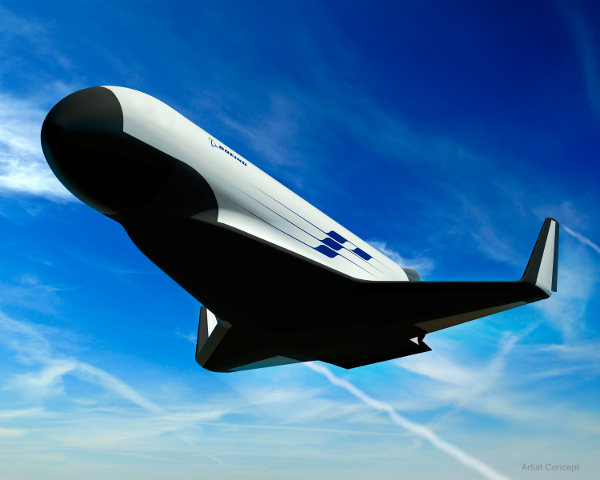
Credit: Boeing
Boeing response
Under the $4 million preliminary design contract, Boeing responded to their win: “Boeing brings a combination of proven experience in developing launch systems and reusable space vehicles, along with unparalleled expertise in the development and fielding of highly operable and cost-effective transportation systems,” said Steve Johnston, director of Boeing’s Phantom Works Advanced Space Exploration division.
Will Hampton, Boeing XS-1 program manager, added: “Drawing on our other innovative technologies, Boeing intends to provide a concept that uses efficient, streamlined ground infrastructure and improves the turnaround time to relaunch this spacecraft for subsequent missions.”
X-37: a leg up?
Just a side note…as it would seem that part of that “innovative technologies” portfolio that Boeing brings to the table are lessons learned in building and flying the X-37B space plane for the Air Force – a craft that is now circling Earth.
When asked about this, Boeing spokeswoman, Cheryl Sampson responded to my inquiry: “Boeing will use experience from a variety of programs in our design. I can’t comment specifically on the X-37B program and direct you to the Air Force for additional information.”
Meanwhile, The U.S. Air Force’s robotic X-37B space plane is high-flying on a classified military mission.
The X-37B space plane that’s now in orbit is carrying out the Orbital Test Vehicle 3 (OTV-3) mission, a flight that marks the third long-duration flight for the robotic Air Force spaceflight program. The miniature, uncrewed space shuttle has been circling the Earth since its launch on Dec. 11, 2012.
Go to a DARPA video on the XS-1 here:
 Posted in Space News

