 By
By  December 15th, 2022
Image credit: Orbital Assembly
Variable gravity in space has long been discussed; an idea harvested as far back as 1883 by the visionary Russian rocket scientist, Konstantin Tsiolkovsky.
Future space habitats may offer hybrid, variable gravity environments to accommodate both human and commercial needs, according to researchers piecing together a unique and exhaustive literature review of artificial gravity opportunities, challenges, and potential impact on humans in space.
Sponsored by Orbital Assembly, the new work – “Challenges and Benefits to Human Operations in Variable & Partial Gravity Earth Orbiting Habitats” — was conducted by the 100 Year Starship initiative, founded and led by former astronaut Mae Jemison. Joining Jemison in the research was University of California, Irvine professor, Ronke Olabisi.

Mae Jemison and Ronke Olabisi.
Image credit: Orbital Assembly
The researchers call for more studies on artificial gravity in a space environment since virtually all the human research on artificial gravity has been conducted on Earth to date.
Hybrid gravity
“This review provides further justification of the need for hybrid gravity space station design that will offer variable levels of gravity in the very near future,” said Rhonda Stevenson, Chief Executive Officer of Orbital Assembly.
The researchers do report that, although artificial gravity would likely prove to be an effective multisystem preventative against the deleterious impact of microgravity, countermeasures such as exercise, pharmaceuticals, and nutrition have been perceived to be much more cost effective and easier to implement.
Gaps in knowledge
“Rotational artificial gravity structures are being proposed as single countermeasure solutions to long duration and interplanetary space travel. Such capabilities may facilitate better accommodations for everyone—from professional crew to researchers to tourists—to protect health, facilitate operations, and optimize time on orbit,” explains an Orbital Assembly statement.
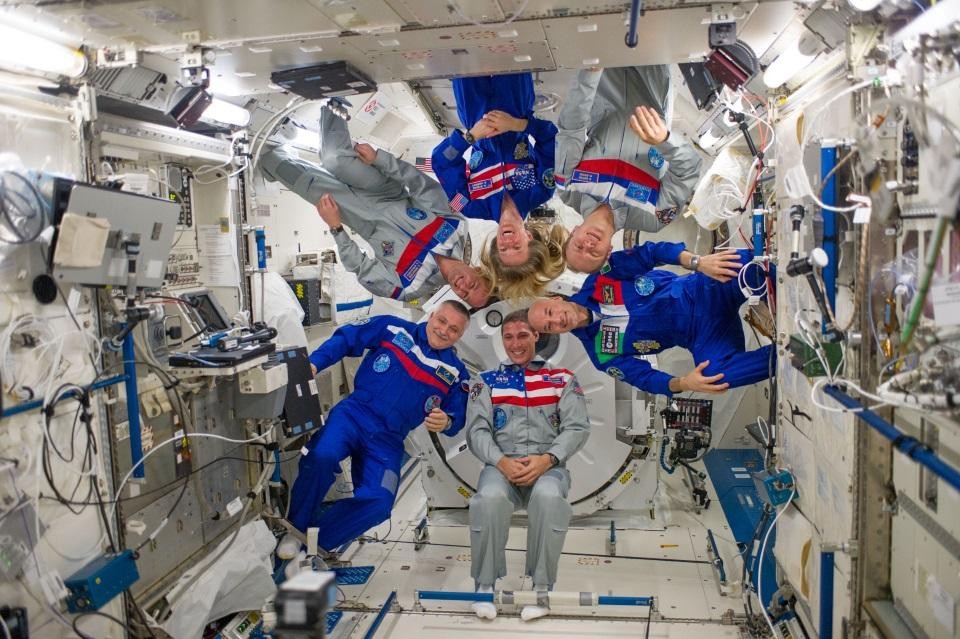
Time to turn in freefall for variable gravity?
Image credit: NASA
The researchers also note that the reality is that there is little direct human evidence that artificial gravity will protect human health, but animal studies combined with ground-based studies provide important clues.
“Regardless of the gaps in knowledge concerning the benefit of artificial gravity as a countermeasure, there are intuitively obvious benefits to artificial gravity, including establishing a well-defined vertical and horizontal reference frame,” the report explains.
“If artificial gravity does prove to be an effective countermeasure, crew compliance with lengthy and tedious 0-G exercise protocols would become unnecessary,” the report points out.
Go to this informative video, “Space Medicine and Artificial Gravity” – featuring Ronke Olabisi at:
 Posted in Space News


David,
Thanks for this article. We need more such public debates to build awareness.
Artificial Gravity (AG) induced by centripital spin is long overdue. There have been many speculations but to date no real data or space investigations on AG equipment that could meet this need.
With potentials for lower launch costs resulting from reusable rockets and NASA’s turn toward commercial LEO facilities the market is finally near for AG space test facilities.
Gravitics is dedicated to building spin-gravity capable habitats and associated systems for both zero-gravity and AG applications for our space station customers.
Leonard,
We at gravitics (and me personally) continue to pursure development of our new-space AG & 0-G capable habitats. Our progress and testing successes can be seen on our website or on LinkedIn.
Steve