 By
By  December 10th, 2020
Credit: ESA
Space Rider is Europe’s next-generation reusable transportation system for low Earth orbit.
The European Space Agency (ESA) has signed a contract with Thales Alenia Space and co-contractor AVIO for the development of the automated reusable Space Rider transportation system, designed for deployment by the new Vega C light launcher into low Earth orbit.
A second contract covers the delivery of the ground segment by Italian co-prime contractors: Telespazio and Altec.
Space Rider would offer routine access to and return from space for a wide range of European space and non-space applications, including in-orbit research and technology demonstrations.
Credit: ESA
First flight of Space Rider is eyed for the third quarter of 2023 from Europe’s Spaceport in French Guiana.
Applications
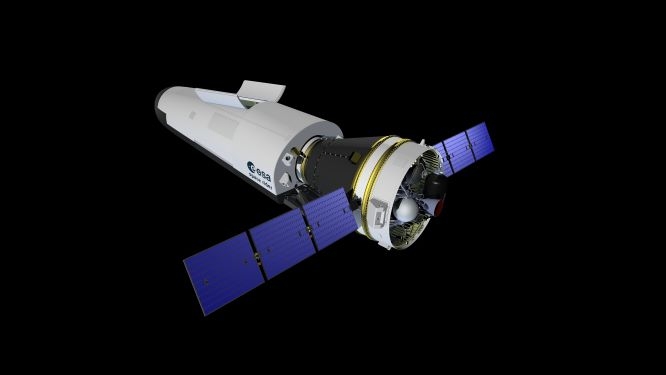
Space Rider is about the size of two minivans.
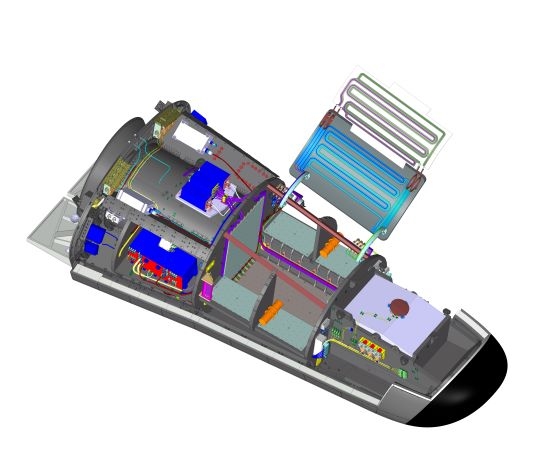
The reentry module hosts the cargo bay, a roomy spot for nearly 1,765 pounds (800 kilograms) of customer payloads and attendant power supply, thermal control, and data handling gear.
The reentry module is powered in orbit by Vega-C’s upper stage AVUM+ enhanced with a life extension kit serving as a service module during missions of at least two months.
Credit: ESA-Jacky Huart
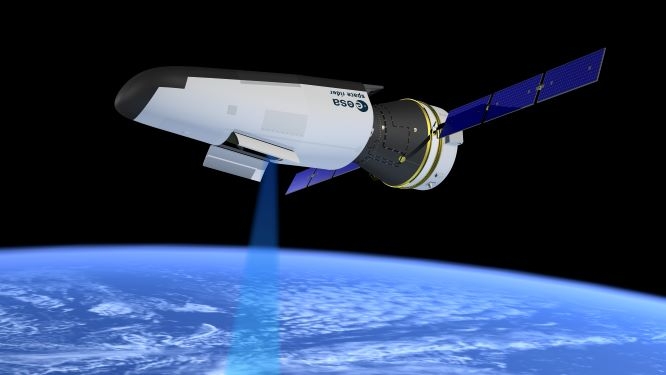
Space Rider can carry out complex maneuvering for experiments in space. An open cargo bay door gives a field of view to Earth or deep space, and fine pointing capability. Scientific experimentation in microgravity for pharmaceutics and biology are key examples of a Space Rider service.
Further applications include in-orbit demonstration and trial-runs of technologies, such as robotics for exploration, instrumentation for Earth observation, surveillance for Earth disaster monitoring, and satellites inspection.
Landing sites
At the end of a Space Rider mission, a final burn of the orbital module will send the reentry module with its user payloads towards the reentry trajectory for a smooth ride back to Earth with a soft precision landing on the ground. After payload recovery and minimal refurbishment, the Space Rider reentry module will be ready to take its next set of payloads on its follow-on mission.
Credit: ESA
Two Space Rider landing sites are viable: Kourou in French Guiana and Santa Maria in the Azores archipelago (Portugal). Kourou is considered as the primary landing site. Santa Maria is considered as the secondary landing site, suitable for high altitude inclination orbits.
Space Rider can be recovered along with its payload, refurbished, and reused for up to six missions, according to Thales Alenia Space.
Company duties
Thales Alenia Space is responsible for the development of the reentry module derived from the IXV, an experimental space shuttle made in Italy that was tested in 2015, with the strong support from the Italian space agency ASI.
AVIO, based in Colleferro, near Rome, Italy, is in charge of the propulsions system and the expendable service module.
Massimo Claudio, Comparini Senior Executive Vice President Observation, Exploration and Navigation at Thales Alenia Space said Space Rider would master technologies needed to further explore the Moon, Mars, and beyond and that the company is now ready to extend its expertise to future applications for point-to-point flights, spaceplanes, and even space tourism.
 Posted in Space News

