 By
By  August 2nd, 2015
Image taken by Curiosity’s Navcam: Left B Sol 1061, August 1, 2015.
Image Credit: NASA/JPL-Caltech
Operators of the NASA Curiosity rover on Mars are pleased to report that drilling into “Buckskin” was successful.
Over the weekend, the plan called for more robotic arm activities, including transferring the sample to the scoop for inspection.
But first, the ChemCam remote micro-imager (RMI) has taken pictures of the new drill hole and Mastcam will image a potential location for eventually dumping the sample, reports Ken Herkenhoff of the USGS Astrogeology Science Center in Flagstaff, Arizona.
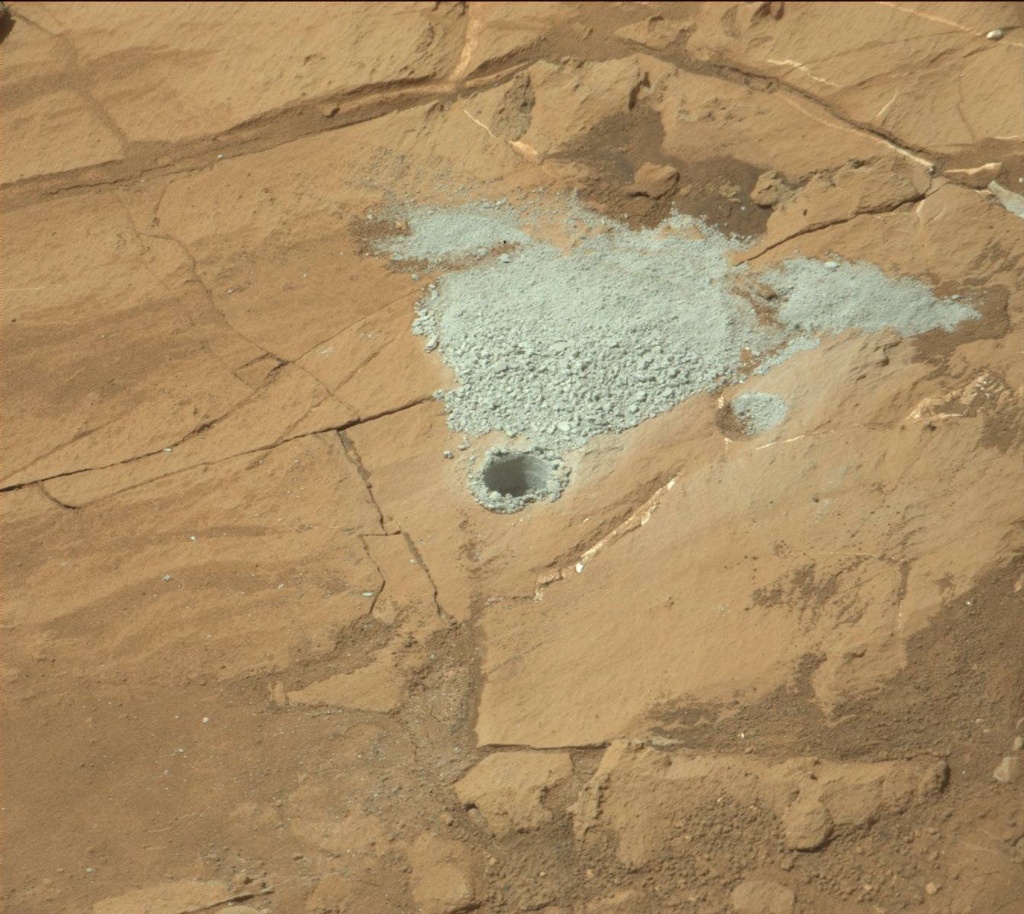
This image was taken by Mastcam: Right onboard NASA’s Mars rover Curiosity on Sol 1060, July 31, 2015.
Image Credit: NASA/JPL-Caltech/MSSS
Mineralogical analysis
Herkenhoff adds that the newly acquired sample will be sieved and a portion of the fine-grained material dropped into CheMin for mineralogical analysis overnight on Sols 1061-1062.
The Chemistry and Mineralogy instrument — or CheMin for short – can identify and measure the abundances of various minerals on Mars.

NASA’s Mars rover Curiosity acquired this image using its Mars Hand Lens Imager (MAHLI), located on the turret at the end of the Curiosity rover’s robotic arm.
Credit: NASA/JPL-Caltech/MSSS
In parallel, the Alpha Particle X-Ray Spectrometer (APXS) is to analyze and measure the potential sample dump location for comparison with future measurements of the dump pile.
Lastly, during the afternoon of Sol 1062, the rover’s robotic arm was to be moved out of the way so that Mastcam and ChemCam can observe the drill hole and tailings, as well as new targets “Diamond Point” and “Summer Hill,” Herkenhoff explains.
 Posted in Space News

