 By
By  January 14th, 2019
Credit: NASA
Long-duration spaceflight leads to marked muscle atrophy.
However, another negative consequence of disuse is intramuscular fatty infiltration. Notably, few studies have investigated the effects of spaceflight on intramuscular fatty infiltration, or how muscle atrophy is associated with in-flight exercise.
New research by Katelyn Burkhart of the Harvard-MIT Health Sciences and Technology Program and colleagues analyzed computed tomography (CT) scans of the lumbar (lower) spine in 17 astronauts and cosmonauts who flew missions on the International Space Station.
Data was collected between years 2000-2006. All crewmembers underwent pre- and post-flight scanning, with pre-flight scans acquired 30-60 days prior to flight and post-flight scans acquired 7-10 days after landing.
Scans obtained before and after missions were studied to determine changes in the size and composition of the paraspinal muscles. Average time of individuals in space was six months.
Credit: NASA
Low back pain
The muscular fatty infiltration that the report notes in the lumbar paraspinal muscles may have a connection to the low back pain that astronauts frequently report during flight.
Running up and down the spine, the paraspinal muscles play a key role in spinal movement and posture.
Previous studies have found reduced paraspinal muscle mass after prolonged time in space, suggesting that muscle atrophy may occur without the resistance provided by gravity.
Exercise
The new study is the first to measure changes in the size and density of individual paraspinal muscles. The results show that muscle size returns to normal upon Earth recovery, but that some changes in muscle composition – particularly increased fatty infiltration – may persist for at least a few years.
Some of the paraspinal muscle changes seem to be affected by exercise, suggesting possible approaches to preventing the adverse effects of prolonged spaceflight on spinal health and functioning.
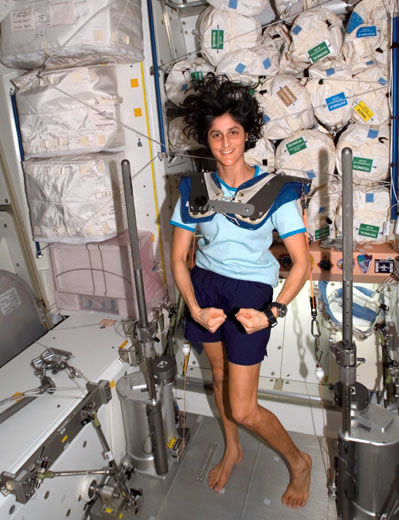
The study assessed such routines as treadmill exercise, cycle ergometer exercise, and resistance exercise.

Credit: NASA
Astronaut abilities
Burkhart and coauthors conclude: “As NASA plans for future missions to Mars and beyond, these results can be used to guide future countermeasures to mitigate declines in trunk muscle morphology and associated functional deficits.”
The researchers say they only investigated changes due to approximately 6 months of spaceflight.
“It’s unclear if the declines in trunk muscle morphology we report in this study would continue at the same rate for longer-duration missions or if they would begin to plateau. This information is of critical importance as NASA plans for longer-duration missions, as trunk muscle deficits could negatively affect an astronaut’s ability to perform mission-related tasks,” they write.

Credit: NASA
Their research paper — Negative Effects of Long-Duration Spaceflight on Paraspinal Muscle Morphology — has been published in SPINE- an International Journal for the study of the spine published by Wolters Kluwer and is available for free at:
 Posted in Space News

