 By
By  August 6th, 2026
Image credit: SpaceX
The dispersion of launch costs has shrunk over the years. A new paper noted that three effects could be causing this phenomenon.
- Historically it has been documented how there is a high degree of trial and error in the early application of technologies, leading to a wide dispersion in productivity outcomes.
- Space exploration began in a Cold War era and was dictated by the objective of showcasing scientific advancements. As a consequence, launch costs were a secondary concern, especially with respect to reliability. Spacefaring nations would want to launch using their home-based rocket technology irrespective of the cost.
- Starting in the 1980s, the private sector has become interested in placing its own satellites in space, predominantly for telecommunication purposes. Evidently, this has progressively led to a shifting focus toward profitability and cost minimization.
This research paper can be read at:
https://academic.oup.com/pnasnexus/article/5/7/pgag217/8732400
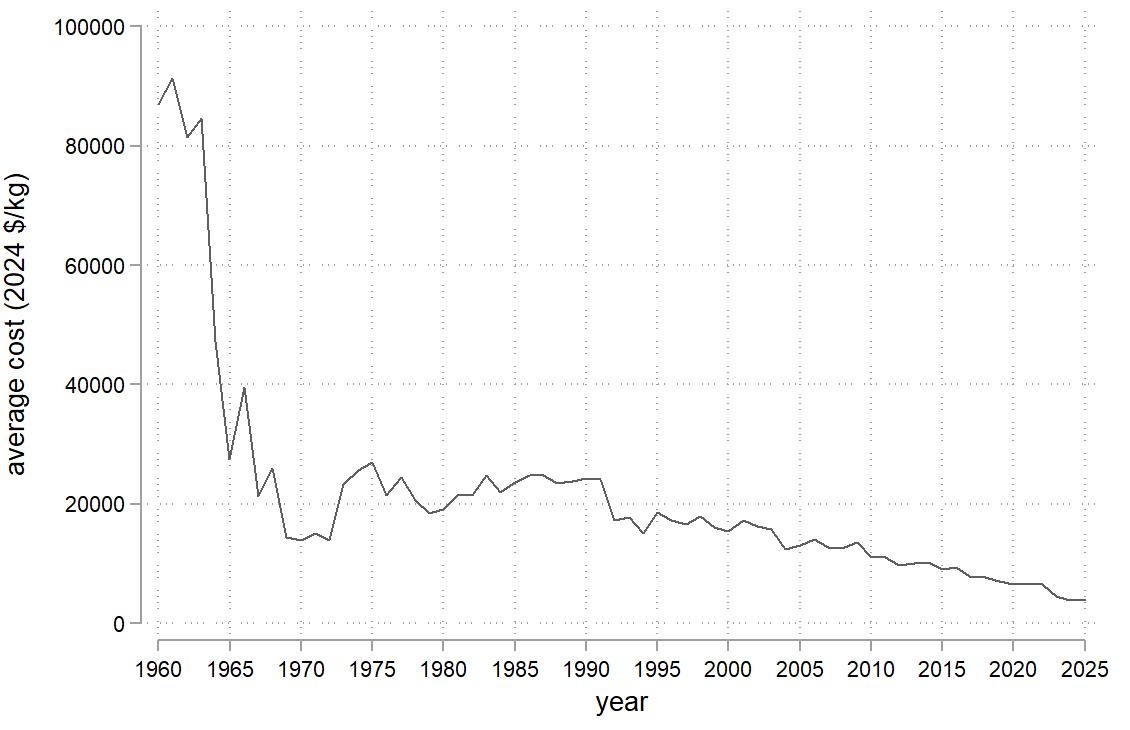
Average launch cost, world. This chart represents the time series estimate of the average cost of launching a kilogram of payload into Low Earth Orbit (LEO) between 1960 and 2025, expressed in 2024 US Dollars.
From Sputnik to Starship: Estimating the experience curve of space launch technology
Image credit: Alessio Terzi, et al.
Geopolitics and space access
Also, go to this companion research that highlights the following points:
- US launch costs are now over 3x cheaper than European ones.
- The US accounts for over 80% of global payload to orbit in 2025.
- Only the US and Europe display a space launch experience curve.
- Cost asymmetries reinforce strategic dependencies with security implications.
Go to “Geopolitics and space access: cost asymmetries and strategic dependence” at:
https://www.sciencedirect.com/science/article/pii/S0165176526003782
 Posted in Space News

