 By
By  November 27th, 2025
Julie Payette is the first Canadian astronaut to visit the International Space Station.
Payette completed two spaceflights, STS-96 and STS-127.
A veteran Canadian astronaut has called for international joint efforts to handle emergency events in space, underscoring the rapid launch of the Shenzhou-22 for an emergency mission.
Former astronaut Julie Payette was the first Canadian to reside on the International Space Station in 1999 and also lived onboard the ISS in 2009.
Payette is currently the President of the international executive committee of the Association of Space Explorers. She is also chairwoman of the Astronauts Administrative Committee of the International Astronautical Federation (IAF).
Mitigate safety issue
“We’d like to congratulate the Chinese space program for sending Shenzhou-22 so quickly into space,” Payette told the China Global Television Network (CGTN).

“This was by far the best way to mitigate the safety issue. So we’re very pleased, especially the astronaut community, to see that our colleagues now have a perfectly operating lifeboat attached to the station,” Payette said.
The Chinese program had done many mitigating aspects to alleviate risks by having safety drills and by having new protocols, Payette added. “But still it is better to have just a life boat if something goes on,” she said.
Emergency mission
China launched a crewless emergency Shenzhou-22 spaceship on November 25, transporting food, medicine, spare parts and other essential supplies to the Shenzhou-21 taikonauts now living on China’s Tiangong space station.

Image credit: CCTV/Inside Outer Space screengrab
The emergency mission was needed due to damage caused to the Shenzhou-20 spacecraft by a suspected debris impact. That in-space incident forced the return of the three Shenzhou-20 astronauts to be delayed in their return to Earth. They later used the newly-arrived Shenzhou-21 spacecraft for their landing on Earth on November 14.
Sharing data
Payette emphasized that improving joint monitoring and sharing data through collaboration among global stakeholders is the solution to reducing risks for all future long-duration missions, according to a China Central Television (CCTV) posting.
The International Astronautical Federation has partners and people working together, Payette said, and “this is perhaps one of the most important topics right now.”
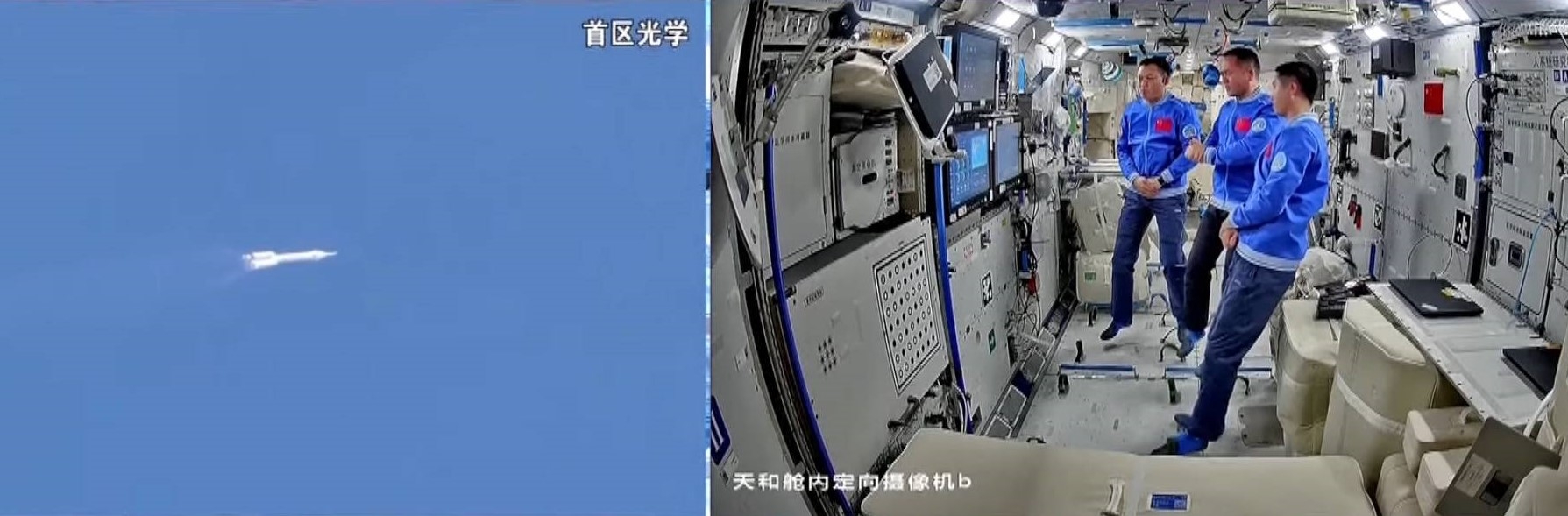
Shenzhou-21 on-orbit crew monitors emergency Shenzhou-22 launch.
Image credit: CCTV/Inside Outer Space screengrab
Help orbit to orbit
There’s a lot of impetus to bring people together, all the players, whether governmental or commercial, Payette added, to collaborate in standardizing procedures.
“And we need also to define some emergency response, help orbit to orbit, depending [on] safety boards and people that can certify spacecraft on the ground to carry humans. And with that, we’ll have a safer and more resilient industry,” Payette concluded.
 Posted in Space News

