 By
By  November 7th, 2020
Credit: Danielle Futselaar, artsource.nl.jpg
Those Fast Radio Bursts, or FRBs, are among the most unexplained astronomical phenomena ever observed.
The powerful, millisecond-duration radio waves come from deep space and are among the brightest sources ever seen in the sky – and then disappear.
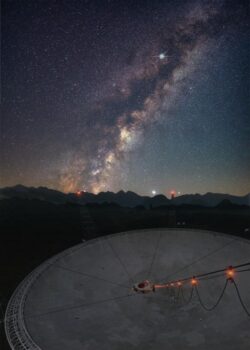
China’s Five-hundred-meter Aperture Spherical Telescope (FAST).
Credit: Bojun Wang, Jinchen Jiang & Qisheng Cui
FAST-paced research
Recent work done at the Five-hundred-meter Aperture Spherical Telescope (FAST) in Guizhou, China appears to have aced out one theory on their origin – that FRBs are similar to gamma-ray bursts (GRBs), the most powerful explosions in the universe.
There’s growing support for a pulsar-like model and the mechanisms of producing FRBs are being greatly narrowed down.
Now in vogue to power FRBs are magnetars – incredibly dense, city-sized neutron stars that possess the most powerful magnetic fields in the universe. Magnetars occasionally make short X-ray or soft gamma-ray bursts through dissipation of magnetic fields.
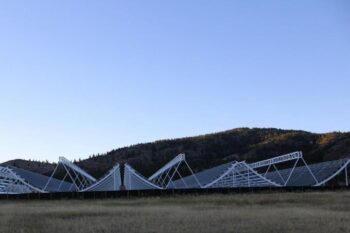
The new Outrigger telescope will work in conjunction with the existing Canadian Canadian Hydrogen Intensity Mapping Experiment (CHIME).
Credit: CHIME
Outrigger
Whatever the case for FRBs, it’s clear more research is needed.
So enter a new telescope at Green Bank Observatory in West Virginia, designed to improve localization of Fast Radio Bursts. At present, most FRB positions are so imprecise it’s unclear which galaxy they come from.
That’s the objective of the new telescope, called Outrigger, backed by the National Science Foundation. It can determine the particular galaxy that has an FRB, as well as localize the source to a specific region within the galaxy.
CHIMEing in
According to a West Virginia University news release, when Outrigger is built, the facility will work in conjunction with the existing Canadian Hydrogen Intensity Mapping Experiment (CHIME) telescope, which is located half a continent away in British Columbia, to triangulate the locations of FRBs.
To search for FRBs, CHIME continuously scans 1024 separate points on the sky. The new Outrigger telescope will have only one cylinder but will monitor the same area of the sky as the original CHIME telescope.
By using very long baseline interferometry techniques, the intent is to localize where FRBs come from. Also, additional outriggers are expected to be built later, allowing even sharper localization of radio bursts.
For more information, go to:
https://www.unlv.edu/news/release/astronomers-discover-clues-unveil-mystery-fast-radio-bursts
 Posted in Space News

