 By
By  January 8th, 2016
Rosetta’s Optical, Specroscopic, and Infrared Remote Imaging System (OSIRIS) acquired this image of Comet 67P/Churyumov-Gerasimenko on December 20, 2015 from a distance of 57 miles (91.5 kilometers).
Credit: ESA/Rosetta/MPS for OSIRIS Team/MPS/UPD/LAM/IAA/SSO/INTA/UPM/DASP/IDA
The European Space Agency’s (ESA) comet lander bounced to full stop on November 12, 2015 atop Comet 67P/Churyumov-Gerasimenko.
The last clear sign of life from the probe was received on July 9, 2015. Since then mum’s been the word.
But now planned for January 10th, ground controllers will, for the first time, send a command to Philae to spin up its flywheel. The hope is to impart some angular momentum to the lander as it sits silently on the comet.
Time running out
“At best, the spacecraft might shake dust from its solar panels and better align itself with the Sun,” explains Technical Project Manager Koen Geurts.
In the worst case, the lander will not receive the commands sent by engineers and scientists at the German Aerospace Center (Deutsches Zentrum für Luft- und Raumfahrt (DLR).
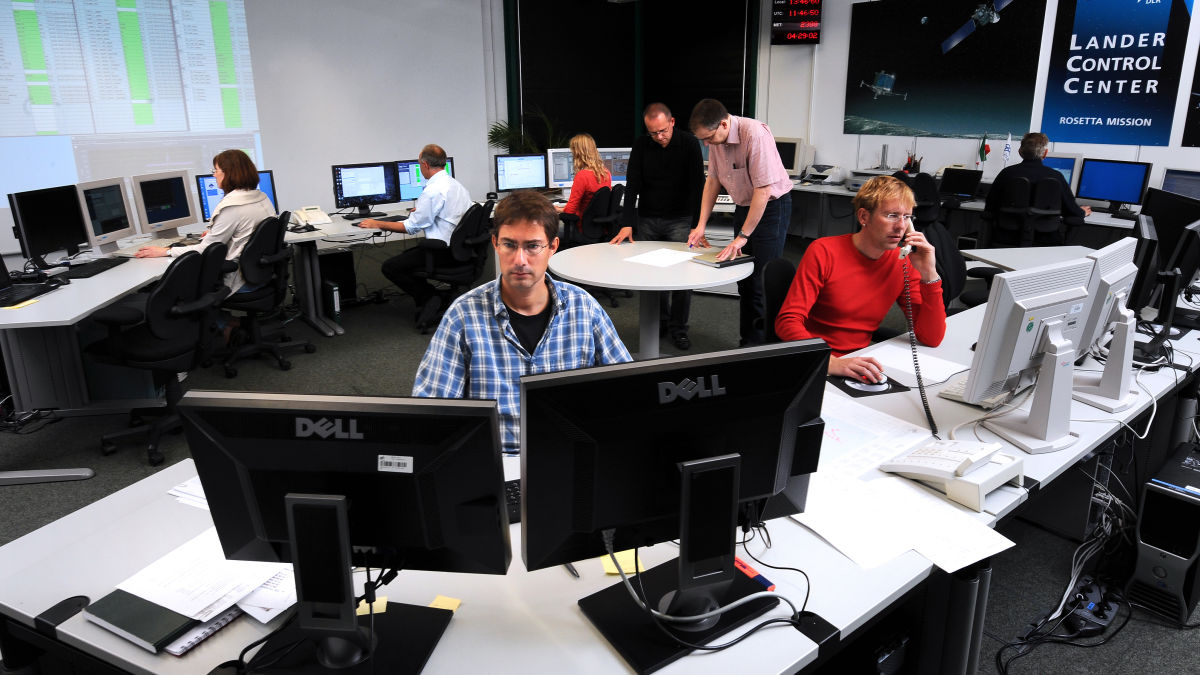
German Aerospace Center (Deutsches Zentrum für Luft- und Raumfahrt (DLR) in Cologne is home to the control center for the Philae comet lander.
Credit: DLR
DLR in Cologne is home to the control center for the Philae lander.
“Time is running out, so we want to explore all possibilities,” says DLR Project Leader Stephan Ulamec.
Lander-hostile
By the end of January things will become increasingly uncomfortable for Philae as the comet continues to move away from the Sun. Conditions on the comet will be “lander-hostile” and Philae’s mission is expected to come to a natural end, according to a DLR press statement.
“There is a small chance,” adds Cinzia Fantinati, an Operations Manager on the DLR control room team.
“We want to leave no stone unturned,” Fantinati explains. The communications unit on board Rosetta will remain active and continue to listen for a signal from Philae beyond mid-January.
ESA’s Rosetta orbiter that dispatched Philae will remain active until September 2016.
Rosetta is an ESA mission with contributions from its member states and NASA. Rosetta’s Philae lander is provided by a consortium headed by DLR, the Max Planck Institute for Solar System Research (MPS), the French Space Agency (CNES) and the Italian Space Agency (ASI).
 Posted in Space News

