 By
By  November 10th, 2018
Artist’s impression of the ExoMars 2020 rover and Russia’s stationary surface platform in background.
Credit:
ESA/ATG medialab
Mars is going to be a busy place in 2021.
The U.S., China, and Europe will attempt robotic Mars landings, with the United Arab Emirates slated to send an orbiter towards the Red Planet.

ExoMars 2020 landing site candidates on elevation map.
Credit: NASA/JPL
The increasing pace of Mars exploration was shown last week by an ExoMars Landing Site Selection Working Group recommendation of Oxia Planum as the touchdown locale for the European Space Agency-Roscosmos rover and surface science platform that will launch to the Red Planet in 2020.
Clear winner
This proposed landing site will be reviewed internally by ESA and Roscosmos with an official confirmation expected mid-2019. Previously, Oxia Planum and Mawrth Vallis have both been under active study. Oxia Planum has been deemed “the clear winner” on both science and engineering constraints.
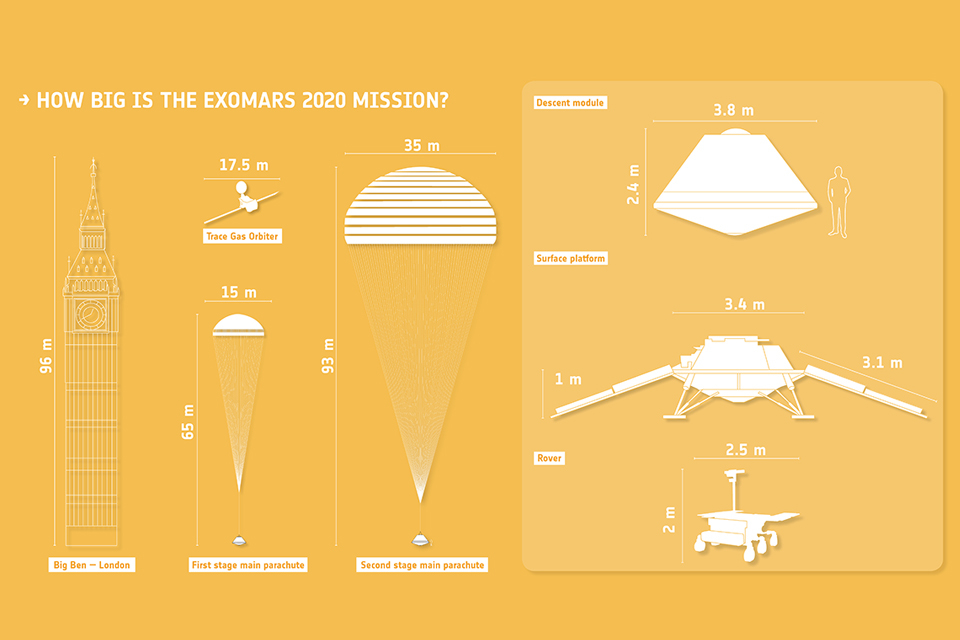
Sizes of key components of the ExoMars 2020 mission.
Credit: ESA
The ESA-led rover and Roscosmos-led surface science platform will launch in the July 25-August 13, 2020 launch window on a Proton-M rocket from Baikonur, Kazakhstan, and cruise to Mars in a carrier module containing a single descent module, arriving at Mars March 19, 2021.
Mars underground
At the heart of the ExoMars program is the quest to determine if life has ever existed on Mars. The ExoMars rover will travel across the Martian surface and drill down 6 feet (2 meters) depth to determine if evidence of life is buried underground.
Oxia Planum lies at the boundary where many channels emptied into the vast lowland plains. Observations from orbit show that the region exhibits layers of clay-rich minerals that were formed in wet conditions some four billion years ago, likely in a large body of standing water.

Europe’s ExoMars 2020 rover.
Credit: ESA
Also, Oxia Planum offers a safety margin for entry, descent and landing, as well as terrain that the rover can easily navigate to sites of scientific interest.
The ExoMars landing ellipse has low elevation and contains very few topographic obstacles or challenging slopes.
 Posted in Space News

