 By
By  March 17th, 2016
European interest is growing in staging a new campaign of lunar exploration.
Earth’s Moon and cis-lunar space will likely see a “renewed and sustained international effort” in the next decade, a concerted effort to engage in exploration missions beyond low Earth-orbit.
A new brochure now circulating underscores key findings from an international gathering of experts that took part in the International Symposium on Moon 2020 – 2030: a New Era of Human and Robotic Exploration held at the European Space Agency’s ESTEC center in December 2015.
“One driver of this renewed interest in the Moon is to assess the economic feasibility of using lunar resources for sustaining human surface exploration activities,” states the new brochure that details meeting outcomes.
Scientific case
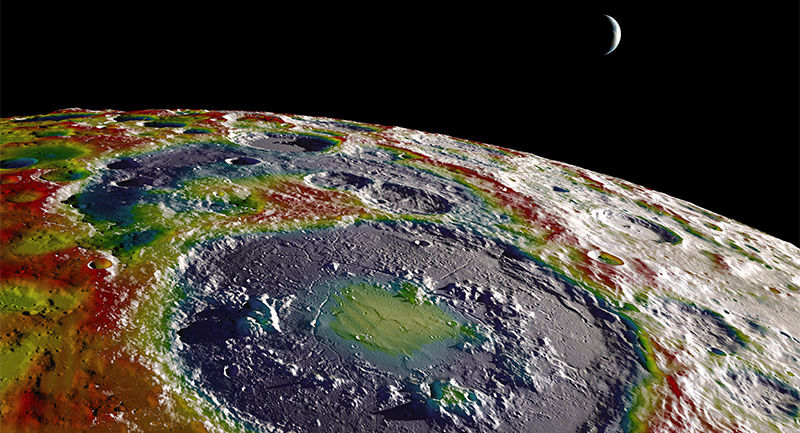
The brochure stresses that there is a strong scientific case for lunar surface exploration.
Credit: ESA
“Data from recent orbital missions and new analysis of Apollo samples using modern techniques show that the Moon is the closest place to Earth where we can find clues to the history of the Solar System, including that of the early Earth and of the formation of the Earth-Moon system,” the brochure notes.
Furthermore, “insights into the environment, in which life began on Earth more than three billion years ago could be preserved in previously unexplored areas, such as the poles, the highlands and the far side of the Moon.”
Roadmap towards Mars
Citing that the development and assembly of the International Space Station is complete, slated to operate until at least 2020, “it is time to build on this partnership and open it to new partners to continue the journey beyond low Earth-orbit.”
ESA’s exploration strategy is in line with the Global Exploration Roadmap drawn up by the International Space Exploration Coordination Group. That European strategy considers the Moon as the next destination for humans venturing beyond low Earth-orbit. Doing so is viewed as an integral part of the roadmap towards human missions to Mars.

Credit: Public Domain/Dylan O’Donnell
Lunar orbit infrastructure
Among recommendations stemming from last year’s gathering:
- Make maximum use of lunar orbit infrastructure already planned by agencies to advance lunar exploration goals.
- Some elements of exploration-enabling infrastructure and services may be best delivered by the private sector, allowing agencies to focus on enabling strategic technologies and infrastructure addressing scientific questions. The private sector is ready to invest and requires commitments from governments to ensure that a market exists.
- Robotic missions to the lunar surface should be implemented in the early 2020’s. These surface missions should be coordinated internationally to ensure that a maximum benefit is derived for human missions, for example by returning pristine samples obtained by robotic missions with the crew. Once an infrastructure is in place near the Moon, precursors to human visits to the lunar surface can include teleoperations of assets on the surface.
Technologies
A number of technologies are flagged in the informative brochure, such as:
- Navigation sensors and control for rendezvous and surface operations with an emphasis on lightweight, efficient navigation systems for human and human-robotic integrated systems
- Propulsion systems – in particular, in Europe, the high-thrust chemical propulsion systems, but also other approaches to efficient chemical propulsion.
- Power and thermal systems for cold, dark destinations (e.g. the lunar poles or Mars), such as radio-thermal generators and fission power
- Teleoperations and shared autonomy as an operational concept for exploration.
The participants that took part in Moon meeting, the brochure explains positively received the ESA Director General’s vision of a lunar village.
For more information on the International Symposium on Moon 2020 – 2030: a New Era of Human and Robotic Exploration, go to:
http://spaceflight.esa.int/humanrobotics/
 Posted in Space News


“One driver of this renewed interest in the Moon is to assess the economic feasibility of using lunar resources for sustaining human surface exploration activities,”
I would add: “And making the life better HERE on the Earth!”
I mean that the Moon may help to improve our Environment and boost the economy! Well, and maybe even “the Moon strategy” could help to resolve some Political issues!