 By
By  September 19th, 2015
Artist’s impression depicts the separation of Europe’s ExoMars 2016 entry, descent and landing demonstrator module — named Schiaparelli — from the Trace Gas Orbiter
Credit: ESA/ATG medialab
Europe’s ExoMars 2016 mission has slipped its launch window from January of next year to March.
A problem recently discovered in two sensors in the propulsion system of the entry, descent and landing demonstrator module — Schiaparelli — has prompted the recommendation to move the launch to March 14 – still within the launch window of early 2016.
ExoMars 2016 is to be launched via a Russian Proton rocket from Baikonur in Kazakhstan.
The ESA ExoMars 2016 mission will arrive at the Red Planet in October.
Technology testing
The European Space Agency’s Schiaparelli module will prove key technologies to demonstrate Europe’s capability to make a controlled landing on Mars.
The Schiaparelli will ride to Mars on the ESA Trace Gas Orbiter.
That orbiter is designed to carry out a five-year mission of studying Mars’ atmospheric gases potentially linked to present-day biological or geological activity.

Credit: ESA
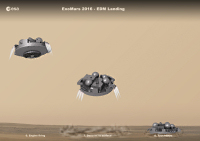
Once released from the orbiter, Schiaparelli is to aerobrake in the upper Martian atmosphere, with a parachute phase and liquid-propellant thruster system phase following.
Landing site: Meridiani Planum
As the thrusters switch off, the lander will drop onto the Mars landscape. Its impact will be cushioned by a crushable structure built into the module.

Credit: ESA
The lander is targeted for touchdown in a region known as Meridiani Planum.
Schiaparelli is planned to operate on the surface for only a short time, powered by batteries. The lander will remain a target for future laser ranging studies as it carries a reflector designed for this purpose.
Credit: ESA
ESA’s ExoMars 2018 mission – also to be launched by a Russian Proton booster — is set to deliver a rover and an instrumented platform on the surface of Mars.
ExoMars is a joint endeavor between ESA and Russia’s Roscosmos space agency.
 Posted in Space News

