 By
By  November 26th, 2025
Image credit: CCTV/Inside Outer Space screengrab
More details are available regarding the saga of engineers and ground staff in China’s first-ever emergency launch – the plight and flight of the uncrewed Shenzhou-22 spacecraft.
The crewless spaceship – including an escape tower — sat atop a Long March-2F Y22 carrier rocket, lifting off shortly after noon local time on November 25 from the Jiuquan Satellite Launch Center in northwest China.
That launch demonstrated the carrier rocket’s rapid-response capability for any space station emergency, space officials explained.

Image credit: CCTV/Inside Outer Space screengrab
Onboard the spaceship were caches of food, medicine, spare parts and other essential supplies – reportedly including devices for treating the cracked spaceship window – quickly prepared for the Shenzhou-21 astronauts that are now living on China’s Tiangong space station.
First-ever emergency
The emergency mission was necessitated by suspected space debris damage to the Shenzhou-20 spacecraft, rendering it not qualified for a safe re-entry to Earth. That delayed the scheduled departure on November 5 of the three Shenzhou-20 astronauts. They used the newly-arrived Shenzhou-21 to return to Earth on November 14.
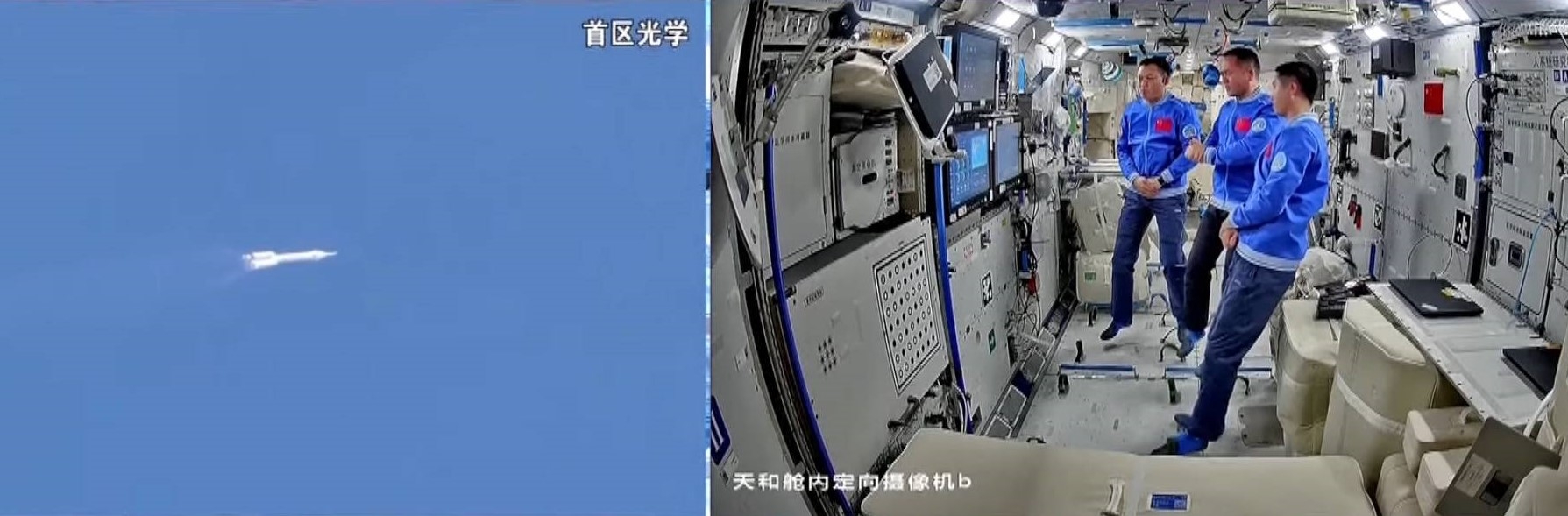
Shenzhou-21 on-orbit crew monitors emergency Shenzhou-22 launch.
Image credit: CCTV/Inside Outer Space screengrab
As the first-ever emergency operation to be launched at short notice in the history of China’s human spaceflight program, there was limited time for preparation, with engineers working around the clock to prepare the Shenzhou-22 and its booster.
Test-to-launch cycle
According to Zeng Yaoxiang, an engineer for CASC, the team reduced a normal test-to-launch cycle of more than 30 days to just 16.

Image credit: CCTV/Inside Outer Space screengrab
That whole period from tests to launch was considered a very short launch window, Zeng told China Central Television (CCTV).
Zeng said that the next rocket in the series, the Long March-2F Y23, is undergoing assembly and test in Beijing. It will be transferred to the launch site upon completion of related work and will be on standby status for emergency response for the Shenzhou-22 mission now underway.
Clearing and sealing process
Yan Wei, an engineer with CASC, told CCTV that at three hours prior to the launch, a “clearing and sealing” process was in action.

Image credit: CCTV/CMSA/Inside Outer Space screengrab
This process is considered the most critical safety inspection immediately before launch.
Unlike the standard mission preparation cycle, which typically lasts over 30 days, this emergency operation took place under a heavily condensed timeline, with the team having only around half of the normal time to get everything ready for the urgent spaceflight, adds CCTV.
Double-checking
“It was 16 straight days. Work that usually takes five days was compressed into two,” said Wang Peng, another CASC engineer. To ensure the Shenzhou-22 mission would be successful, the team also turned to several veteran engineers that were recalled to provide technical support.
“We needed to come and help reinforce the frontline [of the mission]. As an old team member, I’ve come here to work with everyone, double-checking everything and filling in wherever I’m needed,” said Meng Qingfeng, one of the engineers drafted in by the CASC.
One hour before launch, the last group of on-site engineers started to withdraw from the launch tower.
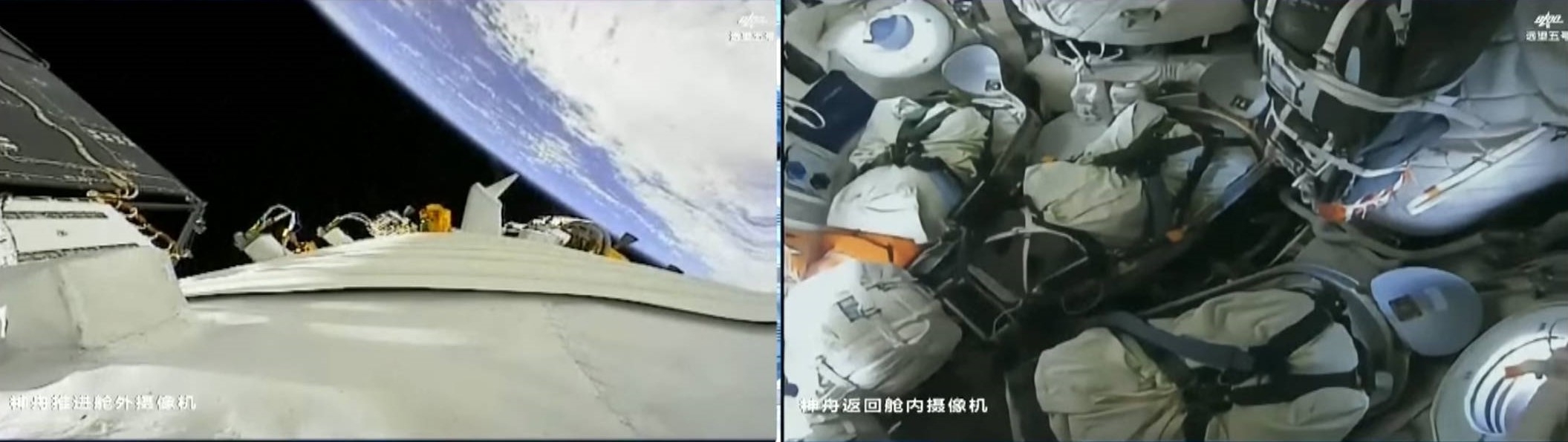
Uncrewed Shenzhou-22 loaded with supplies.
Image credit: CCTV/Inside Outer Space screengrab
Critical situation
“The spacecraft performed very well, and my team performed very well. We withstood the test of this mission,” said He Yu, commander in chief of the Shenzhou spacecraft at the CASC. He said the emergency flight placed a spotlight on the capabilities of China’s space industry.
“We have come through a real critical situation this time. We must be extremely responsible for the lives of the astronauts, and this mission was the best practice of that commitment,” said Jing Muchun, commander in chief of the Long March-2F carrier rocket project at the CASC.
Alternative return procedure
Given the damaged Shenzhou-20 spacecraft, emergency protocols were activated, and a comprehensive simulation analysis, testing and safety assessment of the vessel was conducted to determine the safest course for the astronauts’ return.

As the first-ever emergency operation to be launched at short notice in the history of China’s human spaceflight program, there was limited time for preparation, with engineers working around the clock to prepare the Shenzhou-22 and its booster.
Image credit: CCTV/Inside Outer Space screengrab
Following that review, the CMSA announced that the Shenzhou-20 spacecraft “no longer meets the stringent safety standards required for re-entry,” reported CCTV.
This emergency event, said the CMSA marked the first successful implementation of an alternative return procedure in the country’s space station program history.
Tasks ahead
The trio of on-orbit space crew members are in good condition and are carrying out their tasks as planned, the China Manned Space Agency (CMSA) said, adding that the damaged Shenzhou-20 spaceship will remain in orbit to continue its assigned experiments.
During their projected six-month stay in orbit, the Shenzhou-21 crew members are slated to carry out a total of 27 new in-orbit experiments, including in space life sciences and biotechnology, space medicine, space material science, microgravity fluid physics and combustion, and new space technologies.
 Posted in Space News


Were any images of the damaged window ever released ??