 By
By  May 1st, 2014
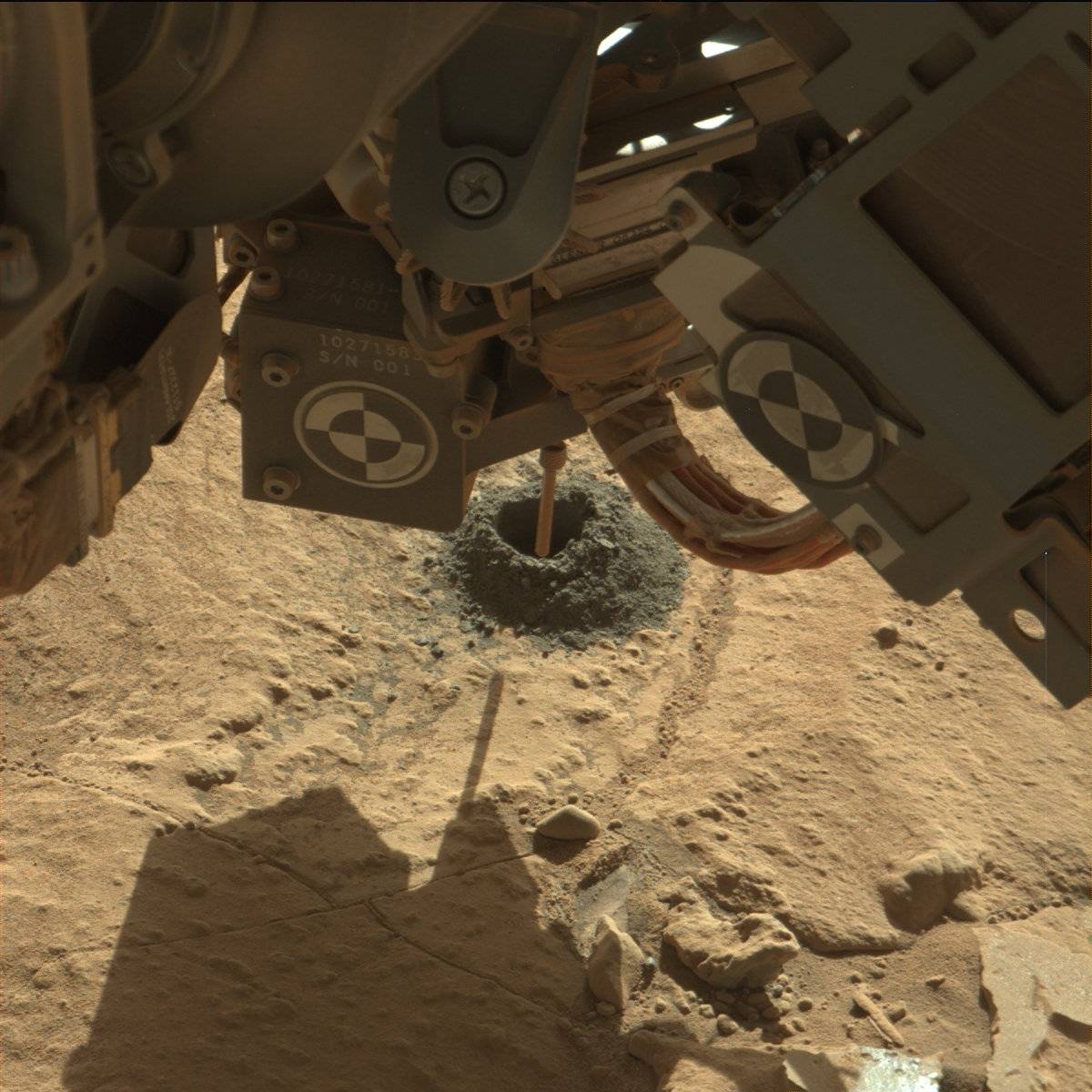
Curiosity arm stretches out for drilling sequence.
Front Hazard Avoidance Camera (Front Hazcam) image for Sol 615
Credit: NASA/JPL
NASA’s Curiosity Mars rover is engaged in new sample-collection drilling. It performed a “mini-drill” operation on April 29, a preparatory step that created a hole about eight-tenths of an inch (2 centimeters) deep.
Word is that the Curiosity team operating the mobile robot plans to proceed in coming days with the third-ever drilling into a rock on Mars to collect a sample for analysis.
Curiosity robot makes its mark on Mars.
Credit: Mast Camera (Mastcam) (MSSS-MALIN)
The first two Martian rocks drilled and analyzed this way were mudstone slabs neighboring each other in Yellowknife Bay, about 2.5 miles (4 kilometers) northeast of the rover’s current location.
Those two rocks yielded evidence last year of an ancient lakebed environment with key chemical elements and a chemical energy source that provided conditions billions of years ago favorable for microbial life.
These remote drilling operations are precursors to how future work on Mars will be carried out – a combination of robotic and human sampling skills.

Humans and robots work together in this futuristic scenario.
Credit: NASA
 Posted in Space News

