 By
By  September 3rd, 2026
NASA Dragonfly on Titan.
Image credit: NASA/Johns Hopkins APL/Steve Gribben
NASA’s Dragonfly spacecraft is scheduled to launch in summer 2028 and reach Saturn’s moon Titan in late 2034.
The rotorcraft’s landing area on Titan has been named – Ahmakiq Undae. The region consists of dunes and interdune areas to the south of Selk Crater, extending to the edge of a range of hills or mountains.
Ahmakiq Undae has a diameter of approximately 500 miles (810 kilometers) and borders the roughly 50-mile (80-kilometer) diameter Selk impact crater.
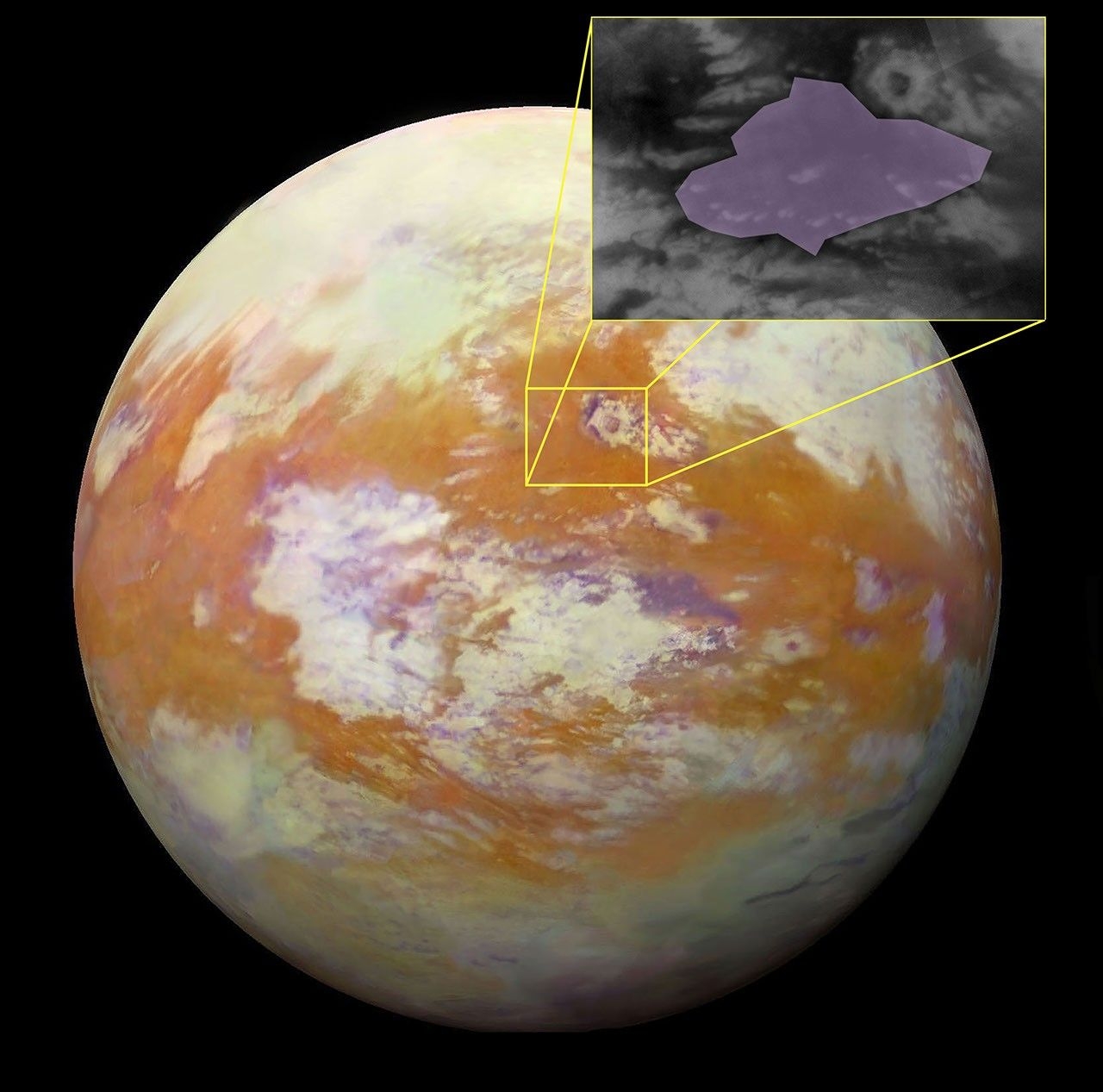
Dragonfly equatorial landing site on Titan.
Image credit: NASA/Jason Barnes
Once Dragonfly reaches Titan, the rotorcraft will conduct a 3.3 year primary mission, exploring diverse environments from organic dunes to deposits associated with Selk Crater, a place where liquid water and complex organic materials key to life once existed together.
“Scientific analysis indicates that the impact that formed Selk melted the icy bedrock, potentially creating a large temporary pool that could have remained liquid for hundreds to thousands of years under an insulating ice layer, like winter ponds on Earth,” explains a NASA statement.
The International Astronomical Union (IAU), the global body responsible for officially designating objects in space, has approved the name for the large dune field where Dragonfly will land on Titan.
 Posted in Space News

