 By
By  August 15th, 2026
Wait-a-Minute!
Image credit: Barbara David
In wait-a-minute style, forget the competition between the U.S. and China to newly place human footprints on the Moon. Also, you can overlook any one-upmanship about dispatching astronauts to Mars, or firsts in piloted spaceflight.
The current space race is this: What country is winning the multi-nation contest to clutter space with discarded rocket bodies?
That’s the view of Darren McKnight, a senior technical fellow at LeoLabs, a group that keeps a persistent eye on what’s going on upstairs in orbital space.
Yes, satellite constellations provide uniquely robust capabilities in global connectivity, voice communications, Earth observation/imaging, navigation, and many other missions, McKnight notes. “The race to create constellations is a race that has some operators leaving space safety, space security, and space sustainability behind,” he adds.

The crowded space environment may look like this a decade from now, with proposed mega-constellations.
Credit: Center for Space Policy & Strategy
Rocket bodies
The new space race, especially at higher altitudes in low Earth orbit (LEO), involves the rocket bodies (R/B) that are abandoned once their payloads are deployed. But as McKnight asks, at what cost?
The current distribution of massive derelicts in high-LEO — above the average altitude of roughly 400 miles (650 kilometers) is highlighted by R/B mass and numbers with the 40 years of contribution by the Soviet Union/Russia amounting to roughly 787 metric tons (787,000 kilograms of mass in 438 rocket bodies.
China has roughly 365 metric tons (365,000 kilograms) in 110 R/Bs.

Image of spent rocket body.
Image credit: Astroscale-Japan
Large constellations
There are now several large constellations in LEO with Iridium, Starlink, and OneWeb, the most mature proliferated architectures.
Toss in AmazonLeo, China’s two very big LEO broadband constellations — Guowang, and Qianfan — all beginning in earnest over the last 18 to 24 months.
“In total, it is anticipated there will be over 100,000 operational payloads in LEO by 2040 due largely to this rapid expansion of constellations,” McKnight. “However, this story is not about the constellations per se – they are all creating value for their owners and already providing anywhere from global reliable services (for the more mature entrants) to initial regional capability (for the recent entrants), he adds.
Accumulation of derelicts
McKnight says that this story is about accumulation of massive derelicts, the leftover rocket bodies in long-lived orbits. The defunct R/Bs left above 400 miles (650 kilometers) will linger for decades to centuries in LEO posing an ever-growing collision hazard at these altitudes, he adds.
That likely erodes the reliability of future space systems and possibly fueling a self-sustaining cascading of collision events, states McKnight. More specifically, this story, he says, is about China adding massive derelict objects in LEO at that altitude at unprecedented rates.
“The bottom line is noteworthy,” McKnight points out. “The R/B mass abandonment rate is accelerating quickly and possibly so quickly that in four to 16 years China will surpass the Soviet Union/Russia abandoned R/B mass that took them 40 years to amass. This is producing a significant effect on space safety, space sustainability, and space security domains.”
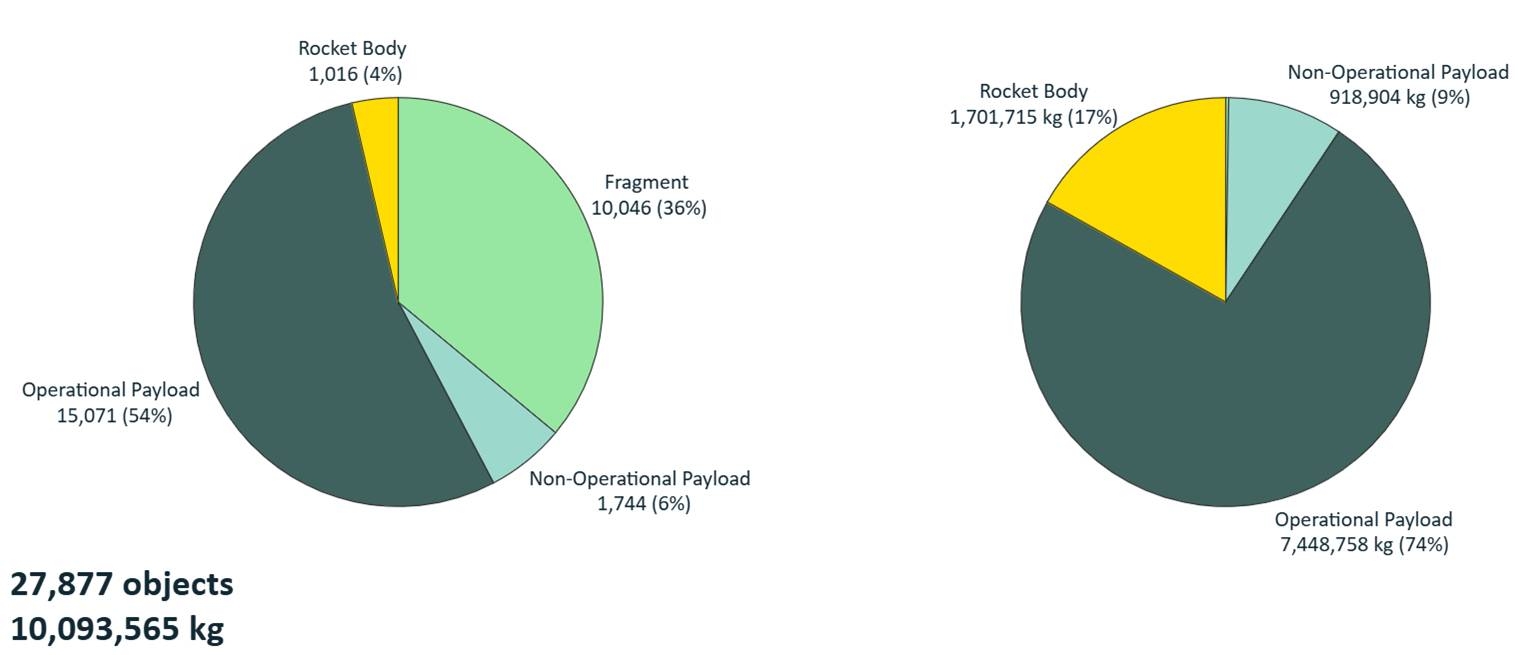
The space hardware population in low Earth orbit as of July 1, 2026 is represented in these charts.
Image credit: Darren McKnight/LeoLabs
Extra level of risk
Among items singled out by McKnight, the current data suggests China is not dealing short-term space safety or long-term space sustainability.
“This accumulation of derelict hardware will affect all global space operators for decades and add an extra level of tension as the space domain becomes more contested with the recent deployment of counterspace and military support space systems globally,” McKnight states.
The possibility of explosions and collisions involving the growing R/B population in high-LEO “is adding a measurable extra level of risk, ambiguity, and confusion when transparency of operations is needed the most,” says McKnight.
So a key conclusion: “China is winning the ‘space race’ in high-LEO, but again two of these three ‘wins’ (i.e., accumulation of derelict mass and fragments) hurt all future space operators – commercial, civil, and military,” McKnight concludes.
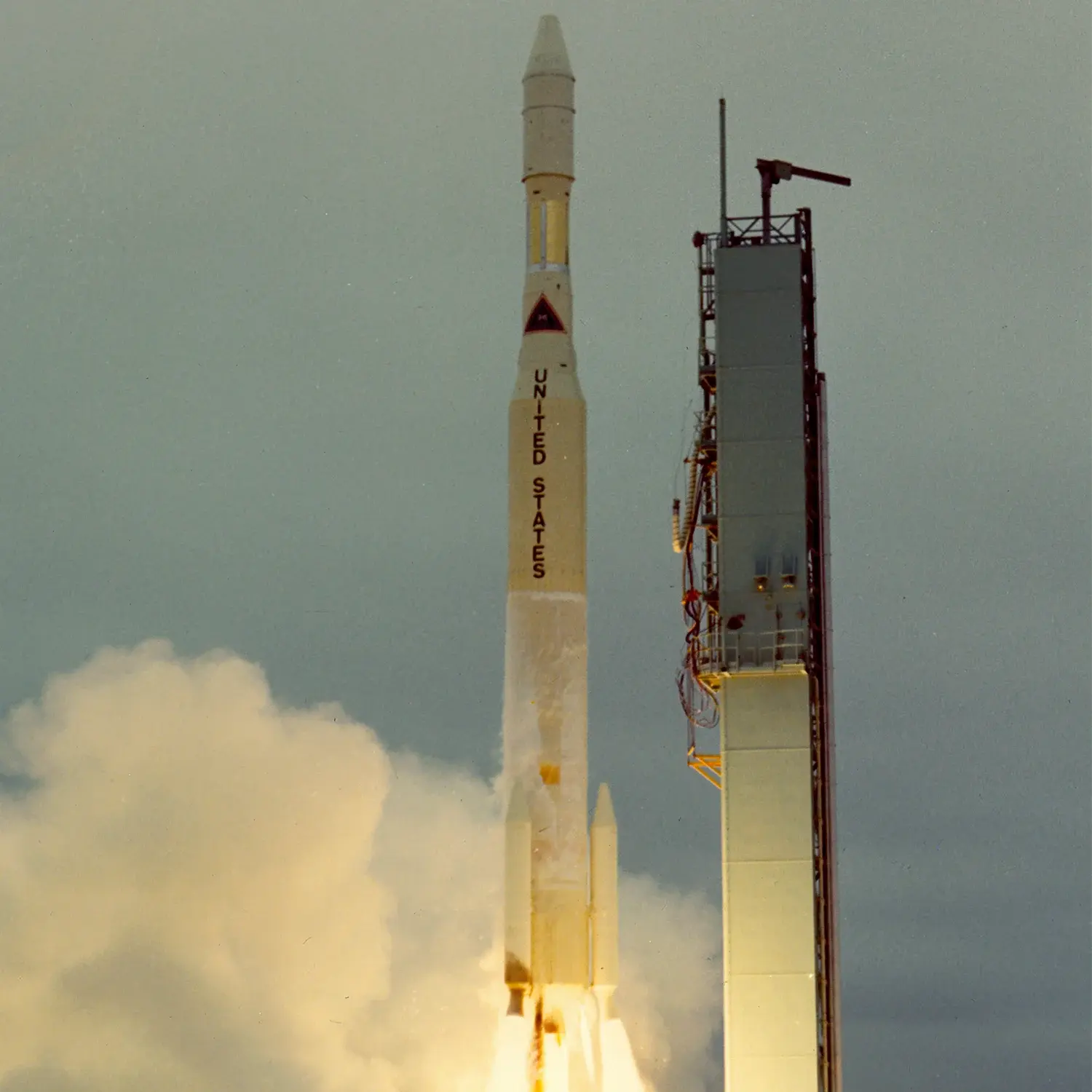
NOAA-3 (also designated ITOS-F) lifts off on Delta 1 launch vehicle in November 1973. The rocket’s upper stage exploded in space a few months later due to residual fuel left onboard.
Image credit: U.S. Air Force
But wait!
McKnight has also issued on August 15 an interesting “Conjunction of the Fortnight.”
“While we may often lament Russian and Chinese space hardware being left on-orbit, the US has areas where we can improve behavior and show leadership in debris remediation (hopefully),” McKnight observes.
This conjunction occurred on March 29th. It involved a non-operational payload (PL) Globalstar that passed in close proximity with a fragment from a Delta 1 rocket body that “was liberated” in 1973 when that second stage exploded creating nearly 220 fragments.
The event took place at over 1,000 miles (roughly 1,700 kilometers) above Earth.
“This is remarkable,” reports McKnight, since the Delta rocket body explosion occurred well over 50 years ago. “This just highlights the persistence of debris-generating events or longevity of abandoned derelicts at these high-LEO altitudes” – above 400 miles (650 kilometers), he notes.

Wait-a-Minute!
Image credit: Barbara David
 Posted in
