 By
By  June 2nd, 2022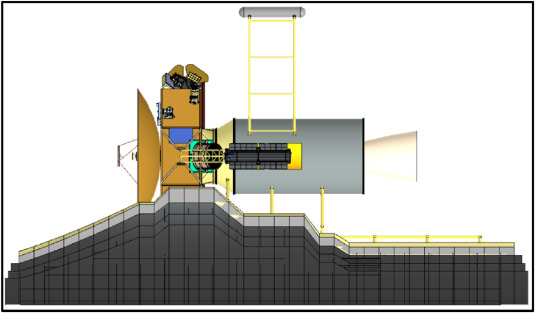
Baseline spacecraft for Option 3 Interstellar Probe with “interstage” (yellow), ballast (top), Orion 50XL kick stage, undeployed RTGs (one visible at center), and thermal shield
assembly (TSA) designed for 2 Rs perihelion.
Credit: Ralph McNutt Jr. et al.
It has been decades in the making, bolstered by study after study and numerous name changes.
Now tagged as the “Interstellar Probe,” the concept has matured to enable new discoveries that can be made in no other way, by going places yet to be explored.
For the Interstellar Probe mission especially: “It isn’t about where we are going. It’s about the journey out there. And it is a journey now long overdue.”
That’s the assessment of a research paper newly appearing in the journal, Acta Astronautica. Lead author is Ralph McNutt Jr. of the John Hopkins University Applied Physics Laboratory (APL) in Laurel, Maryland.

Point-design matrix to flesh out the Interstellar Probe concept.
Credit: Ralph McNutt Jr. et al.
Unified view
Interstellar Probe is a mission that can capture a unified view of our heliosphere and its surroundings from the Earth and out into nearby interstellar space.
“Understanding the dynamics and structure of our heliosphere is fundamental to understanding those of other astrospheres, the ‘heliospheres’ which apparently surround all stellar systems, and how they interact with the galaxy, and how those interactions, in turn, inform the knowledge of habitability in other stellar systems besides our own,” the paper explains.
As now envisioned, Interstellar Probe would utilize today’s technology to take the first explicit step on the path of interstellar exploration, and can pave the way, scientifically, technically, and programmatically for more ambitious future journeys – and more ambitious science goals.

Credit: NASA/MSFC
Furthermore, with the new class of super heavy-lift launch vehicles — notably NASA’s Space Launch System (SLS) – the paper suggests that a scientifically compelling Interstellar Probe mission can now become a reality.
Relay race
Interstellar Probe is a decades-long mission to reach several hundreds of astronomical units while providing new unified, measurements of the conditions throughout the heliosphere and through the heliosheath – the outer shell of the bubble of charged particles around our Sun.

This artist’s concept shows NASA’s two Voyager spacecraft exploring a turbulent region of space known as the heliosheath, the outer shell of the bubble of charged particles around our sun. After more than 33 years of travel, the two Voyager spacecraft will soon reach interstellar space, which is the space between stars.
Credit: NASA
By moving forward on Interstellar Probe, “it will take up the relay race that began with Pioneer 10 and is running with less and less energy with Voyager 1 and Voyager 2,” the paper notes.

Pioneer 10 was the plucky little spacecraft that was the first probe to leave the solar system.
Credit: NASA
To travel as far and as fast as possible with available technology, the use of the SLS Block 2 cargo version is enabling: carrying the spacecraft as well as a 3rd and 4th stage. Solar system escape speeds of at least twice that of Voyager 1 (i.e., up to 7.2 astronomical units per year) should be doable.
Wide net of possibilities
The research paper – “Interstellar probe – Destination: Universe! – makes the case for how fast can one realistically escape the solar system with a scientifically compelling and credible Interstellar Probe mission.
“Our team put a lot of work into making sure the study was as thorough and detailed as possible, while also casting a ‘wide net’ of possibilities,” said APL’s Ralph McNutt. “We eagerly look forward to what our colleagues with the Solar and Space Physics Decadal Survey have to say,” he told Inside Outer Space.
The paper can be found here at:
https://www.sciencedirect.com/science/article/pii/S0094576522001503
 Posted in Space News

