 By
By  March 9th, 2016
This artist’s concept depicts NASA’s InSight Mars lander fully deployed for studying the deep interior of Mars. Robot arm would deploy the sensitive Seismic Experiment for Interior Structure (SEIS) device, white object in foreground.
Credit: NASA/JPL-Caltech
NASA announced today that the delayed InSight mission to Mars is back – headed for a May 2018 launch date, with landing on the Red Planet in late November 2018.
The Interior Exploration using Seismic Investigations, Geodesy and Heat Transport (InSight) mission was to fly this month. However, a vacuum leak in its prime science instrument prompted NASA last December to suspend preparations for launch.
InSight’s primary goal is to help us understand how rocky planets — including Earth — formed and evolved.
Redesign of SEIS
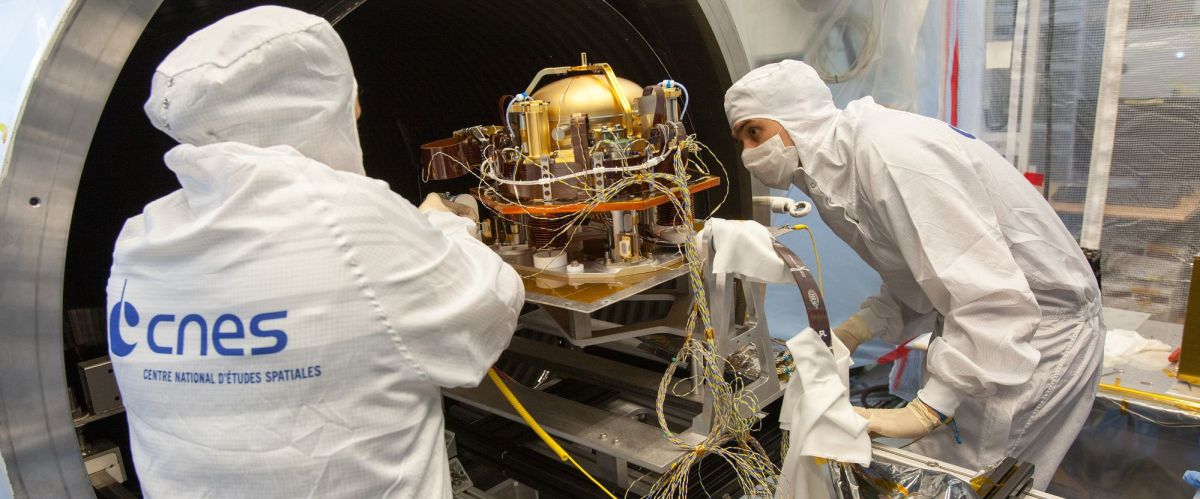
Preparing the SEIS instrument for thermal vacuum testing.
Credit: CNES / MALIGNE Frederick, 2015.
NASA’s Jet Propulsion Laboratory in Pasadena, California, will redesign, build and conduct qualifications of the new vacuum enclosure for the Seismic Experiment for Interior Structure (SEIS), the component that failed in pre-launch tests. The French space agency (CNES) will lead instrument level integration and test activities, allowing the InSight Project to take advantage of each organization’s proven strengths.
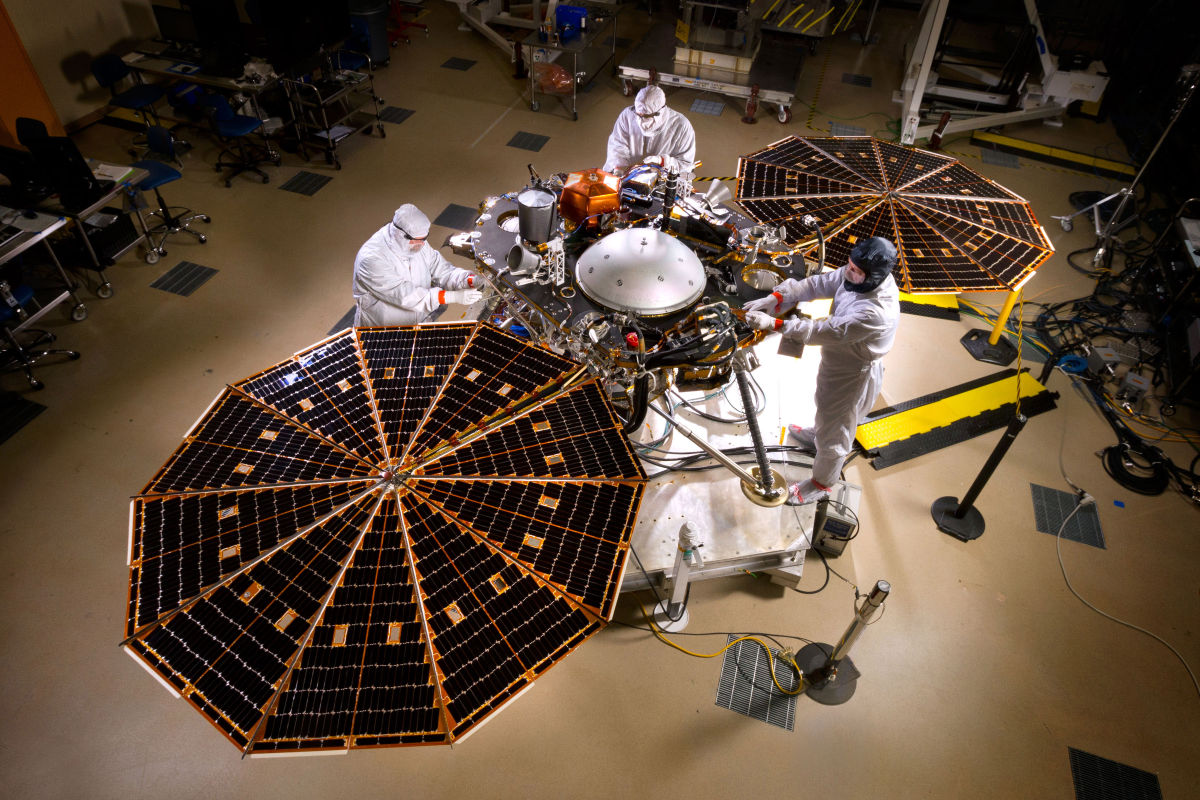
Pre-ship photo shows NASA’s InSight Mars lander spacecraft in a Lockheed Martin clean room near Denver. As part of a series of deployment tests, the spacecraft was commanded to deploy its solar arrays in the clean room to test and verify the exact process that it will use on the surface of Mars.
Credit: NASA/JPL-Caltech/Lockheed Martin
In storage
The InSight spacecraft, including cruise stage and lander, was built and tested by Lockheed Martin Space Systems in Denver. It was delivered to Vandenberg Air Force Base, California, in December 2015 in preparation for launch, and returned to Lockheed Martin’s Colorado facility last month for storage until spacecraft preparations resume in 2017.

InSight Mars lander undergoing a solar array deployment test in the MTF clean room at Lockheed Martin.
Credit: Lockheed Martin
Lockheed Martin’s spacecraft program manager for InSight, Stu Spath, said in a statement:
“We’re delighted that NASA has approved the launch of the InSight mission in May 2018. Our team worked hard to get the InSight spacecraft built and tested, and although InSight didn’t launch this year as planned, we know ultimately the scientific knowledge it will bring us is crucial to our understanding of how Mars and other rocky planets formed. Currently, we are preparing the spacecraft to go into storage at our Space Systems facility near Denver.”
The targeting of InSight’s launch to Mars begins May 5, 2018, with a Mars landing scheduled for Nov. 26, 2018.
 Posted in Space News

