 By
By  May 19th, 2026
Lunar dust haunted Apollo moonwalkers. Can that dust offer a way to mitigate climate change on Earth?
Image credit: NASA/Azita Valinia
There is no doubt that the Moon is a Disneyland of dust. Past moonwalkers have attested to that fact.
The lunar surface cycles between hot and super-chilly temperature swings. It receives unfiltered solar radiation, solar wind flux, and continuous micrometeoroid bombardment.
In the absence of atmospheric protection, the Moon’s landscape is exposed to radiation and electrostatic dust levitation and accumulating electrostatic charge.
In short the lunar surface is a dynamic environment. Multiple nations are keen on “rebooting” the Moon, however, lunar dust poses persistent operational and health hazards for future missions.
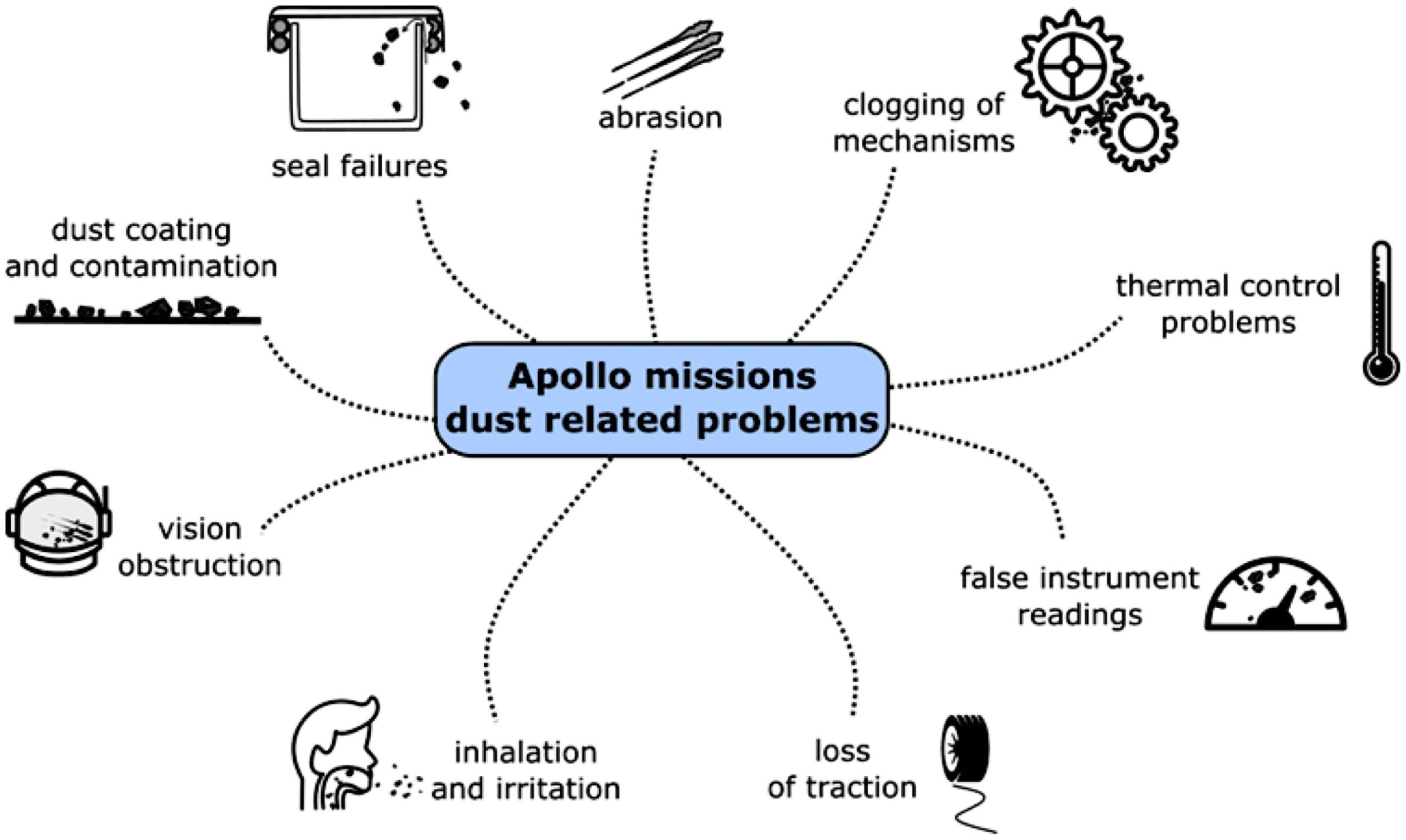
Illustration of dust-related issues, based on data from J.R. Gaier, R.A. Creel “The effects of Lunar dust on advanced EVA systems: Lessons from Apollo”
How best to deal with the dust?
Scoring rubric
An Australian research group has evaluated over 30 passive lunar dust mitigation and tolerance surfaces. They created a weighted scoring rubric using five criteria: added build-up (thickness), manufacturability, complexity, environmental durability and dust interaction performance.

Apollo 17 helmets and dusty spacesuits stuffed inside lunar lander following the last human treks on the Moon in December 1972.
Credit: NASA
The team was led by Ankush Sookram in the School of Engineering at the Royal Melbourne Institute of Technology, done in concert with the Commonwealth Scientific and Industrial Research Organization (CSIRO). They charted “validation maturity” through technology readiness level, known as TRL. However, the researchers add that there are critical gaps in standardizing high vacuum dust tests and combined stressor protocols.
Highest scoring technologies
The two highest scoring technologies are graphene-enhanced perfluorosilane coating and graphene/polyamide-imide coatings.
“The most promising development path is to pair high-efficacy mitigation surfaces with lightweight, durable tolerance coatings and then evaluate those pairings under combined vacuum, UV, thermal-cycling, and abrasion stressors,” the Australian researchers report.
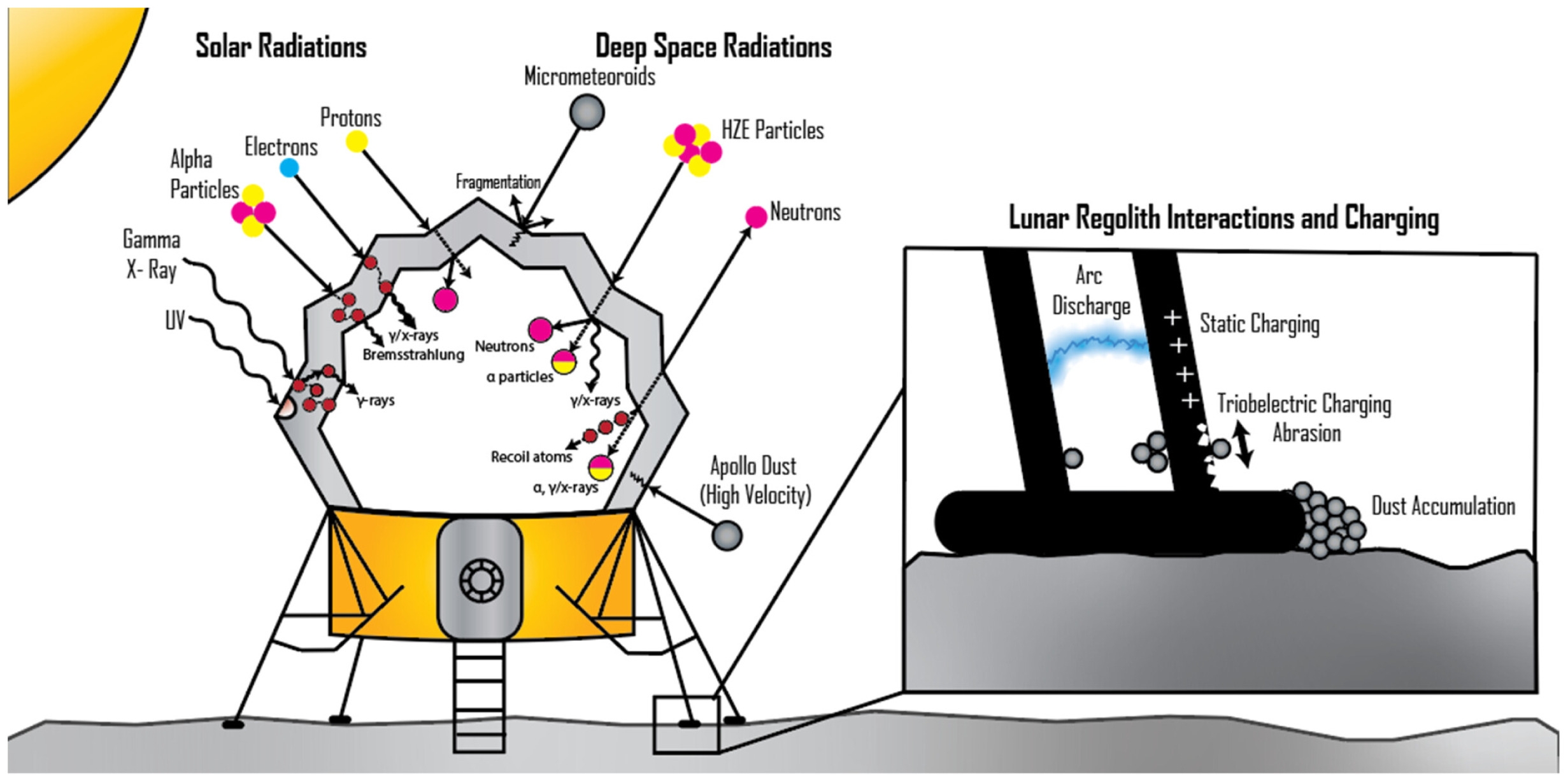
Schematic of anticipated environmental hazards on the Moon. These include unfiltered solar and deep space radiation, micrometeoroid impacts, and complex interactions with lunar regolith. The inset highlights dust-specific hazards such as electrostatic charging, triboelectric effects, abrasion, and persistent surface accumulation. Credit: E.A. Ryan, Z.D. Seibers, J.R. Reynolds, M.L. Shofner
“Electrically conducting polymers and composites for applications in space exploration” and reproduced with permission from John Wiley and Sons, Inc.
They conclude that “the principal contribution of this review is not simply to catalogue passive lunar dust surfaces, but to identify which concepts are genuinely promising, which remain under-validated, and which evidence gaps most directly prevent progression beyond laboratory promise.”
To access the work published in the journal Acta Astronautica – “Evaluating passive surface technologies for lunar dust mitigation and tolerance” – go to:
https://www.sciencedirect.com/science/article/pii/S0094576526003292
 Posted in Space News

