 By
By  March 24th, 2018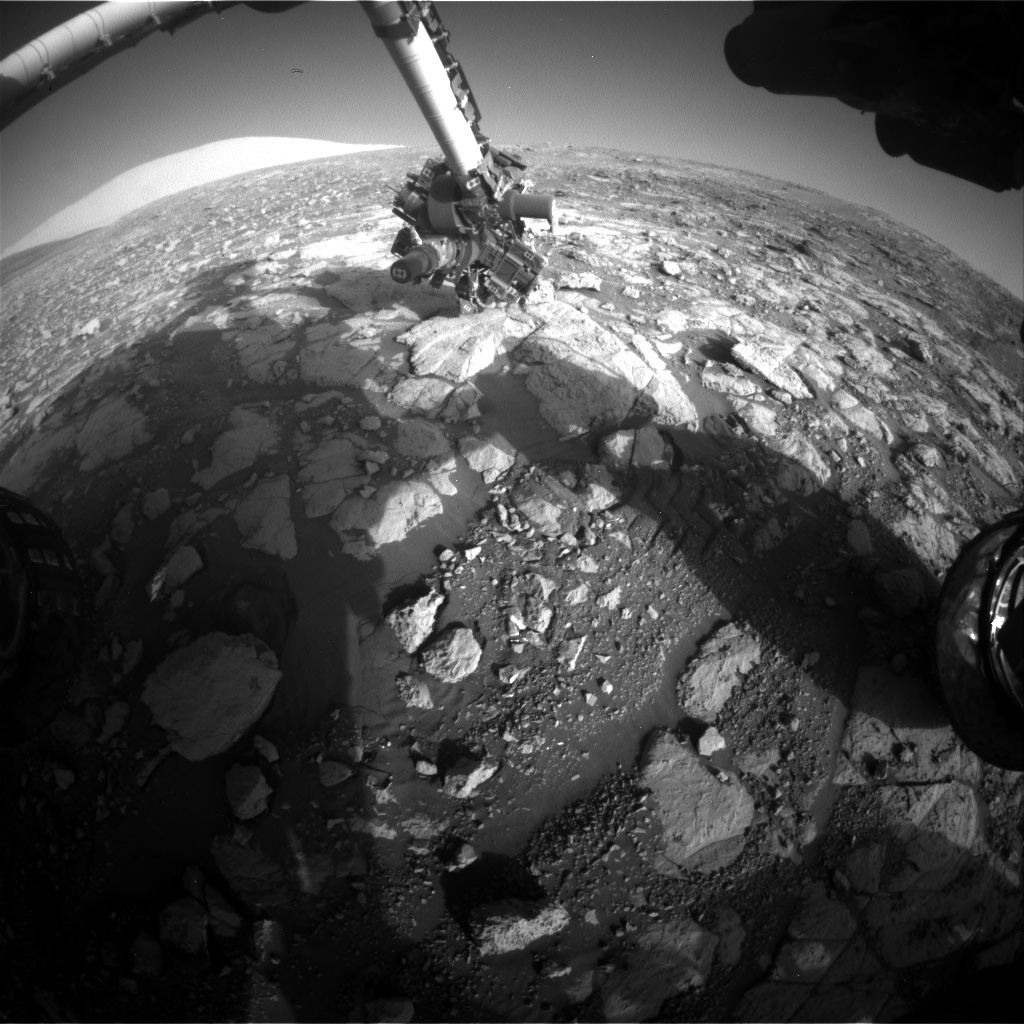
Curiosity Front Hazcam Right B image acquired on Sol 2000, March 23, 2018.
Credit: NASA/JPL-Caltech
NASA’s Curiosity Mars rover is wrapping up Sol 2001 duties.
Controllers operating the robot put together Sol 2001 activities listening to a rousing rendition of “Also sprach Zarathustra” – the signature song from the movie 2001: A Space Odyssey.
Reports Abigail Fraeman, planetary geologist at NASA/Jet Propulsion Laboratory (JPL) in Pasadena, California, that inspirational music motivated them to pick two new target names that were as close to A Space Odyssey as they could get: “Boddam” for David Bowman (the mission commander of the Discovery 1) and “Kirkcudbright” for the movie’s director, Stanley Kubrick.

Curioisty Navcam Left B photo acquired on Sol 2000, March 23, 2018.
Credit: NASA/JPL-Caltech
Steep outcrop
“Curiosity is currently sitting in front of a steep outcrop that shows some interesting geologic relationships between rocks in the Vera Rubin Ridge. We acquired some great images of these rocks,” Fraeman notes, so the focus has been on understanding the properties of those rocks.

View of rover’s workspace taken by Curioisty Mastcam Left on Sol 1999, March 22, 2018.
Credit: NASA/JPL-Caltech/MSSS
In the first sol of the plan, sol 2001, the plan called for collecting Mars Hand Lens Imager (MAHLI) photos of a target named “Apin,” and doing Dust Removal Tool (DRT), MAHLI, and Alpha Particle X-Ray Spectrometer (APXS) tasks on a target named “Brora.”
Vertical rocks
The second sol, sol 2002, will focus on remote sensing, with Chemistry and Camera (ChemCam) observations on targets named Boddam, “Sgurr of Eigg,” and Kirkcudbright.
The ChemCam observations will be accompanied by Mastcam documentation images. Multispectral observation of the DRT targets from Brora and Sgurr of Eigg are to be done, some multispectral images of the landscape in front of the rover, and some additional color images of vertical rocks in front of Curiosity to complement previously collected data.
“We’ll top off the science block with a dust devil movie and dust devil survey. We’ll stay up after dark on sol 2002 to collect additional nighttime MAHLI images of Appin and Brora,” Fraeman explains.

Dust Removal Tool (DRT) is viewed by Curiosity Mastcam Right camera. Image taken on Sol 2000, March 23, 2018.
Credit: NASA/JPL-Caltech/MSSS
Distant features
On sol 2003, the plans calls for taking dedicated environmental science measurements, including a tau to measure the dust in the atmosphere, a Navcam 360 sky survey, a Navcam zenith and suprahorizon movies, and a crater rim extinction image.
Also part of the plan is producing another ChemCam remote micro-imager (RMI) mosaic of distant features on Mt. Sharp.

Curiosity Navcam Right B image acquired on Sol 1999, March 22, 2018.
Credit: NASA/JPL-Caltech
Spectral signatures
Sol 2003 will finish with the robot driving roughly 165 feet (50 meters) towards an area “where we see some of the strongest spectral signatures of hematite on the ridge in orbital data,” Fraeman points out.
A standard set of post-drive images will be taken over the weekend to set Mars researchers up to characterize the new location in the sol 2004 plan.
“It will be very exciting,” Fraeman concludes, “to see the exact rocks that are the source of the orbital signature which helped us realize the importance of Vera Rubin Ridge over five years ago!”
 Posted in Space News

