 By
By  July 3rd, 2021
Credit: NASA/JPL-Caltech/Univ. of Arizona
The NASA Curiosity Mars rover at Gale Crater is now performing Sol 3166 duties.
Lauren Edgar, a planetary geologist at the USGS Astrogeology Science Center in Flagstaff, Arizona, reports: “On Sol 3165 Curiosity carried out a short bump to better position the rover for drilling. The bump went well and we were excited to dive straight into planning today. This plan will cover four days on Earth to account for the Independence Day holiday in the U.S., but it also coincides with a “soliday” on Mars – a day without planning to allow Earth and Mars schedules to sync back up. So we still planned a typical three-sol weekend plan. Well-timed, Mars!”
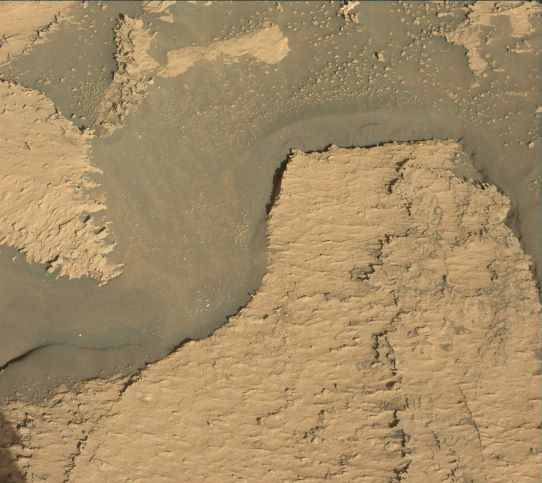
Curiosity Mast Camera Left image taken on Sol 3165, July 2, 2021.
Credit: NASA/JPL-Caltech/MSSS
Identifying future targets
Edgar adds that the plan starts by taking a 360-degree Mastcam mosaic, which will be helpful for documenting the rover’s location, identifying future targets, and looking for changes during the course of the drill campaign.
Then Curiosity’s Chemistry and Camera (ChemCam) will investigate the target “Pontours” that scientists are evaluating as the drill location.
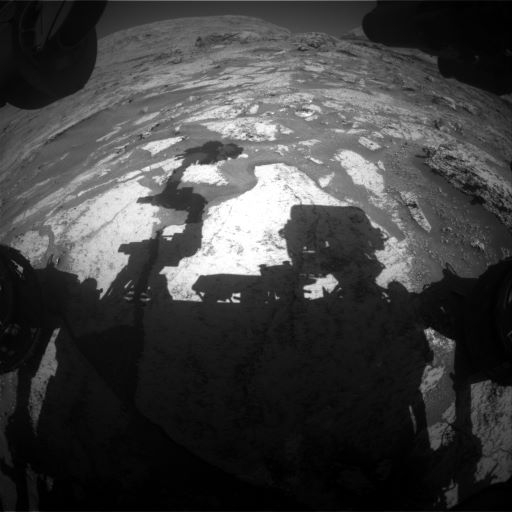
Curiosity Front Hazard Avoidance Camera Right B photo acquired on Sol 3166, July 3, 2021.
Credit: NASA/JPL-Caltech
Next, the plan calls for brushing the “Pontours” target with the Dust Removal Tool (DRT) and use the Mars Hand Lens Imager (MAHLI) and the Alpha Particle X-Ray Spectrometer (APXS) to characterize its texture and chemistry.
Drill and dump
“On the second sol we’ll conduct a drill pre-load test to make sure that the bedrock and hardware can withstand the force of drilling at this location, along with a lot of MAHLI documentation of the intended drill, dump, and portion locations,” Edgar notes.
The Sample Analysis at Mars (SAM) Instrument Suite will also conduct a cross-calibration activity.
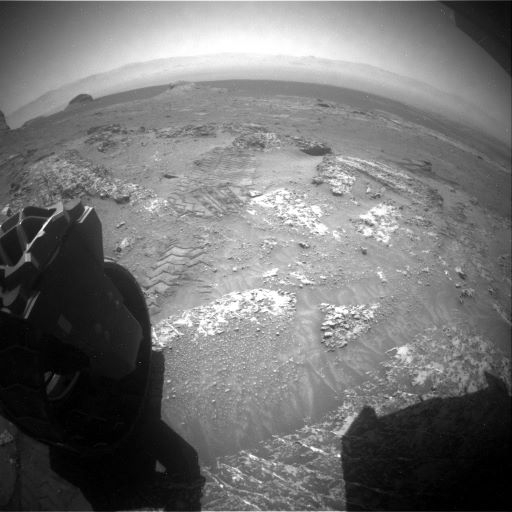
Curiosity Rear Hazard Avoidance Camera Left B image acquired on Sol 3166, July 3, 2021.
Credit: NASA/JPL-Caltech
Nodule-rich target
“The third sol starts with a Navcam sky survey to look at the scattering phase functions of clouds. Later in the morning, Navcam will search for dust devils and Mastcam will monitor the dust content in the atmosphere,” Edgar adds.
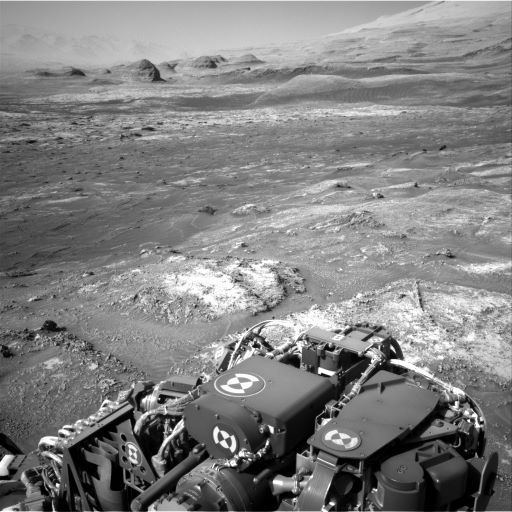
Curiosity Right B Navigation Camera photo taken on Sol 3165, July 2, 2021.
Credit: NASA/JPL-Caltech
“Then we’ll acquire a Mastcam multispectral observation of “Pontours” followed by imaging of a nearby sandy trough named “Lolme” which will be used to track movement before and after drilling,” Edgar reports. Then the robot’s Chemistry & Camera (ChemCam) will assess a nodule-rich target named “Dournazac,” to evaluate the chemistry of these “diagenetic” features – features that formed after the sediment first was deposited.
“There were a lot of other great science observations that were suggested, but it was a challenge to fit everything in today,” Edgar concludes. “Looking forward to seeing the data from this new location and preparing to drill next week!”
 Posted in Space News

