 By
By  March 23rd, 2018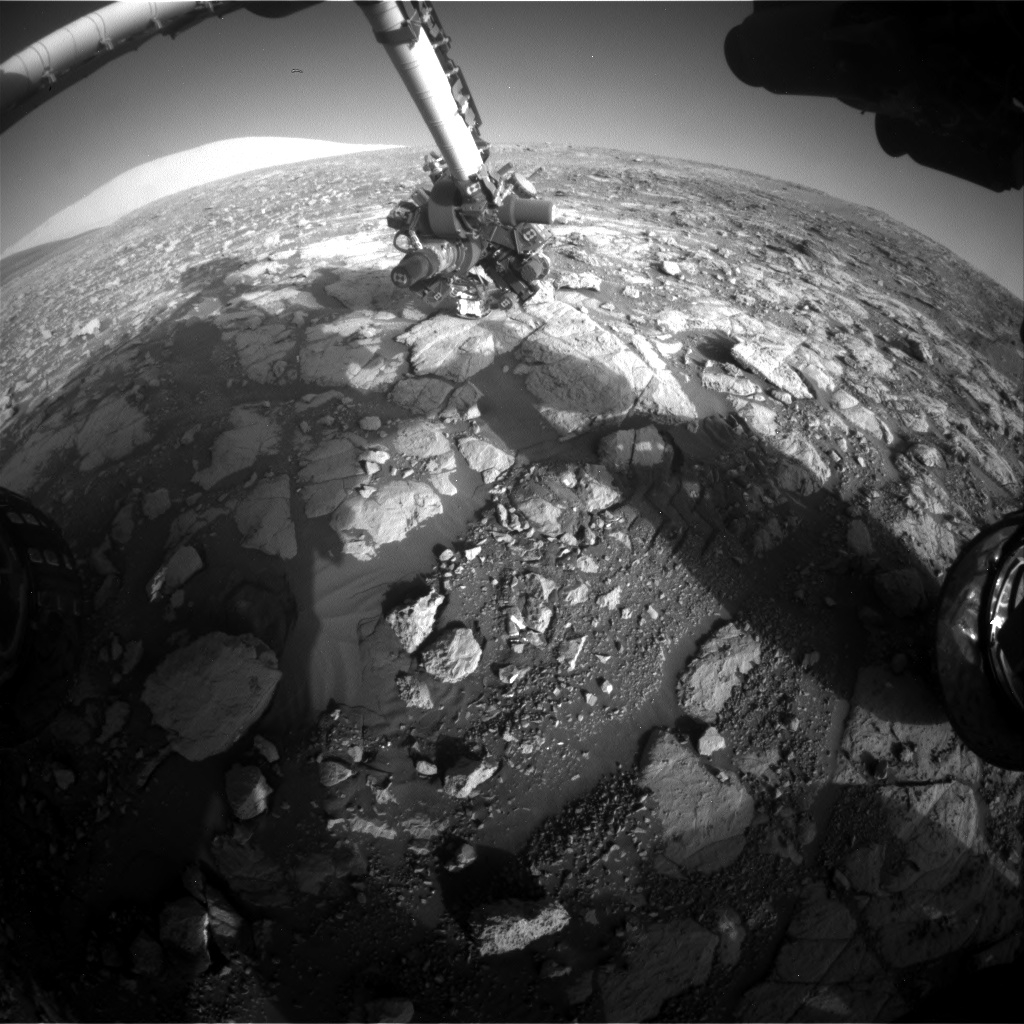
Curiosity Front Hazcam Right B image acquired on Sol 2000, March 23, 2018.
Credit: NASA/JPL-Caltech
NASA’s Curiosity robot on Mars has reached 2000 Martian Days of Red Planet roving, reports Christopher Edwards, a planetary geologist at Northern Arizona University in Flagstaff.
“Our trusty Martian rover has spent 2000 sols exploring Gale Crater helping to unravel the geologic history preserved in the rocks,” Edwards explains. “We’ve observed a huge variety of past environments ranging from conglomerate rocks that indicate flowing surface water to mudstones that document a time when Gale crater contained an ancient lake.”

Curiosity Navcam Left B photo taken on Sol 2000, March 23, 2018.
Credit: NASA/JPL-Caltech
Strong signature
Curiosity is continuing its exploration of past environments preserved within Gale crater, further examining the Vera Rubin Ridge. The rover is continuing to make its way to the location where the strongest orbital signature of hematite is observed, Edwards notes.
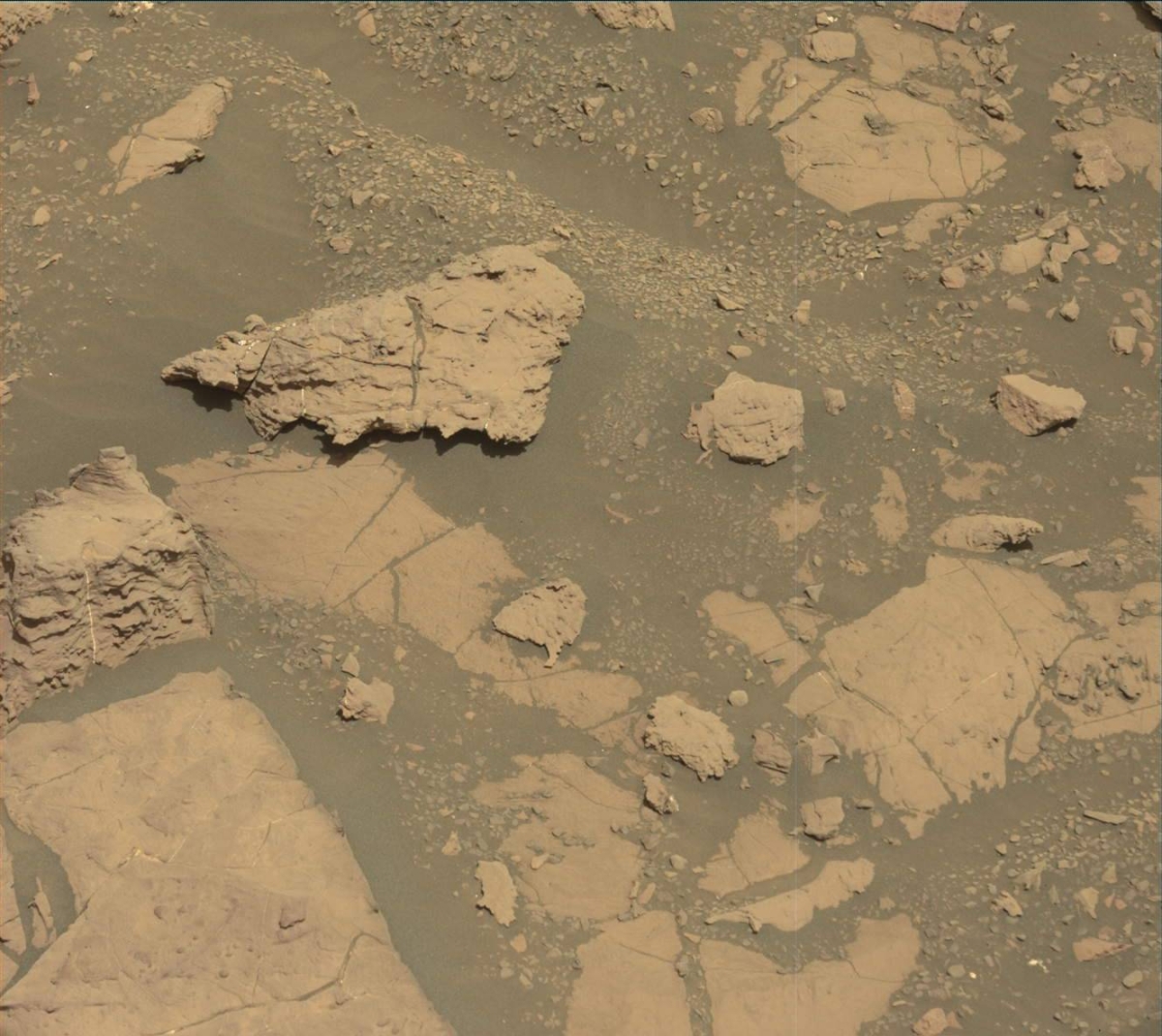
Curiosity Mastcam Left image acquired on Sol 1999, March 22, 2018.
Credit: NASA/JPL-Caltech/MSSS
A recent plan has Curiosity carrying out remote sensing activities to examine layering in the rocks, as well as contact science on the target dubbed “Sgurr of Eigg” to characterize the unit’s chemistry and fine-scale morphology. “We’ll continue these types of activities over the weekend plan,” Edwards adds, “to refine our understanding of this workspace.”
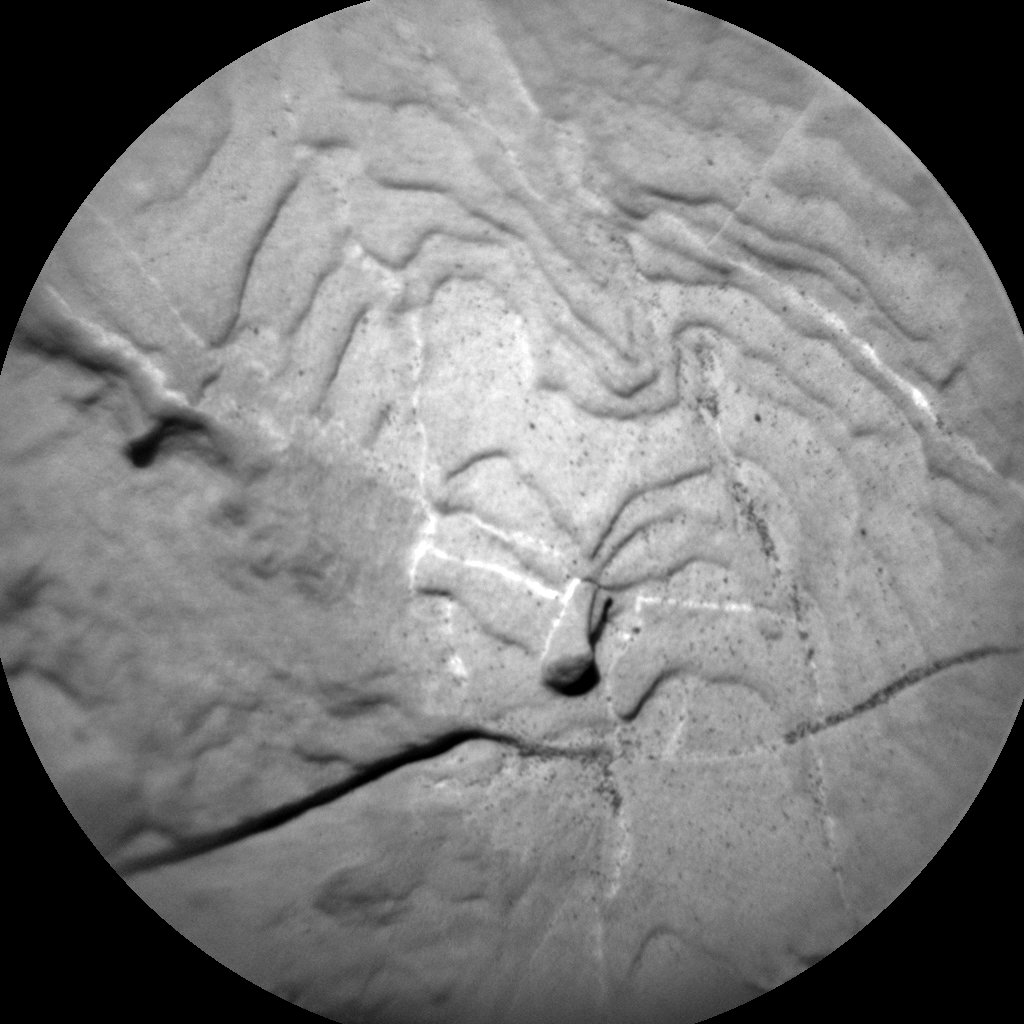
Curiosity ChemCam Remote Micro-Imager photo taken on Sol 2000, March 23, 2018.
Credit: NASA/JPL-Caltech/LANL
Road map
A new traverse map has been issued showing the route driven by Curiosity through the 1999 Martian day, or sol, of the rover’s mission on Mars (March 22, 2018).
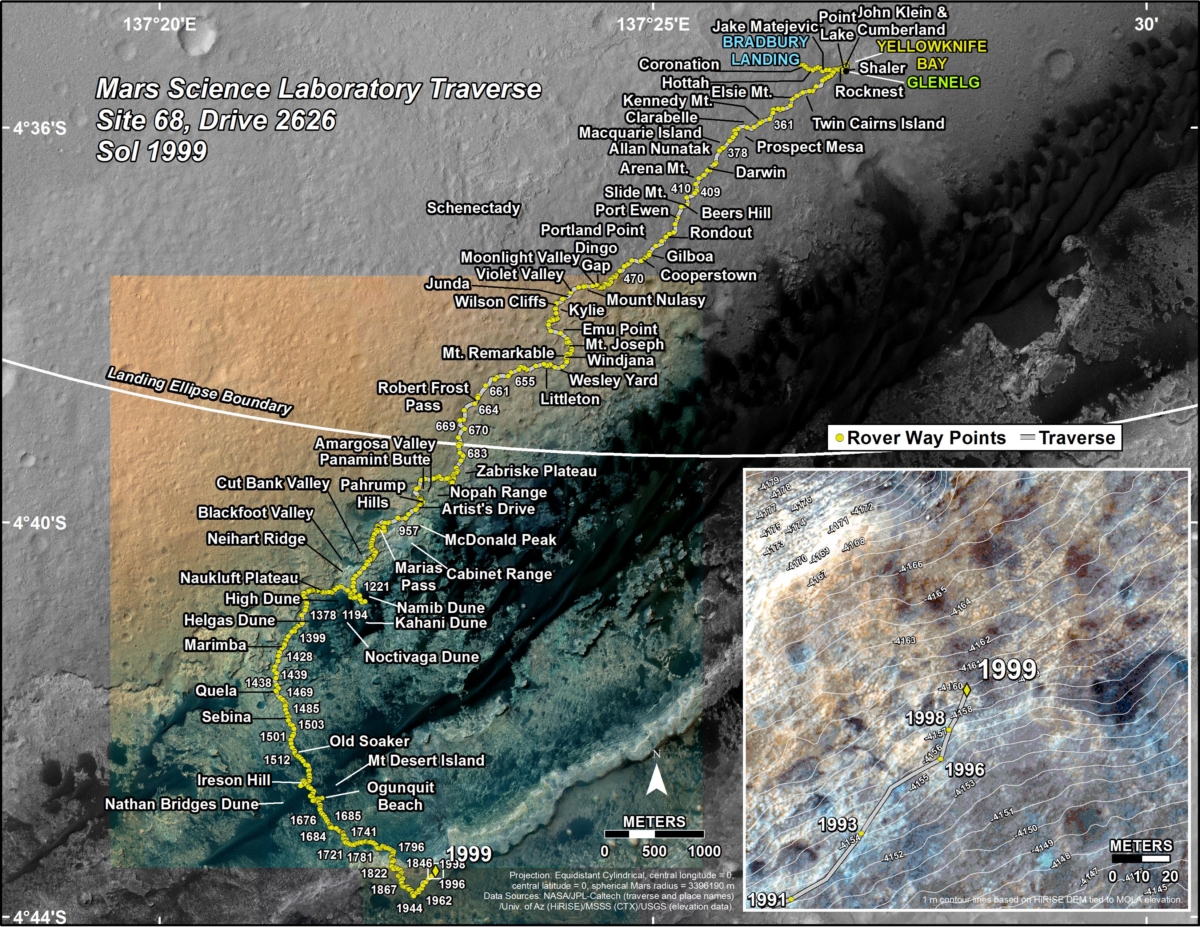
Credit: NASA/JPL-Caltech/Univ. of Arizona
Numbering of the dots along the line indicate the sol number of each drive. North is up. The scale bar is 1 kilometer (~0.62 mile).
From Sol 1998 to Sol 1999, Curiosity had driven a straight line distance of about 50.39 feet (15.36 meters), bringing the rover’s total odometry for the mission to 11.48 miles (18.47 kilometers).
The base image from the map is from the High Resolution Imaging Science Experiment Camera (HiRISE) in NASA’s Mars Reconnaissance Orbiter.
 Posted in Space News

