 By
By  January 12th, 2017
Curiosity Navcam Left B image taken on Sol 1576, January 11, 2017.
Credit: NASA/JPL-Caltech
NASA’s Curiosity Mars rover is now busy at work performing Sol 1577 duties.
The robot drove almost 100-feet (30-meters) on Sol 1576, stopping in a location with a nice exposure of bedrock in the arm workspace, reports Ken Herkenhoff of the USGS Astrogeology Science Center in Flagstaff, Arizona.

Optics check on Mars Hand Lens Imager (MAHLI).
Curiosity Mastcam Right image taken on Sol 1576, January 11, 2017.
Credit: NASA/JPL-Caltech/MSSS
Clean optics
The word is that the rover’s Mars Hand Lens Imager (MAHLI) optics look clean, so the plan called for a full suite of MAHLI images to be taken, along with a short Alpha Particle X-Ray Spectrometer (APXS) integration on a bedrock target named “Mansell Mountain.”
“Fitting the remote sensing observations we wanted, along with the contact science and a roughly 46-meter [150-foot] drive, into the Sol 1577 plan was a challenge,” Herkenhoff notes. “But the tactical team did a great job, working together to put together an excellent plan.”
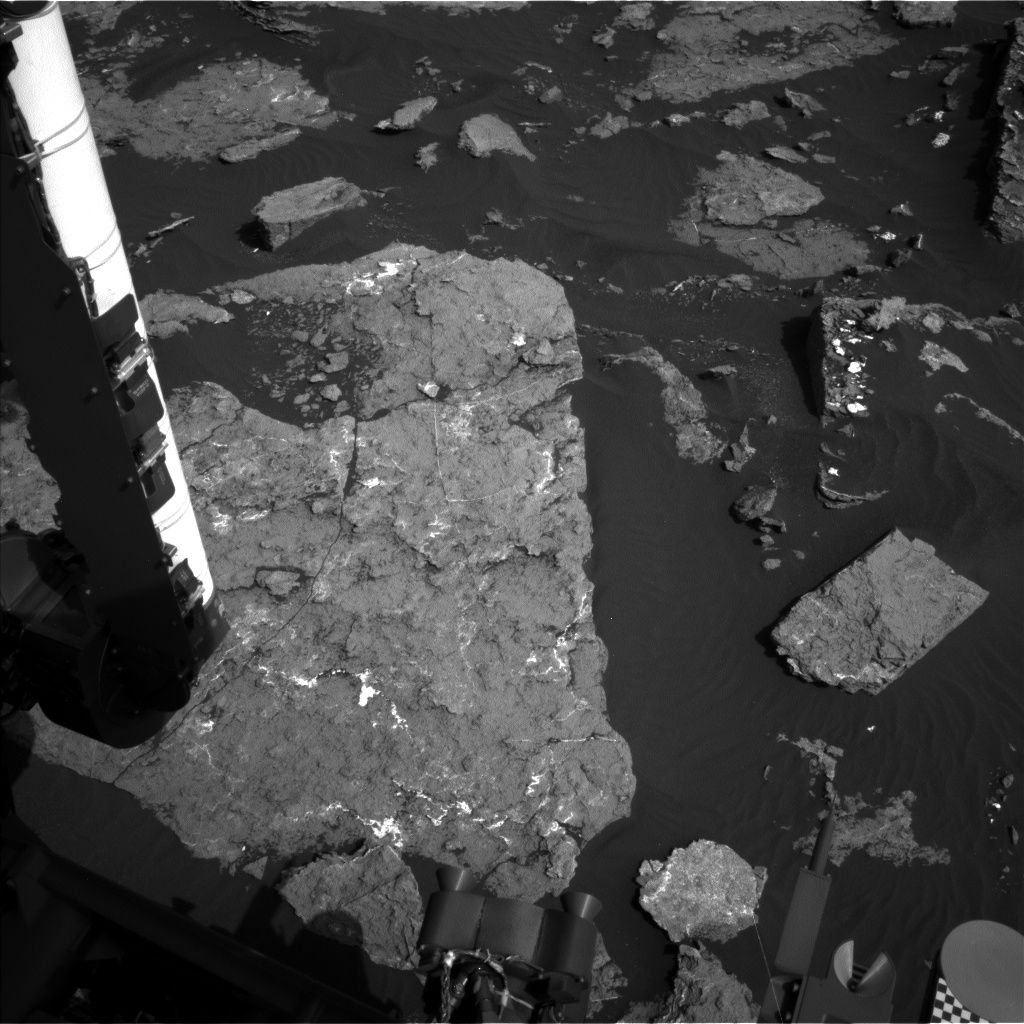
Curiosity Navcam Left B image taken on Sol 1576, January 11, 2017.
Credit: NASA/JPL-Caltech
Odd cobble
After the contact science is completed, Curiosity’s Chemistry & Camera (ChemCam) and Right Mastcam will observe an odd cobble called “Ames Knob” and a bedrock target dubbed “Day Mountain.”
The rover’s Left Mastcam is set to acquire a 2-image mosaic of the bedrock slab in front of the rover, and Right Mastcam will take an image of the Sol 1576 Autonomous Exploration for Gathering Increased Science (AEGIS) target and a 4×1 mosaic of a layered exposure named “Appleton Ridge.”

Curiosity Mastcam Right image taken on Sol 1575, January 10, 2017.
Credit: NASA/JPL-Caltech/MSSS
After the rover’s drive and the post-drive imaging needed to plan Sol 1578 activities, Navcam will acquire a panorama and search for dust devils and clouds, Herkenhoff concludes.
 Posted in Space News

