 By
By  November 2nd, 2021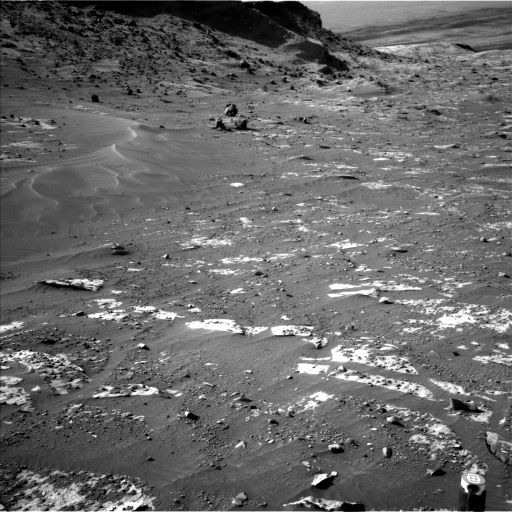
Curiosity Left B Navigation Camera image acquired on Sol 3285. November 2, 2021.
Credit: NASA/JPL-Caltech
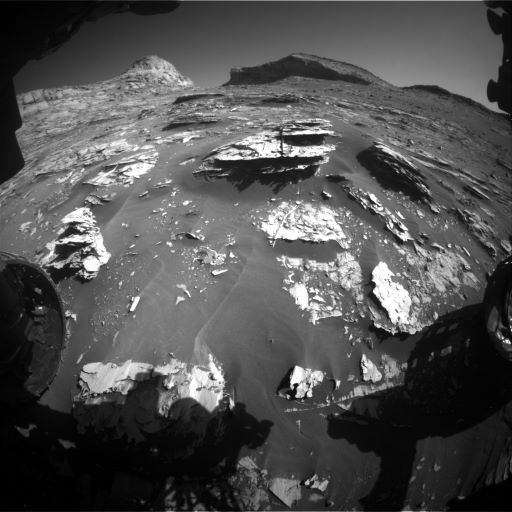
“Coylton Rocking Stone” is seen in this Curiosity Front Hazard Avoidance Camera Left B image taken on Sol 3285, November 2, 2021.
Credit: NASA/JPL-Caltech
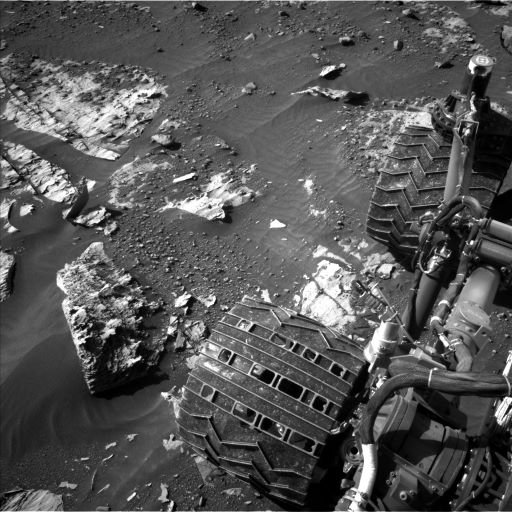
Curiosity Front Hazard Avoidance Camera Left B image taken on Sol 3285, November 2, 2021.
Credit: NASA/JPL-Caltech

Curiosity Front Hazard Avoidance Camera Left B image taken on Sol 3285, November 2, 2021.
Credit: NASA/JPL-Caltech
NASA’s Curiosity Mars rover at Gale Crater is now closing out Sol 3285 duties.
Reports Michelle Minitti, a planetary geologist at Framework in Silver Spring, Maryland, Curiosity performed a weekend drive, chalking up some 20 feet (6 meters) in elevation. “Not bad for a weekend hike!”
Looking at images of the terrain, it is probably not surprising that the rover is looking uphill into the tilted bedrock slabs and thin resistant veins jutting up in all directions.
That makes it hard to plan the robot’s next move, Minitti says. Indeed, a scripted drive will take Curiosity close to the area where researchers want to drill next, but not necessarily the exact spot.
Looking left…and right
“We hope to be able to look around us after the next drive – looking left and right across the tops of these bedrock slabs and veins – and pick a sweet spot to drill,” Minitti adds. “Given the variety of features around us right now, surely sweet spots will not be in short supply!”
Before the rover’s drive, scientists had time to gather data from its surroundings.
The rover’s workspace was considerably less rocky than the last one, but the sand ripples cutting through made an intriguing target.
Sand chemistry
The robot’s Mars Hand Lens Imager (MAHLI) and Alpha Particle X-Ray Spectrometer (APXS) are set to image and measure one ripple, “Dornoch Beach,” the first purely sand target Mars scientists have studied in quite awhile.
“It is good to keep track of sand chemistry, as sand is a mixture of rock components near and far, and changes in sand chemistry can indicate changes how much local rocks are contributing to the sand,” Minitti says.
The rover’s Chemistry and Camera (ChemCam) is scheduled to measure the chemistry of one of the roughly centimeter-sized resistant nodules, “Aztec Tower,” in bedrock out of reach of the arm instrument.
Spectacular slabs
Curiosity’s Mastcam is also on task to acquire a mosaic of one of the spectacular slabs nearby. It is dubbed “Coylton Rocking Stone.”
Minitti reports that before and after the drive, Mastcam will support measurement of the amount of dust in the atmosphere with an image aimed at the sun, using a big filter keeping the camera safe while doing so.
Curiosity’s Navcam is scheduled to look for dust devils and clouds.
The Radiation Assessment Detector (RAD) and the Rover Environmental Monitoring Station (REMS) run throughout the plan.
DAN will run in passive mode for nearly 8 hours before, during, and after the drive while adding an active measurement after the drive is complete, Minitti concludes.
 Posted in Space News

