 By
By  August 4th, 2021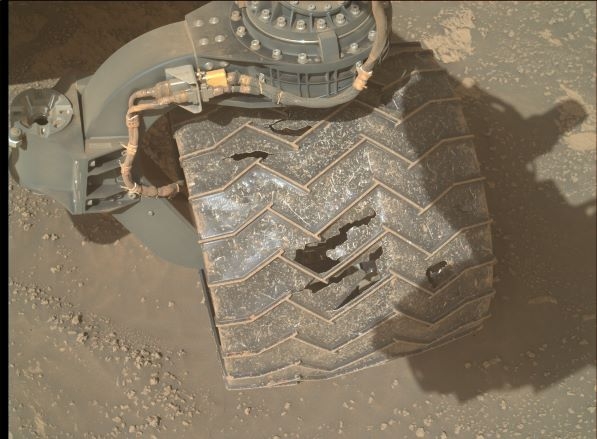
Curiosity operators have recently done full Mars Hand Lens Imager (MAHLI) wheel imaging. Image shows wheel, bedrock and some nodules.
MAHLI photo produced on Sol 3195, August 2, 2021.
Credit: NASA/JPL-Caltech/MSSS
NASA’s Curiosity Mars rover at Gale Crater has just begun performing Sol 3198 tasks.
Reports Susanne Schwenzer, a planetary geologist at The Open University; Milton Keynes, in the U.K.: A recently scripted two-sol (3197, 3198) plan focuses on what geologists call nodules, “little rounded things that stick out of the surrounding rock because they are just a little bit more resistant to weathering than the rock itself. The term nodule thereby does not say anything about how they formed; it’s just a description of what you see in the images.”
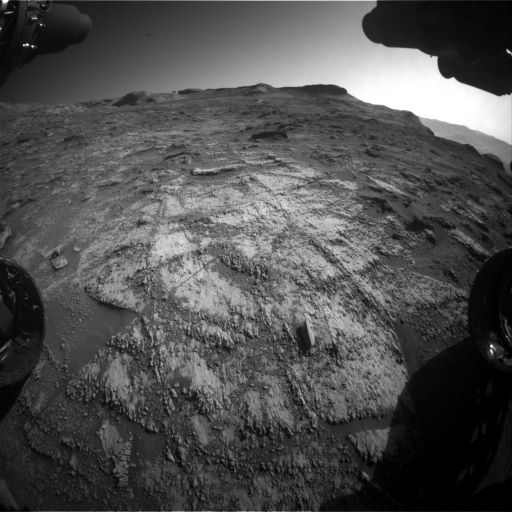
Curiosity Front Hazard Avoidance Camera Right B photo taken on Sol 3197, August 4, 2021.
Credit: NASA/JPL-Caltech
Curiosity is parked in an area that has lots of those nodules. Consequently, the robot’s Alpha Particle X-Ray Spectrometer (APXS) was set to look at target “Vendoire” in the workspace, and that target has lots of these nodules.
Fingers crossed
The Chemistry and Camera (ChemCam) instrument is also to join the effort, trying to hit some of the nodules also imaged by a Mastcam multispectral observation, “but they are tiny, so, fingers crossed,” Schwenzer adds. “Always remember, we are trying to hit something of the size of a dime or smaller at a distance from about 3 meters or more. Let’s see what target “Beleymas” brings, but we are confident to at least hit some!”
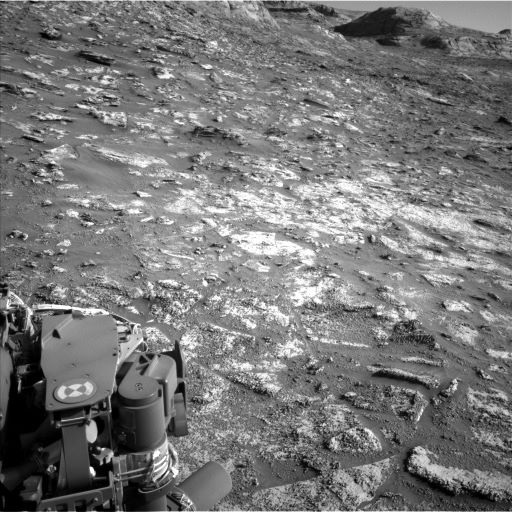
Curiosity Left B Navigation Camera image acquired on Sol 3197, August 4, 2021.
Credit: NASA/JPL-Caltech
ChemCam is also looking into the distance, where scientists have spotted an outcrop where there are changes in the textures – the upper part of the outcrop looks smoother from the rover’s vantage point than the lower part.
“What’s better than getting close by pointing the remote imager at it? That will help us decide what might be behind the patterns in the current images,” Schwenzer notes. “Mastcam is joining the distance-imaging and adding color to the ChemCam images, as well as looking right in front of the rover to support the nodule investigations and a butte in the ‘Sands of Forvie’ area. It is collecting two multispectral observations in support of the nodule observation on targets ‘Baneuil’ and the above named target ‘Beleymas.’”
Clast survey
After all this science there is a rover drive, more imaging, and more science.
“The imaging is mostly to get the data needed for the next planning, but also a little science as we are also getting an image for our regular clast survey,” Schwenzer explains.
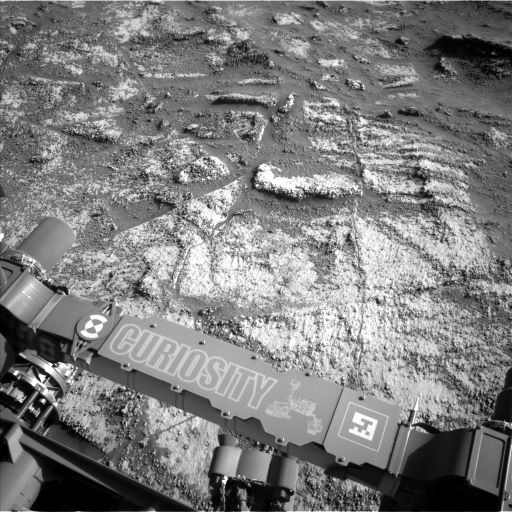
Curiosity Left B Navigation Camera image acquired on Sol 3197, August 4, 2021.
Credit: NASA/JPL-Caltech
Clast surveys are high angle monoscopic images acquired periodically of soil deposits in front of the rover.
The robot’s ChemCam will perform an Autonomous Exploration for Gathering Increased Science (AEGIS) observation, where it looks for its own target after the drive.
“Those investigations add important capabilities to our plans as they allow us to use ChemCam [Laser Induced Breakdown Spectroscopy] (LIBS) before we here on Earth have seen the new parking space,” Schwenzer concludes. “It’s an interesting area, especially for me as a mineralogist, as all those nodules usually also mean chemical and mineralogical changes. Well, we’ll soon find out!”
 Posted in Space News

