 By
By  May 1st, 2023
Curiosity Left B Navigation Camera image taken on Sol 3815, May 1, 2023.
Image credit: NASA/JPL-Caltech
NASA’s Curiosity Mars rover at Gale Crater is now performing Sol 3816 duties.
Curiosity has arrived at a new location with some bright toned, and more rounded rocks in its vicinity, reports Elena Amador-French, Science Operations Coordinator at NASA’s Jet Propulsion Laboratory.
“Unfortunately, we could look but not touch as our wheels were positioned such that we could not safely unstow the arm for contact science. We typically have a large suite of arm activities in weekend plans but with those now removed, the science team had ample power and time to do remote sensing,” Amador-French adds.
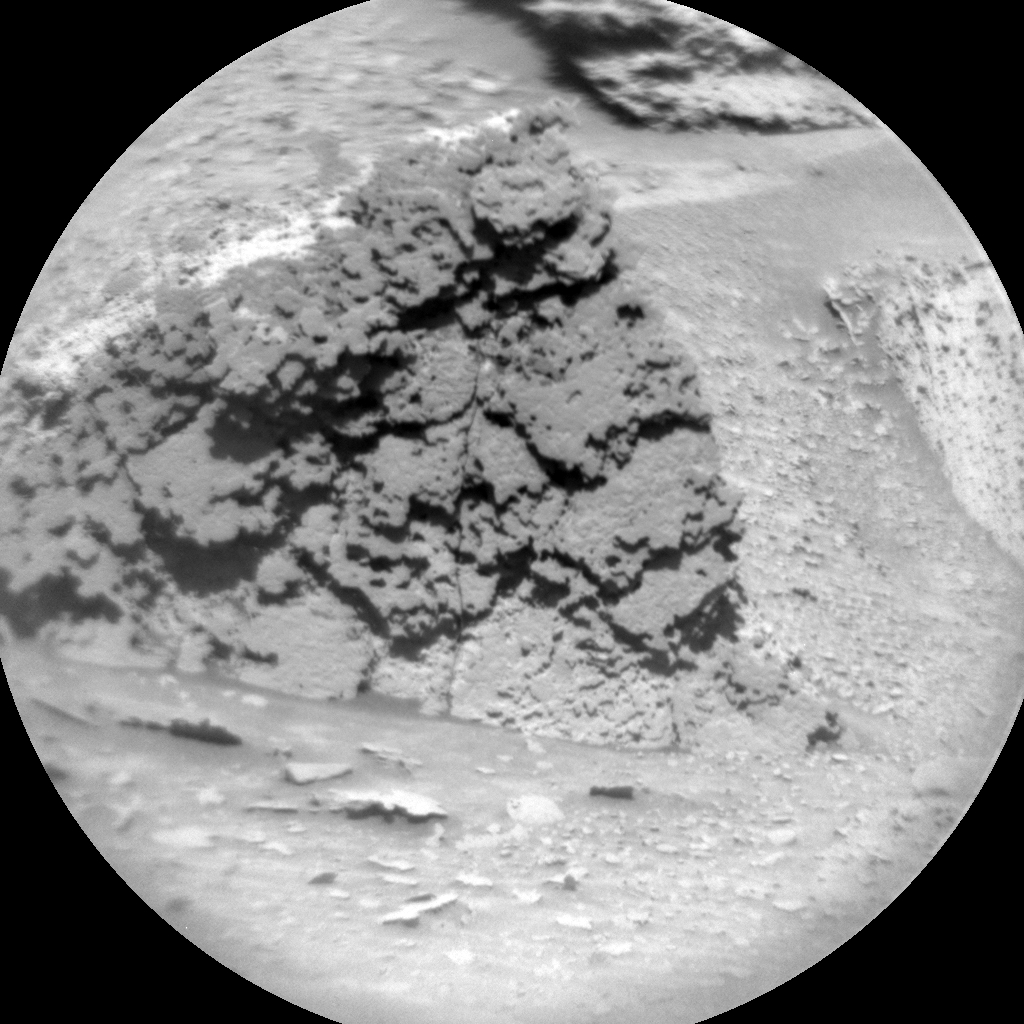
Curiosity Chemistry & Camera (ChemCam) Remote Micro-Imager (RMI) photo taken on Sol 3815, April 30, 2023.
Image credit: NASA/JPL-Caltech/LANL
Rhythmic textures
In a recent plan for Sols 3814-3816, the first sol had the robot use Mastcam to image the target “Ekeni,” a target just in front of the rover’s right front wheel “with interesting rhythmic textures, Amador-French notes. “Could they be due to how the sediment was originally emplaced or how it has since eroded?”
Similarly, the target “Fazendinha” appears to represent a transition between rock textures.

Curiosity Left B Navigation Camera image taken on Sol 3815, May 1, 2023.
Image credit: NASA/JPL-Caltech
High resolution Mastcam images will allow scientists to consider the history of these blocks.
“We’ll also use our ChemCam [Chemistry and Camera] instrument to provide compositional information for the target ‘Sao Miguel,’ giving us our first ‘taste’ of the bedrock in front of us,” Amador-French reports.
More Mastcam
On the second sol, the rover was to continue investigating the area around it with more Mastcam and another ChemCam LIBS [Laser Induced Breakdown Spectroscopy] observation on “Sao Tome” before taking a short drive – a scoot of just a few meters – to a potential sampling location.

Curiosity Left B Navigation Camera image taken on Sol 3815, May 1, 2023.
Image credit: NASA/JPL-Caltech
Mastcam will document this new location with a 360-degree mosaic, capturing all the terrain that surrounds Curiosity.
New location
On the third sol of the plan, ChemCam was slated to use its autonomous target selection capability, AEGIS, to collect compositional data from the robot’s new location.

Curiosity Left B Navigation Camera image taken on Sol 3815, May 1, 2023.
Image credit: NASA/JPL-Caltech
As is typical for weekend plans, it called for the rover to take a suite of environmental monitoring measurements – searching for dust devils with its navigation camera, studying the dust opacity in the atmospheric with Mastcam and engineering cameras, as well as a regular cadence of Rover Environmental Monitoring Station (REMS) observations.

Curiosity Front Hazard Avoidance Camera Left B image acquired on Sol 3815, May 1, 2023.
Image credit: NASA/JPL-Caltech
Sample dump
In addition to these remote sensing activities, also planned were two Chemistry & Mineralogy X-Ray Diffraction/X-Ray Fluorescence Instrument (CheMin) activities to set Curiosity up for potential sampling next week.
“Both activities are intended to ensure our instrument is as clean and prepared as possible to accurately measure mineralogy,” Amador-French concludes. “We’ll vibe CheMin’s inlet funnel, as well dump any potential remaining sample from the cell we intend to deliver our next sample to.”
As always, dates of planned rover activities are subject to change due to a variety of factors related to the Martian environment, communication relays and rover status.
 Posted in Space News

