 By
By  August 14th, 2021
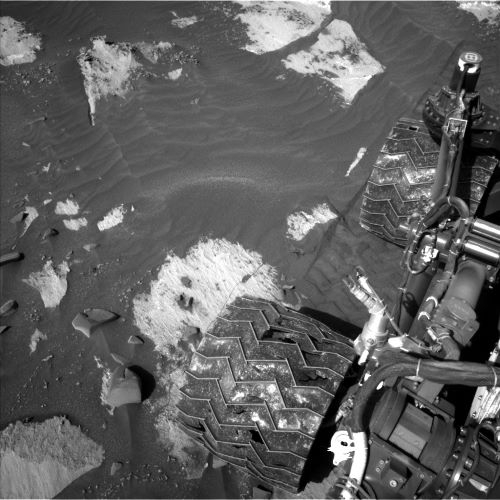
Curiosity Front Hazard Avoidance Camera Left B image taken on Sol 3206, August 13, 2021.
Credit: NASA/JPL-Caltech
NASA’s Curiosity Mars rover at Gale Crater is now performing Sol 3207 duties.
“Curiosity continues her climb up Mt. Sharp, navigating her way towards the southwest,” reports Mark Salvatore, a planetary geologist at the University of Michigan.
Curiosity Left B Navigation Camera image acquired on Sol 3206, August 13, 2021.
Credit: NASA/JPL-Caltech
Transition region
In the previous plan, Curiosity traveled approximately 131 feet (40 meters) through fairly rocky terrain that coincides with the transition region between the clay-bearing bedrock that the robot has been exploring for the past few years and the overlying sulfate-bearing materials.
“The science team is carefully characterizing this compositional transition both laterally and vertically, hoping to identify key evidence for environmental transitions along the way,” Salvatore adds.
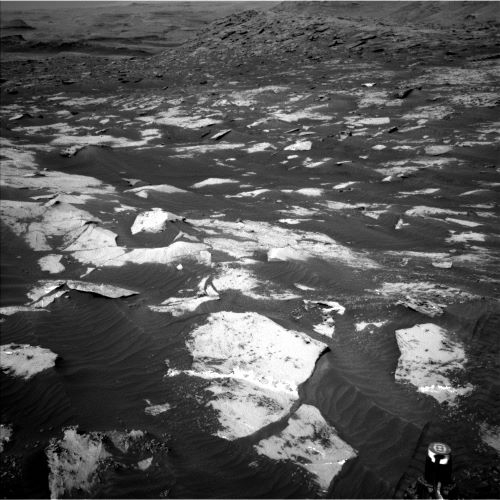
Curiosity Left B Navigation Camera image acquired on Sol 3206, August 13, 2021.
Credit: NASA/JPL-Caltech
“The current transition zone was one of the main reasons why NASA and the scientific community selected Gale crater as the Curiosity landing site,” Salvatore points out.
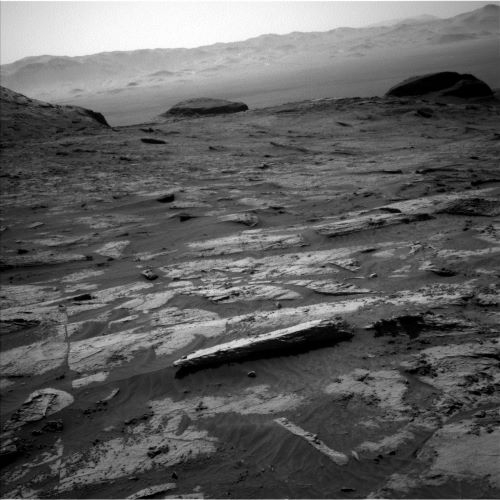
Curiosity Left B Navigation Camera image acquired on Sol 3206, August 13, 2021.
Credit: NASA/JPL-Caltech
Environmental history
Spectral evidence from the Compact Reconnaissance Imaging Spectrometer for Mars (CRISM) instrument on NASA’s Mars Reconnaissance Orbiter showed a clear compositional transition here that might be indicative of significant environmental change recorded in the rock record.
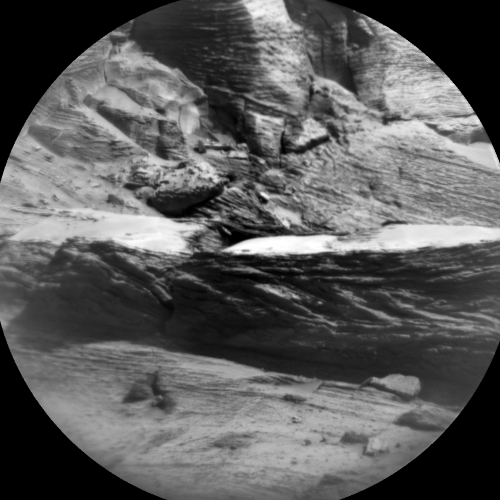
Curiosity Chemistry & Camera Remote Micro-Imager photo taken on Sol 3206, August 13, 2021
Credit: NASA/JPL-Caltech/LANL
Salvatore says that “Curiosity is now in a position to begin understanding and unraveling this environmental history!”
In the current plan, Curiosity will be acquiring local and long-distance imagery, as well as some compositional measurements of local bedrock and diagenetic features (the process of chemical and physical change in deposited sediment during its conversion to rock).
The plan will end with a rover drive of roughly 82 feet (25 meters) to the southwest “as we continue our way through this transition zone,” Salvatore concludes.
 Posted in Space News

