 By
By  May 3rd, 2022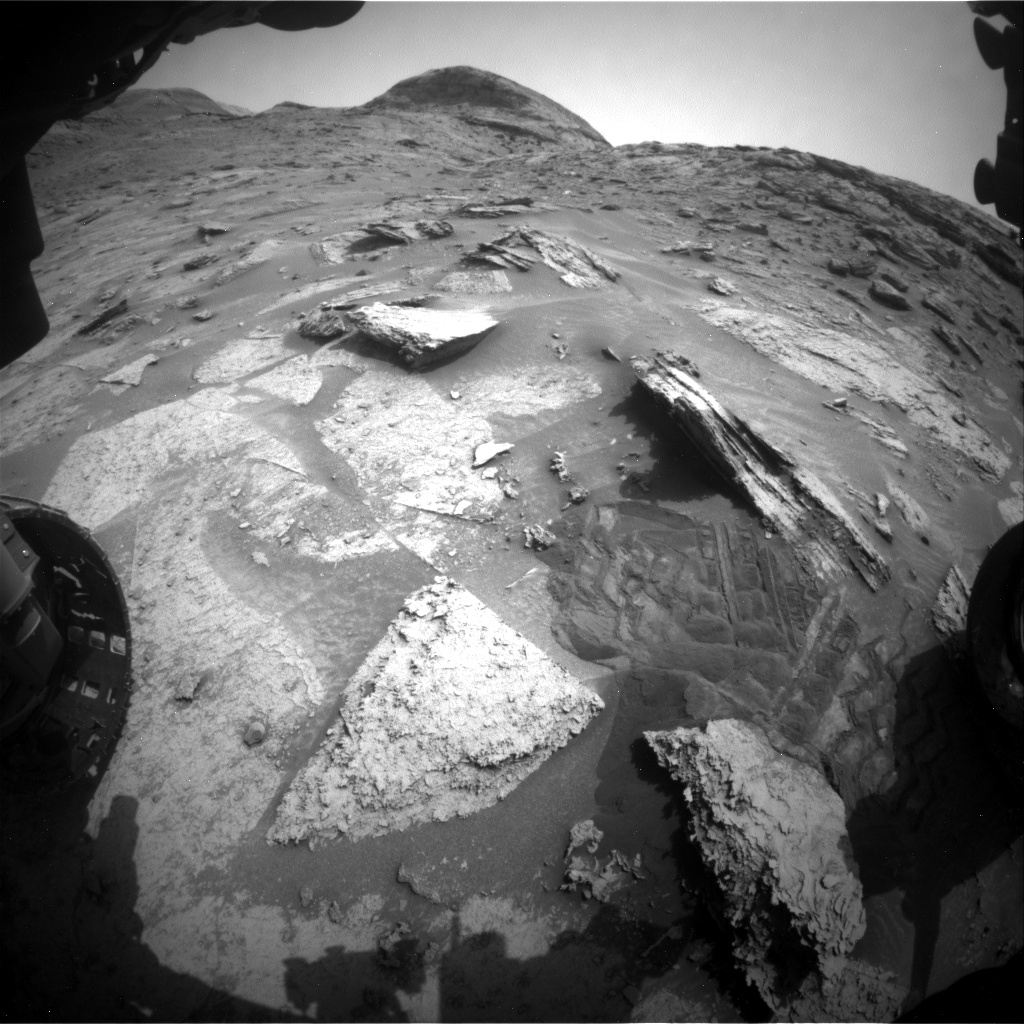
Curiosity Front Hazard Avoidance Left B Camera photo taken on Sol 3461, May 2, 2022.
Credit: NASA/JPL-Caltech
“We have left the pediment behind and are making our way back to an alternate “MSAR” or “Mount Sharp Ascent Route,” reports Catherine O’Connell-Cooper, a planetary geologist at the University of New Brunswick; Fredericton, New Brunswick, Canada.
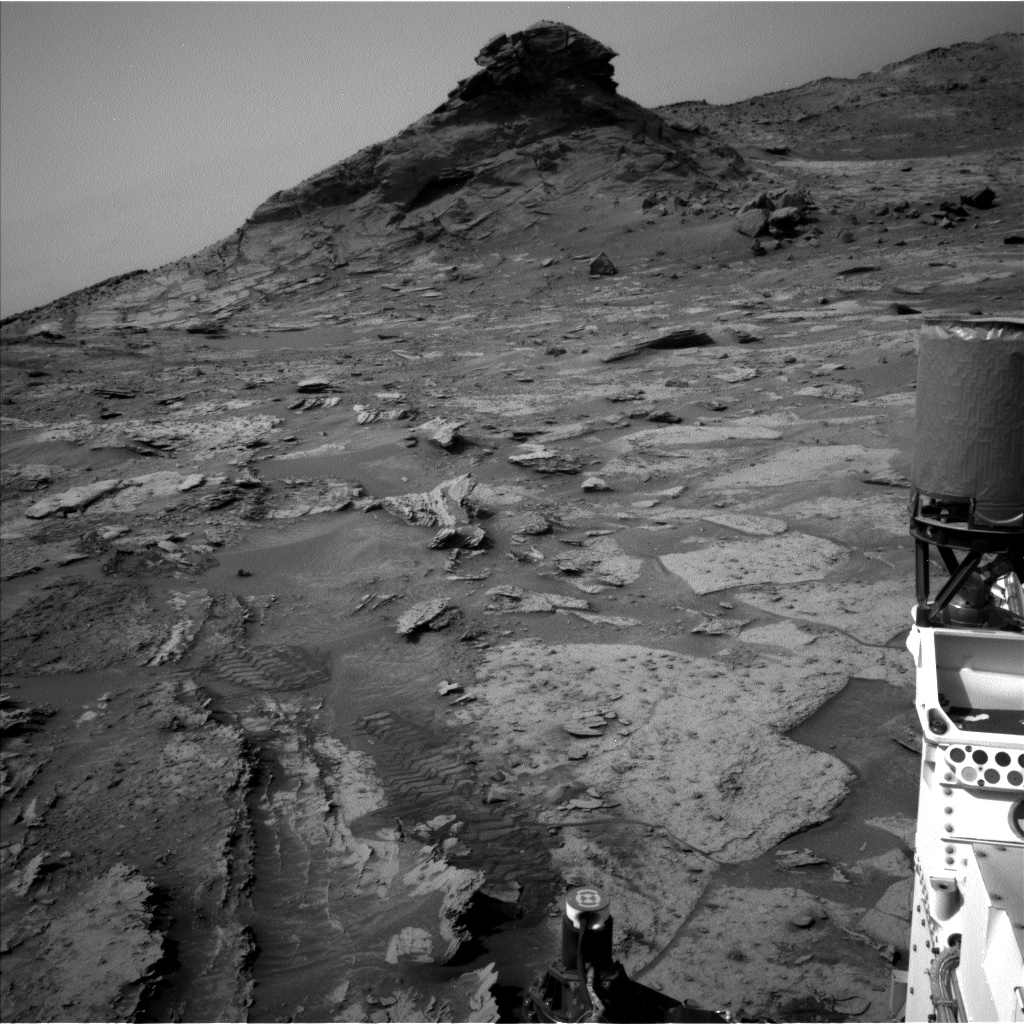
Curiosity Left B Navigation Camera image acquired on Sol 3461, May 2, 2022.
Credit: NASA/JPL-Caltech
“We are at the second (of three) observation stops for this area, chosen as they offer the best chance to acquire high resolution images of the structures in the buttes,” O’Connell-Cooper adds. “We have noticed some dark layers which are reminiscent of the lenses at ‘The Prow’ and may indicate changing grain sizes or depositional environments. In an ideal world, we geologists would just climb up the side of a given butte to thoroughly investigate the layer but sadly, we are not going to be able to walk… or drive the rover… up the side of these buttes, so Mastcam is taking a large (132 frame) mosaic of the ‘Maringma’ butte here at this vantage point.”

Curiosity Left B Navigation Camera image acquired on Sol 3461, May 2, 2022.
Credit: NASA/JPL-Caltech
Low on rocks
The rover’s Chemistry and Camera (ChemCam) is also acquiring a long distance RMI (remote image) of “Tweedbank,” which is one of these dark layers.

Curiosity Left B Navigation Camera image acquired on Sol 3461, May 2, 2022.
Credit: NASA/JPL-Caltech
Although the rover is surrounded by large buttes and rocky hills, the robot’s reachable workspace was recently pretty low on rocks.

Curiosity Left B Navigation Camera image taken on Sol 3462, May 3, 2022.
Credit: NASA/JPL-Caltech
“Fortunately, there are small fragments peeking out from under the sand and dust cover,” O’Connell-Cooper notes, so Alpha Particle X-Ray Spectrometer (APXS) and Mars Hand Lens Imager (MAHLI) were able to get two targets close to each other.
“Castlecraig” is a tilted fragment, with a brighter appearance than surrounding rocks. These targets are often veins (of calcium sulphate) and scientists like to analyze these periodically, as veins can reveal hints about conditions at the time of deposition or later.

Curiosity Left B Navigation Camera image taken on Sol 3462, May 3, 2022.
Credit: NASA/JPL-Caltech
Changes in base bedrock
The second target “Cat Firth” is on more regular bedrock. “Unfortunately, this target is too small to brush off the sand and dirt. However, it appears to be relatively clean, so hopefully will provide good quality APXS measurements on bedrock, so that we can document changes in base bedrock composition too. Mastcam is also imaging some fine laminations in the target “Moorhowe” which is in the workspace but out of reach of the arm,” O’Connell-Cooper points out.

Curiosity Left B Navigation Camera image taken on Sol 3462, May 3, 2022.
Credit: NASA/JPL-Caltech
Continuing the drive
As always, there is ongoing monitoring of the atmospheric opacity and dust levels. On the first night of a recent plan, an APXS environmental measurement was on tap, to monitor argon levels in the atmosphere which change with the seasons.

Curiosity Left B Navigation Camera image taken on Sol 3462, May 3, 2022.
Credit: NASA/JPL-Caltech
“Once all the contact science and imaging are done here, we continue with our drive which is planned to take us to the third observation point, which is actually in the next naming quad – so in this drive, we will say ‘Mar sin leat’ (goodbye in Scots Gaelic) to the Torridon quad and ‘Olá’ (hello in Portuguese) to the ‘Roriama’ quad,” O’Connell-Cooper concludes.

Curiosity Mars Hand Lens Imager photo produced on Sol 3461, May 2, 2022.
Credit: NASA/JPL-Caltech/MSSS
Dates of planned rover activities described in these reports are subject to change due to a variety of factors related to the Martian environment, communication relays and rover status.

Curiosity Right B Navigation Camera image taken on Sol 3462, May 3, 2022.
Credit: NASA/JPL-Caltech
 Posted in Space News

