 By
By  February 4th, 2020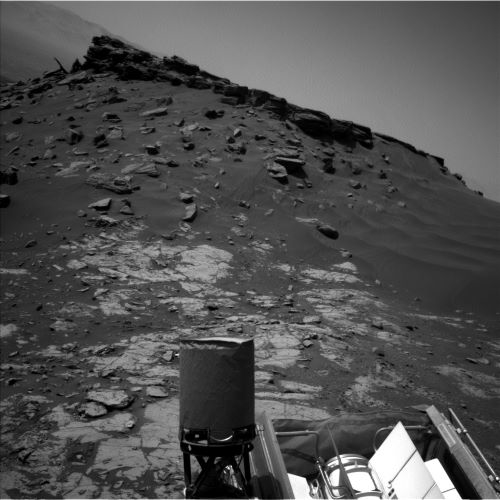
Curiosity Left Navigation Camera image taken on Sol 2661, January 31, 2020.
Credit: NASA/JPL-Caltech
NASA’s Curiosity Mars rover is now performing Sol 2665 tasks.
“It’s not the ground that is tilted, we are!” That’s the report from Abigail Fraeman, a planetary geologist at NASA’s Jet Propulsion Laboratory.

Curiosity Front Hazard Avoidance Camera Left B image taken on Sol 2665, February 4, 2020.
Credit: NASA/JPL-Caltech
Curiosity is near the contact between the clay-bearing “Glen Torridon” unit and the “Greenheugh” pediment, and the rover is parked at a mission-record setting 26.9˚ tilt.

Curiosity Left B Navigation Camera photo acquired on Sol 2664, February 3, 2020.
Credit: NASA/JPL-Caltech
Chemical information
Mars researchers are set to use the rover’s arm and remote sensing instruments to investigate the interesting textures and chemistry of rocks near the contact.
Fraeman says also on tap is use of the robot’s Chemistry and Camera (ChemCam) to collect chemical information from a bedrock target filled with nodules called “Garron Point” and a dark float rock that may have come from the Greenheugh pediment named “Mull of Galloway.”
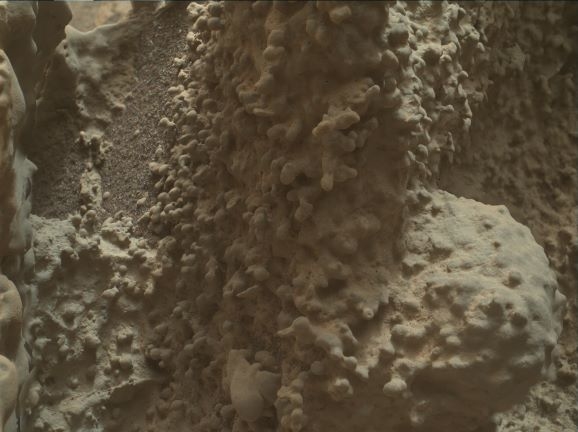
Curiosity Mars Hand Lens Imager photo produced on Sol 2664, February 3, 2020.
Credit: NASA/JPL-Caltech/MSSS
Curiosity Dust Removal Tool (DRT) is in use as is Alpha Particle X-Ray Spectrometer (APXS), the Mars Hand Lens Imager (MAHLI) and ChemCam to make observations of “Berwickshire,” a typical-looking piece of bedrock.
Nodules and veins
APXS and MAHLI will also observe “Cairnbulg,” an area with nodules, and MAHLI will take some images of a vein named “Ross and Cromarty.”
Also on the plan is a Mastcam multispectral observation of Berwickshire and a stereo Mastcam mosaic of the contact between the Greenheugh pediment and Glen Torridon.
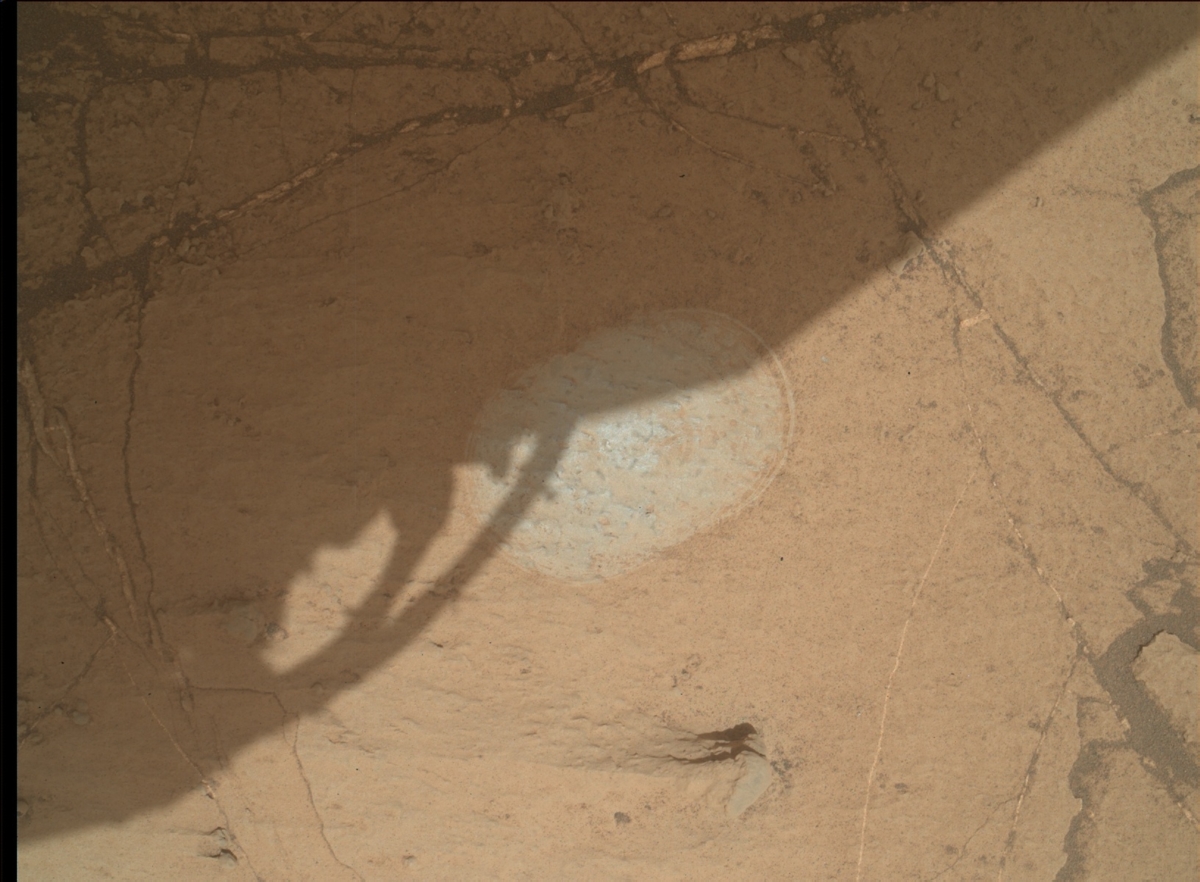
Curiosity Mars Hand Lens Imager photo produced on Sol 2665, February 4, 2020.
Credit: NASA/JPL-Caltech/MSSS
“ChemCam will collect more data from ‘Ramasaig,’ a dark vein near the rover, and ‘St. Monanas,’ another piece of rock with interesting textures,” Fraeman adds. “The rover will also acquire some environmental science observations that will be used to understand atmospheric properties and search for dust devils.”
Drill target
On the plan is a drive by Curiosity towards some flat rock outcrops that are nearby, but which the rover will be able to reach without having to park at such a high tilt.
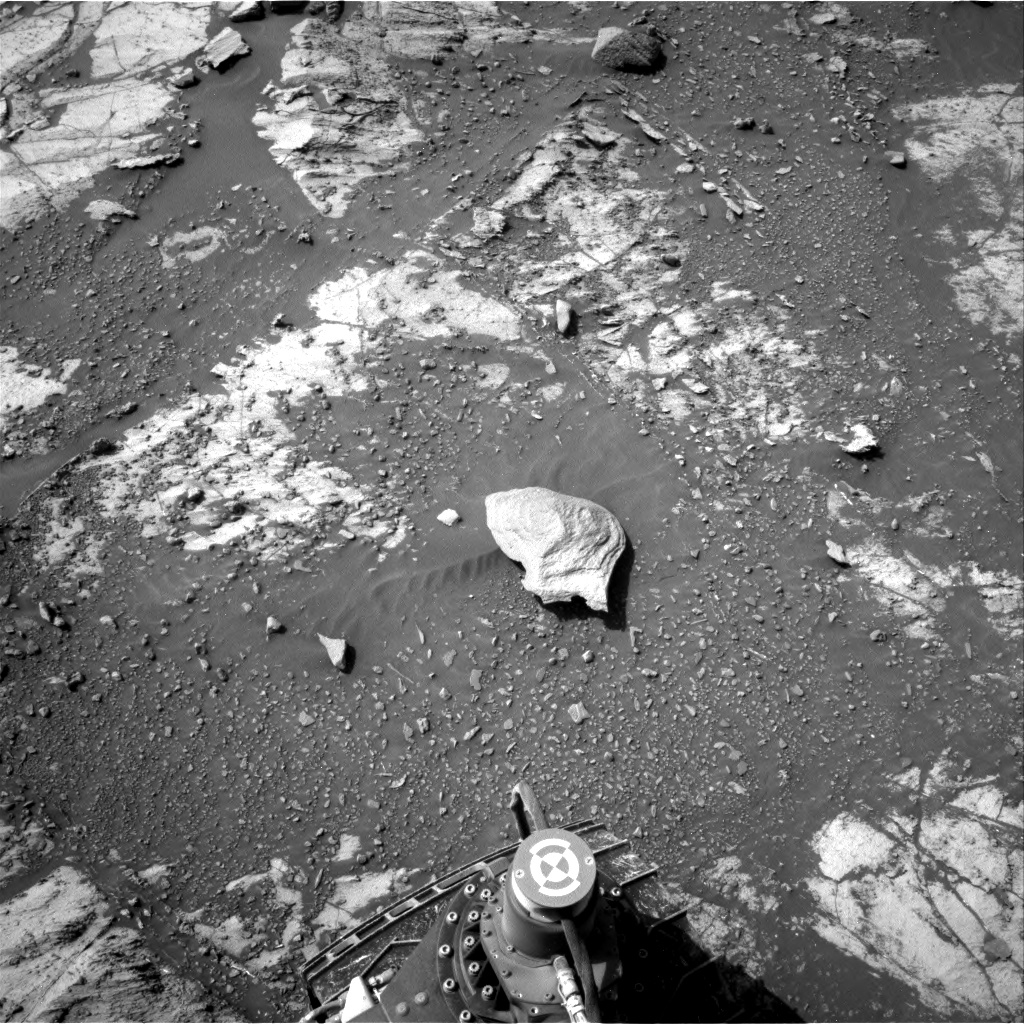
Curiosity Right B Navigation Camera image acquired on Sol 2664, February 3, 2020.
Credit: NASA/JPL-Caltech

Curiosity Right B Navigation Camera image taken on Sol 2665, February 4, 2020.
Credit: NASA/JPL-Caltech
“The observations we collect from this area next week,” Fraeman concludes, “will help us decide whether these flatter rocks would be a good target to drill!”
 Posted in Space News

