 By
By  March 23rd, 2024
Curiosity’s location as of Sol 4132. Distance driven 19.55 miles/31.46 kilometers since landing in Gale Crater on Aug. 5, 2012.
Image credit: NASA/JPL-Caltech/Univ. of Arizona
NASA’s Curiosity Mars rover at Gale Crater is now performing Sol 4134 duties.
The rover is driving south along the eastern edge of the upper Gediz Vallis Ridge or uGVR in geological shorthand, reports Sharon Wilson Purdy, a planetary geologist at the Smithsonian National Air and Space Museum in Washington, D.C.

Curiosity Right B Navigation Camera taken on Sol 4133, March 22, 2024.
Image credit: NASA/JPL-Caltech
Wide range of activities
“The rover drove up to the uGVR last summer and investigated several rocks; now with the beautiful ‘Fascination Turret’ section of the uGVR in sight,” Purdy notes, the team is excited to have another opportunity to “further characterize the material within the ridge and assess the nature of its contact with the underlying Mt. Sharp bedrock.”
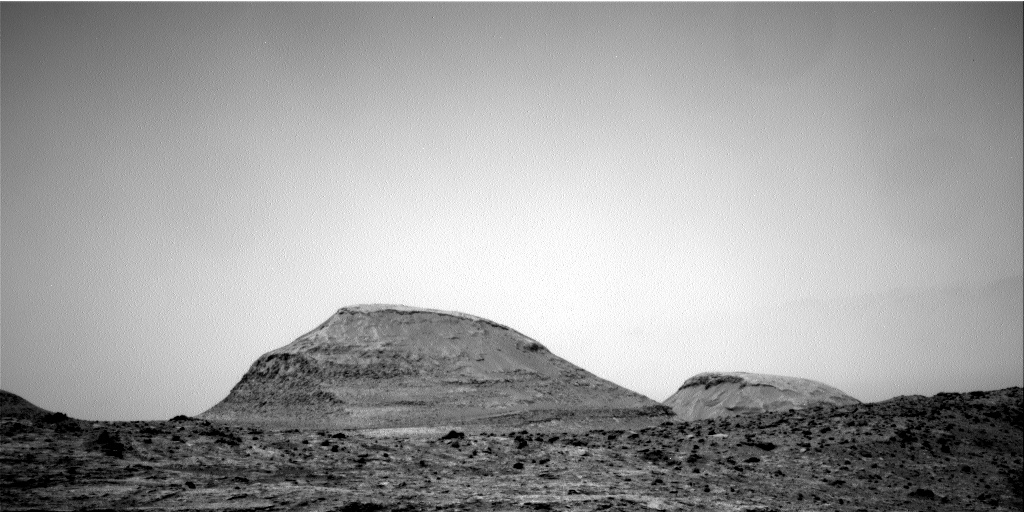
Curiosity Right B Navigation Camera taken on Sol 4133, March 22, 2024.
Image credit: NASA/JPL-Caltech
Purdy notes that the robot’s excellent power situation for a recently scripted two-sol plan (Sols 4132-4133) yielded the ability to do a wide range of activities.

Curiosity Right B Navigation Camera taken on Sol 4133, March 22, 2024.
Image credit: NASA/JPL-Caltech

Curiosity Right B Navigation Camera taken on Sol 4133, March 22, 2024.
Image credit: NASA/JPL-Caltech
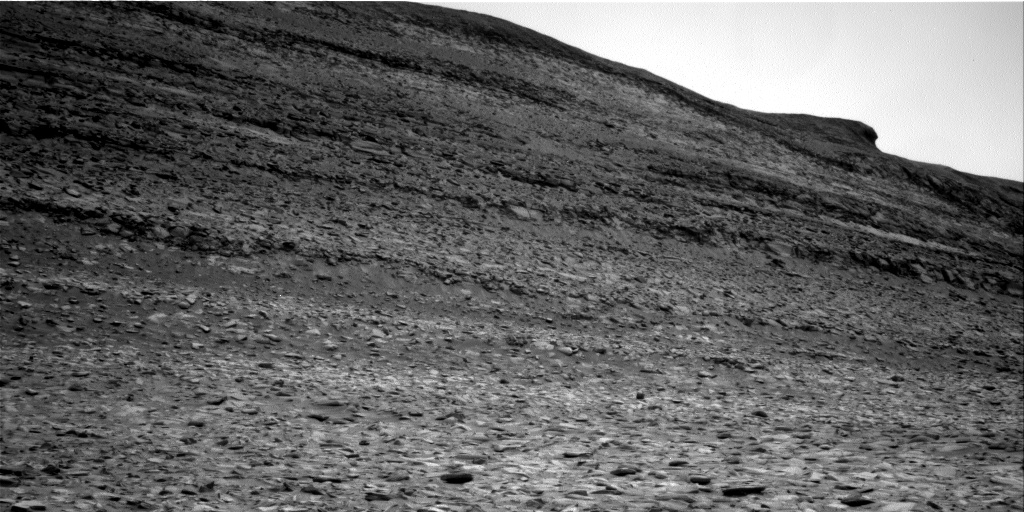
Curiosity Right B Navigation Camera taken on Sol 4133, March 22, 2024.
Image credit: NASA/JPL-Caltech

Curiosity Right B Navigation Camera taken on Sol 4133, March 22, 2024.
Image credit: NASA/JPL-Caltech

Curiosity Right B Navigation Camera taken on Sol 4133, March 22, 2024.
Image credit: NASA/JPL-Caltech
Laminated ridge
In the workspace in front of Curiosity, the Mars Hand Lens Imager (MAHLI) inspected a vertical banded rock with veins at “Col de Doodad.”
“We used the dust removal tool (DRT) and MAHLI to characterize the grain size and material in a flat bedrock target named ‘Three Tooth Doodad,” Purdy adds.
The rover’s Chemistry and Camera (ChemCam) Laser Induced Breakdown Spectroscopy (LIBS) was slated to analyze a laminated ridge within bedrock at the “Kuna Crest” target with Mastcam providing a complementary context image.

Curiosity Right B Navigation Camera taken on Sol 4133, March 22, 2024.
Image credit: NASA/JPL-Caltech
Upcoming route
Mastcam planned stereo mosaics within the workspace were scheduled to document “small-scale laminations and to investigate the nature of subtle variations between light and dark bedrock at the ‘East Vidette’ target. The ‘Giant Forest Mastcam mosaic was scheduled to document interesting fractures in the nearby bedrock,” reports Purdy.
“Looking off in the distance, the plan includes several observations of the Fascination Turret section of the uGVR so we can view it from different angles as we drive along our upcoming route,” Purdy observes.

Curiosity Chemistry & Camera (ChemCam) Remote Micro-Imager (RMI) photo acquired on Sol 4133, March 22, 2024.
Image credit: NASA/JPL-Caltech/LANL

Curiosity Mast Camera (Mastcam) Right image produced on Sol 4132, March 21, 2024.
Image credit: NASA/JPL-Caltech/MSSS
ChemCam was able to fit two long distance Remote Micro-Imager (RMI) photos into the plan that document interesting ledges within Fascination Turret, Purdy says, while Mastcam put together a mosaic of the lower portion of the ridge to evaluate the composition, structure, and its relationship with the underlying bedrock.
“Our plan incorporates several ENV [environment] activities including a dust devil survey, a suprahorizon movie, and a sky survey,” Purdy concludes. “Keep on humming along, Curiosity!”

Curiosity Mast Camera (Mastcam) Right image produced on Sol 4132, March 21, 2024.
Image credit: NASA/JPL-Caltech/MSSS

Curiosity Mast Camera (Mastcam) Right image produced on Sol 4132, March 21, 2024.
Image credit: NASA/JPL-Caltech/MSSS

Dust Removal Tool (DRT) close-up. Curiosity Mast Camera (Mastcam) Right image produced on Sol 4132, March 21, 2024.
Image credit: NASA/JPL-Caltech/MSSS
 Posted in Space News

