 By
By  February 3rd, 2018
Curiosity Front Hazcam Left B image acquired on Sol 1953, February 2, 2018.
Credit: NASA/JPL-Caltech
Now wheeling and dealing with Mars on Sol 1954, NASA’s Curiosity rover operations feel like Groundhog Day, reports Abigail Fraeman, a planetary geologist at NASA/JPL in Pasadena, California.
“Every February 2nd the people of the United States and Canada observe a quirky holiday called Groundhog Day. In the US, the country turns its eyes to Punxsutawney, Pennsylvania to find out whether Punxsutawney Phil, a groundhog, will see his shadow and predict six more weeks of winter,” Fraeman explains.
“The holiday provides the namesake for a 1993 film in which reporter Phil Conners, brilliantly portrayed by Bill Murray, finds himself in a time loop while covering the events in Punxsutawney,” Fraeman adds.

Curiosity Navcam Left B photo taken on Sol 1950, January 30, 2018.
Credit: NASA/JPL-Caltech
Same location
Planning Curiosity’s activities on February 2nd, aka sol 1954 – 1956, “felt a little bit like Groundhog Day on Mars,” Fraeman notes. “Unfortunately the uplink to the rover for the sol 1952 – 1953 failed, so we unexpectedly found ourselves in the same location as Wednesday.”

Curiosity Mastcam Left Sol 1950 January 30, 2018
Credit: NASA/JPL-Caltech/MSSS
The Sol 1953 part of the plan was later uplinked to the rover.
“Never wanting to lose missed opportunities, we made a plan today that will recapture the missing Sol 1952 observations we were hoping to get in Wednesday’s plan, and also adds a few new things into the mix given additional time that is available to us,” Fraeman reports.
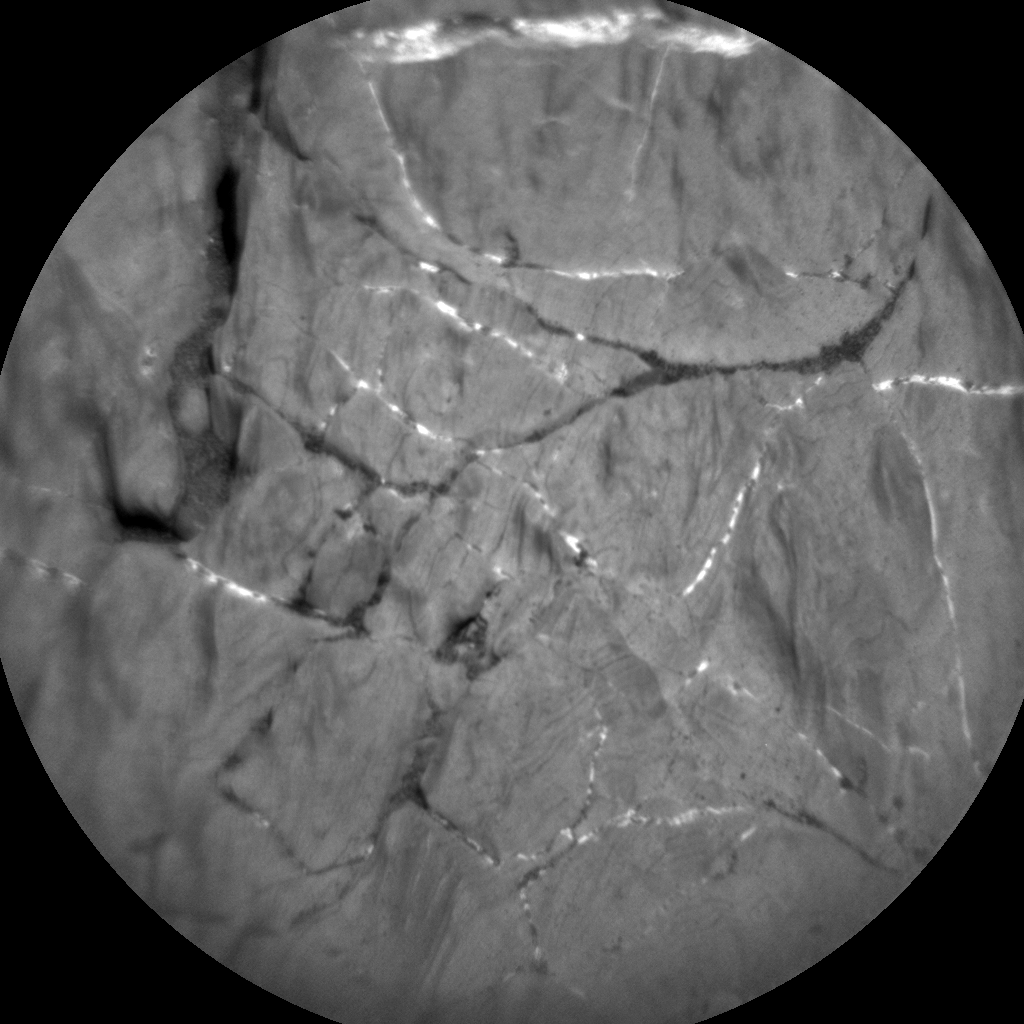
Curiosity ChemCam Remote Micro-Imager photo acquired on Sol 1953, February 2, 2018.
Credit: NASA/JPL-Caltech/LANL
SAM geochronology experiment
The biggest activity of the plan is setting up Curiosity to conduct a Sample Analysis at Mars (SAM) Instrument Suite geochronology experiment next week.
This activity is so power intensive and requires ground in the loop between certain steps, a robot drive will not occur. “We will instead do additional remote sensing with our extra time,”

Curiosity Mars Hand Lens Imager (MAHLI) product from Sol 1950, January 30, 2018.
Image Credit: NASA/JPL-Caltech/MSSS
Broken up rocks
Besides the SAM preparation activities, the main science carried out recently is focused on characterizing the broken up rocks in front of the rover, which are the typical targets on the top of Vera Rubin Ridge.
On tap is using the Mars Hand Lens Imager (MAHLI) on targets “Skara Brae,” “Glen Roy,” and “Drummock.”
Also slated is an observation using Curiosity’s Alpha Particle X-Ray Spectrometer (APXS) of Glen Roy and Skara Brae.

Curiosity Mastcam Left image taken on Sol 1950, January 30, 2018.
Credit: NASA/JPL-Caltech/MSSS
Crater rim mosaic
Additionally, a remote sensing block on the second sol of the plan is scheduled. In this block, the robot will collect Chemistry and Camera (ChemCam) Laser-Induced Breakdown Spectrometer (LIBS) data on Glen Roy, “Harra Ebb,” and “Cocksburnpath,” and a Remote Micro-Imager (RMI) mosaic of “Bloodstone Hill.”
All of the LIBS observations will be accompanied by Mastcam documentation images, Fraeman points out. Additional Mastcam images will be taken of two Autonomous Exploration for Gathering Increased Science (AEGIS) software-selected targets from an earlier plan, documentation of surrounding landscape with multispectral filters, scoping out an outcrop named “Scalpay,” and taking a large 37×2 mosaic of the crater rim.

Curiosity Mastcam Left photo taken on Sol 1950, January 30, 2018.
Credit: NASA/JPL-Caltech/MSSS
The third sol of the plan (Sol 1954-1956) is a morning science block with a Mastcam look at airborne dust, shooting a crater rim movie, a Navcam zenith movie, a Navcam suprahorizon movie, and a Navcam 360 degree sky survey, Fraeman concludes.
 Posted in Space News

