 By
By  August 13th, 2018
Curiosity Mastcam Right photo taken on Sol 2138, August 11, 2018.
Credit: NASA/JPL-Caltech/MSSS
NASA’s Curiosity Mars rover is now performing Sol 2140 duties, and there’s confirmation of new drilling.
“Success at Pettegrove Point,” reports Catherine O’Connell-Cooper, a planetary geologist at the University of New Brunswick, New Brunswick, Canada.
On our third attempt at drilling within the Pettegrove Point member on the Vera Rubin Ridge, we have success! Curiosity has successfully drilled, and generated a pile of drill tailings.
Tailings
At the new Stoer drill hole, the tailings derived from the drill are under observation. A portion characterization is also being done prior to sending samples to the robot’s analytical instruments, the Sample Analysis at Mars (SAM) Instrument Suite and the Chemistry & Mineralogy X-Ray Diffraction/X-Ray Fluorescence Instrument (CheMin).
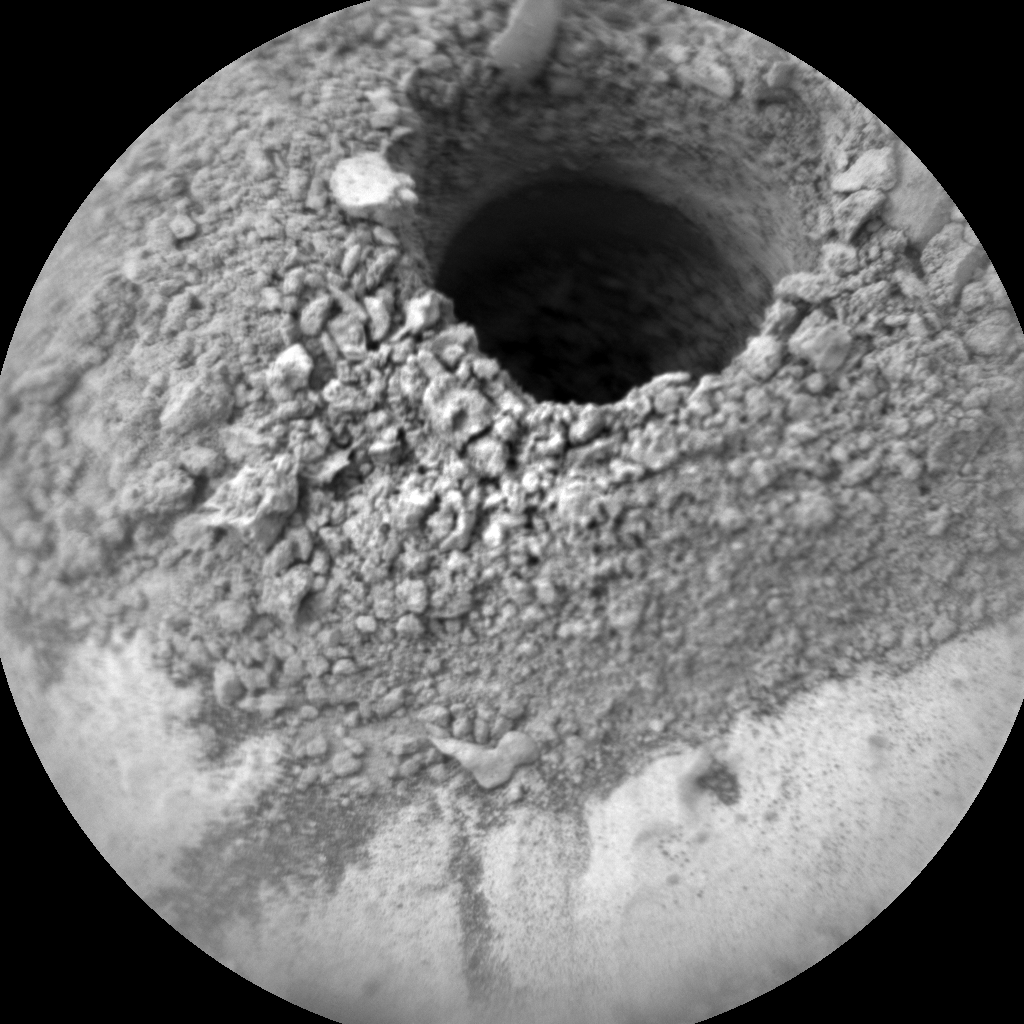
Curiosity ChemCam Remote Micro-Imager photo acquired on Sol 2136, August 9, 2018.
Credit: NASA/JPL-Caltech/LANL
This is being done to ensure that the materials will not pose any threat to the instruments, adds O’Connell-Cooper.
Chemistry and Camera (ChemCam) passive and Mastcam multispectral imaging will be taken of the drill tailings, O’Connell-Cooper explains, “to identify any potential differences between the surface and material from deeper within the drill hole.
The ChemCam laser (LIBS) will be used to characterize the Stoer drill hole and a bedrock target “Greian,” which appears to show some color variations. Mastcam will provide color documentation for Greian.

Curiosity Front Hazcam Right B image acquired on Sol 2139, August 13, 2018.
Credit: NASA/JPL-Caltech
Change detection
O’Connell-Cooper adds that there will also be Mastcam change detection on the drill tailings (to identify if there is any movement of the drill tailings) and continuing change detection on three targets (“Camas Mor,” “Belhelvie” and “Sandray”).
Environmental measurements are also planned to search for both cloud motion and dust devils.
 Posted in Space News

