 By
By  May 21st, 2023
Curiosity Mars Hand Lens Imager (MAHLI) photo produced on Sol 3834, May 20, 2023.
Image credit: NASA/JPL-Caltech/MSSS
NASA’s Curiosity Mars rover at Gale crater is now performing Sol 3835 duties.
There has been confirmation of the success of the sample drop-off to the robot’s Sample Analysis at Mars (SAM) Instrument Suite and the start of the Evolved Gas Analysis (EGA).
“So for now, we’re still in a planning holding pattern until SAM decides if the Ubajara drill sample is tasty enough for further analysis,” reports Natalie Moore, a mission operations specialist at Malin Space Science Systems in San Diego, California.

Curiosity Mars Hand Lens Imager (MAHLI) photo produced on Sol 3835, May 21, 2023.
Image credit: NASA/JPL-Caltech/MSSS
Veins/nodules
“Something I’ve noticed at Ubajara is that everyone’s excited about the surrounding geological contacts and chemically-interesting veins/nodules in the bedrock around us,” Moore adds. “We’re also at a high vantage point of our traversed path, including Marker Band valley and its towering buttes like Deepdale, Bolivar, Amapa, and Chenapau – not to mention the crater rim shining through the fairly low atmospheric opacity. All of this visible diversity means our remote science teams are eager to fill up the plan as much as our battery will let us.”

Curiosity Front Hazard Avoidance Right B Camera image acquired on Sol 3835, May 21, 2023.
Image credit: NASA/JPL-Caltech
A recently scripted two-sol plan (Sols 3832-3833) was slated to start off with a Mastcam multispectral of the Jardinopolis dark vein target the rover’s Chemistry and Camera (ChemCam) shot with Laser Induced Breakdown Spectroscopy (LIBS) on sol 3830.
Rim shots
“ChemCam is using their one-LIBS-per-sol on a bedrock target named “Les Trois Dents” and treating the clear atmosphere as an opportunity to get high-resolution imaging of the crater rim,” Moore explains, “supplementing Mastcam’s most recent observation on sol 3830.”

Curiosity Right B Navigation Camera photo taken on Sol 3835, May 21, 2023.
Image credit: NASA/JPL-Caltech
Evening and night of sol 3832 is to feature environmental data collection from the Radiation Assessment Detector (RAD) and the Rover Environmental Monitoring Station (REMS) and pick up in the afternoon of sol 3833 with more Mastcam images of the atmosphere for tau measurements, the drill fines for measuring wind presence, and the ChemCam LIBS shots for color context.
“ChemCam will shoot the same block we drilled on a target named ‘Madeira’ for spectral diversity, and Navcam will take horizon movies to watch for any dust devils,” Moore reports.
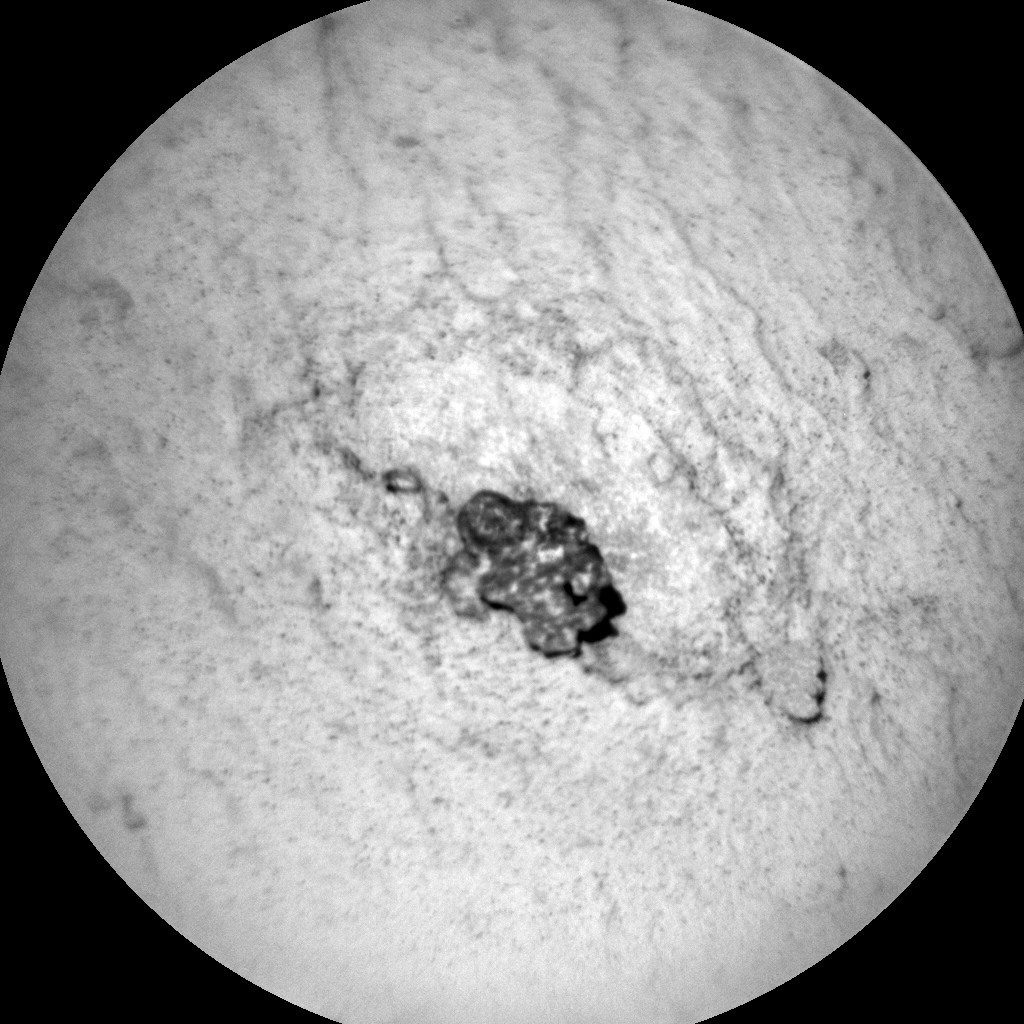
Curiosity Chemistry & Camera (ChemCam) Remote Micro-Imager (RMI) photo taken on Sol 3835, May 21, 2023.
Image credit: NASA/JPL-Caltech/LANL
Decision point
The plan was to finish with more environmental measurements and another Chemistry & Mineralogy X-Ray Diffraction/X-Ray Fluorescence Instrument (CheMin) analysis of some Ubajara drill sample to see if chemistry results differ over time.
“Our next plan’s fate now rests in the hands of the SAM team: to continue analyzing or wrap up this campaign and move on,” Moore concludes.
 Posted in Space News

