 By
By  August 24th, 2020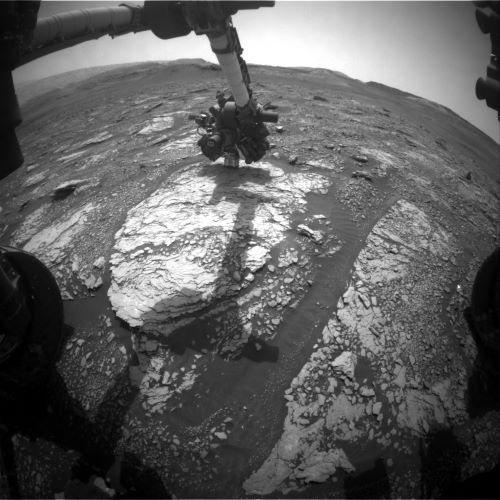
Curiosity Front Hazard Avoidance Camera Left B image taken on Sol 2861, August 23, 2020.
Credit: NASA/JPL-Caltech
NASA’s Curiosity Mars rover is now carrying out Sol 2862 tasks.
“Curiosity is still at the “Mary Anning” drill location, investigating the chemistry and sedimentary structures in this vicinity,” reports Lauren Edgar, a planetary geologist at the USGS Astrogeology Science Center in Flagstaff, Arizona.

Fossil hunter Mary Anning and faithful dog.
Courtesy: Biodiversity Heritage Library
“As we continue to dig into the science at this location, the team is having some fun with naming targets. Today the team decided to name a nearby ChemCam target ‘Tray,’ after paleontologist Mary Anning’s faithful dog who helped her with fossil hunting,” Edgar adds.

UAE’s Hope Mars orbiter.
Credit: UAE Space Agency
DSN support
It is actually the dog days of spring for Curiosity in the southern hemisphere of Mars.
A big last weekend plan involved 4 sols instead of the usual 3, due to Deep Space Network (DSN) support the Mars 2020 and Emirates Mars orbiter missions that are en route to Mars.
The first sol of a 4-sol plan — Sols 2860-2863 – was to kick off with a midday science block for Mastcam deck monitoring, a change detection observation of some nearby ripples, and a Mastcam mosaic to document local troughs and patterned ground.
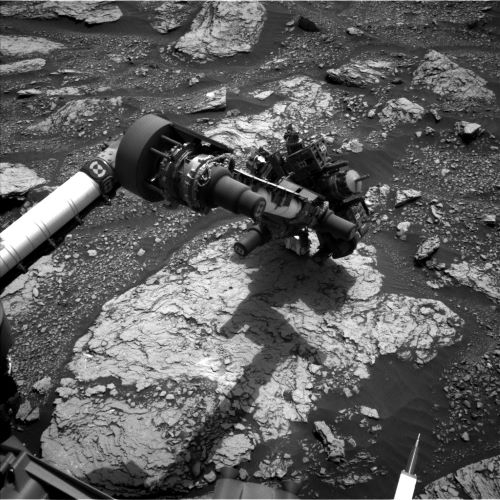
Curiosity Left B Navigation Camera photo acquired on Sol 2861, August 23, 2020.
Credit: NASA/JPL-Caltech
In the evening, the rover’s Chemistry and Camera (ChemCam) was on tap to do a planned dark spectra experiment, which is a nighttime test for the CCD dark level.
Atmospheric opacity
“The second sol includes a ChemCam passive observation of the sky to assess water vapor and dust in the atmosphere, along with several other environmental monitoring activities to characterize atmospheric opacity, search for clouds, and constrain aerosol scattering,” Edgar explains.
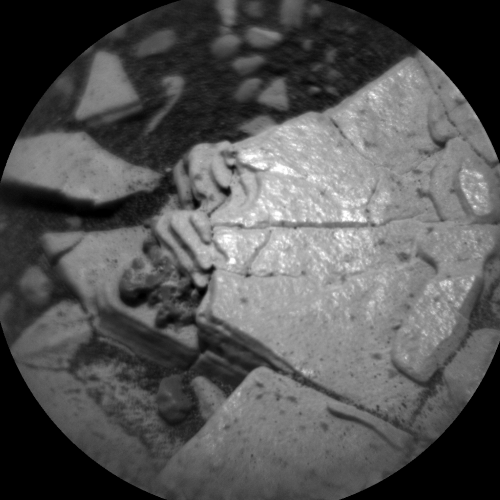
Curiosity Chemistry & Camera Remote Micro-Imager (RMI) photo taken on Sol 2859, August 21, 2020.
Credit: NASA/JPL-Caltech/LANL
The third sol starts with a big science block, including a Mastcam multispectral observation of the second site that scientists plan to drill at Mary Anning, a few different change detection observations of ripples and troughs, ChemCam observations of bedrock targets “Tain” and “Tray,” and additional environmental observations.
Dark nodules
Also planned is use of the robot’s Mars Hand Lens Imager (MAHLI) to image some dark nodules at the target “Falkirk Wheel” and the rover’s Alpha Particle X-Ray Spectrometer (APXS) will investigate its chemistry.
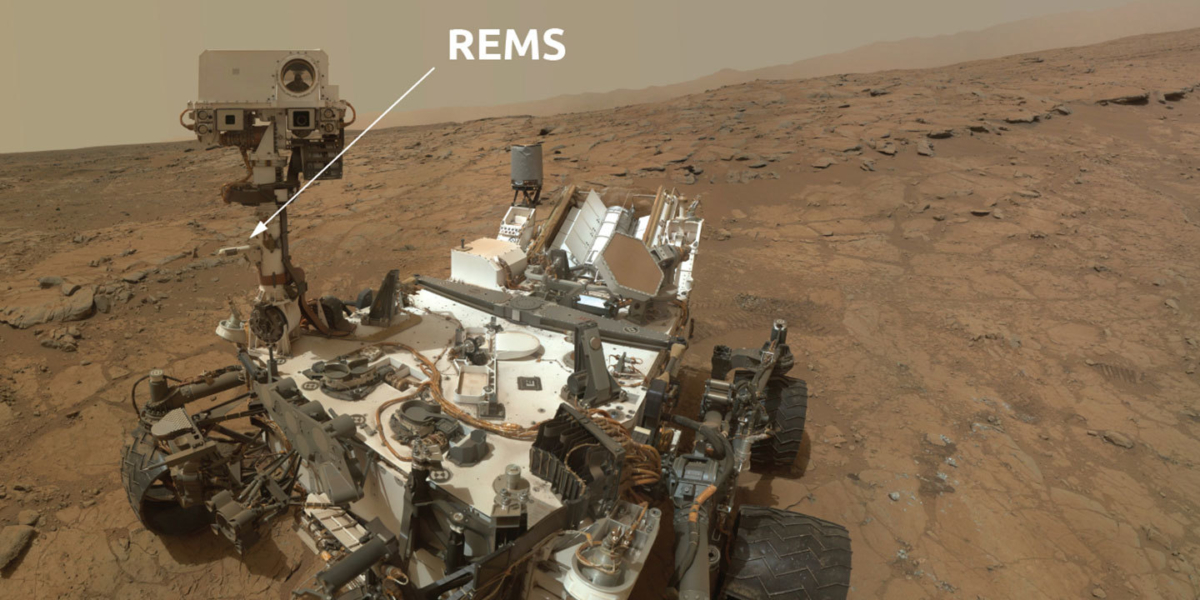
The Rover Environmental Monitoring Station is nicknamed REMS, and it contains all the weather instruments needed to provide daily and seasonal reports on meteorological conditions around the rover.
Spain’s Centro de Astrobiologia (CAB), a joint center of Consejo Superior de Investigaciones Cientificas – Instituto Nacional de Tecnica Aeroespacial (CSIC-INTA), provided a weather monitoring station contributed by the Spanish government.
Credit: NASA/JPL-Caltech
Early in the morning of Sol 2863 Curiosity will conduct more atmospheric monitoring with Mastcam and Navcam, and then most of the 4th sol will be devoted to Rover Environmental Monitoring Station (REMS) observations, Edgar reports.
Throughout the plan there are also a number of Mars Descent Imager (MARDI) change detection activities, Edgar concludes, to try to better constrain when the wind is moving sand grains around.
 Posted in Space News

