 By
By  September 18th, 2016
Mars Hand Lens Imager (MAHLI) taken on September 17, 2016, Sol 1463.
Credit: NASA/JPL-Caltech/MSSS
Now in Sol 1464, Curiosity’s Mars roving continues, although late last week the robot’s drilling activities did not complete as expected. The intended drill target is “Quela.”

Mars Hand Lens Imager (MAHLI) image taken on September 17, 2016, Sol 1463.
Credit: NASA/JPL-Caltech/MSSS
Given the drill issues, the plan focused on trying to understand and troubleshoot the problem while also doing remote sensing, reports Ryan Anderson, a planetary scientist at the USGS Astrogeology Science Center in Flagstaff, Arizona.
Nearby butte
The plan as scripted called for starting off with Mastcam multispectral observations of the target “Ekunha” on the nearby butte.
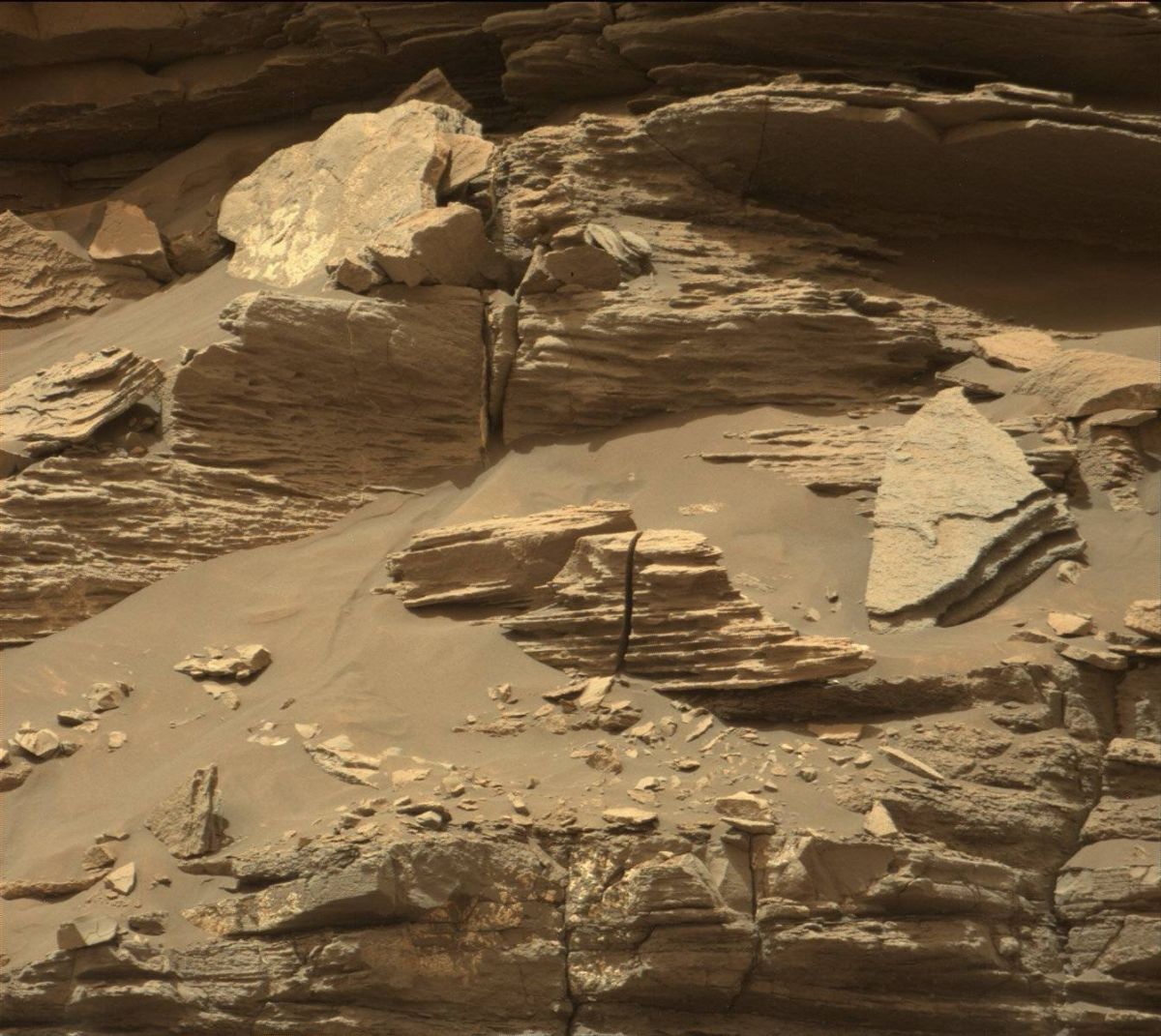
Curiosity Mastcam Right image taken on Sol 1462, September 16, 2016.
Credit: NASA/JPL-Caltech/MSSS
Chemistry & Camera (ChemCam) work was slated to analyze the targets “Cuasa” and “Cuimba”, and then Mastcam was to document those targets and take an 8×3 mosaic of the butte, along with a change detection observation at “Goantagab.”
Also on tap, the robot’s Mastcam was to create a mosaic of the target “Karasburg” to help with planning contact science, and then in the morning of Sol 1463 Mastcam was producing another mosaic of the nearby butte, under different lighting, and Navcam was to acquire an atmospheric measurement.
Sunlight scattering
“Throughout the whole plan, there are also a number of joint Navcam and Mastcam photometry observations of the same location at different times of day to help understand how sunlight scatters off the surface,” Anderson reports.

Curiosity Navcam Left B image taken on Sol 1463, September 17, 2016.
Credit: NASA/JPL-Caltech
A quick survey of incoming Curiosity imagery points to assembly of yet another “selfie” that shows the current whereabouts of the Mars machinery and its surrounding terrain.
 Posted in Space News

