 By
By  October 28th, 2021
Curiosity’s location as of Sol 3279. Since landing in August 2012, the rover’s distance driven is 16.45 miles/26.47 kilometers.
Credit: NASA/JPL-Caltech/Univ. of Arizona
NASA’s Curiosity Mars rover at Gale Crater is now performing Sol 3280 duties.
A pre-drive contact science target is “Rhue,” a bright white vein – one of the largest seen, reports Ashley Stroupe, a mission operations engineer at NASA’s Jet Propulsion Laboratory.
On tap is taking short Alpha Particle X-Ray Spectrometer (APXS) integrations as well as Mars Hand Lens Imager (MAHLI) imaging of the vein.
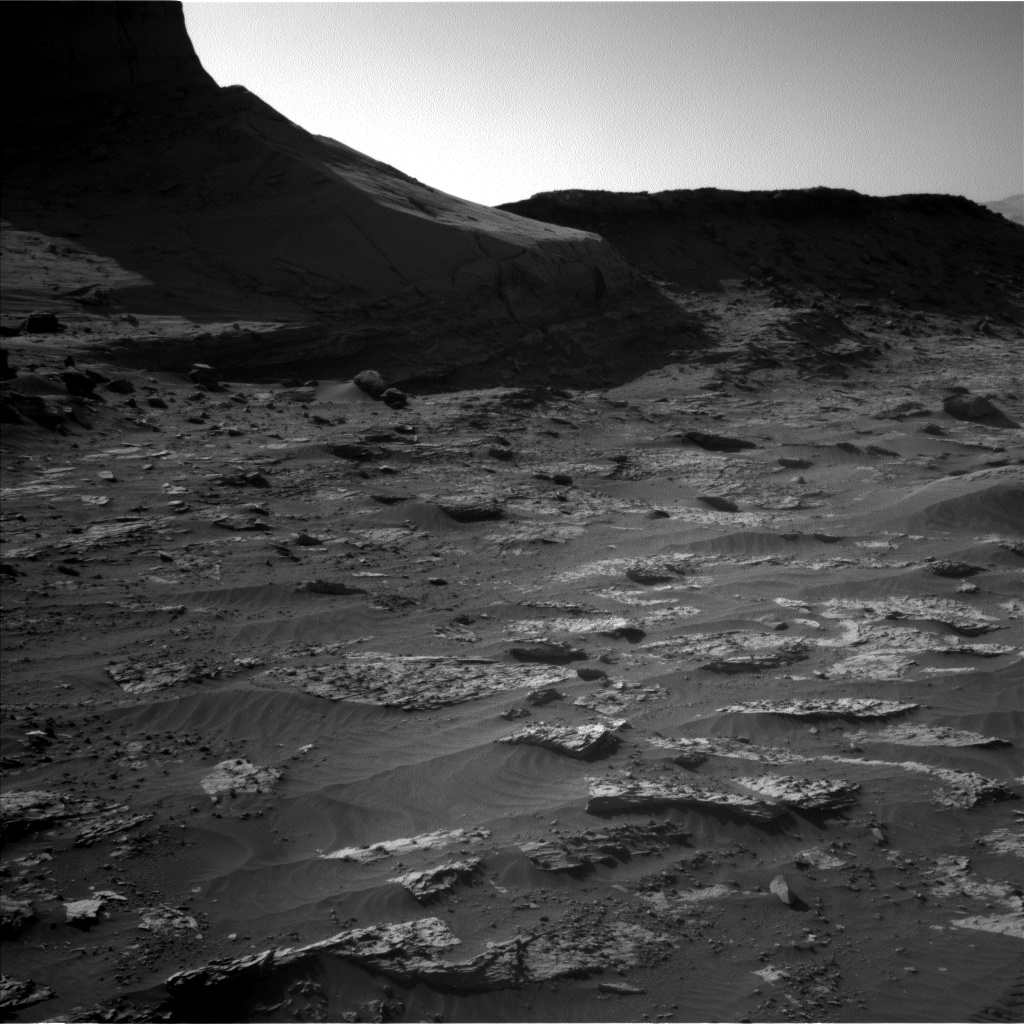
Terrain continues to be challenging, with large boulders, sharp rocks that are wheel hazards, and sand ripples.
Image taken by Left Navigation Camera on Sol 3279, October 27, 2021.
Credit: NASA/JPL-Caltech
“Unlike the really tiny veins that we normally see, this is one is so large enough that we should be able to target it well and accurately,” Stroupe adds.
With and without veins
After robotic arm activities, Mars researchers have a series of targeted science observations.
They are looking at the target “Bludgers Revelation,” a typical bedrock target, with both the Chemistry and Camera (ChemCam) Remote Micro-Imager (RMI) and the robot’s Mastcam.
“We are also taking multispectral mosaics of some nearby features, including a regolith fracture, a laminated rock, and additional bedrock targets (both with and without veins). We are also taking a Navcam suprahorizon movie, looking off to the south,” Stroupe explains.

Curiosity Front Hazard Avoidance Camera Right B image taken on Sol 3280, October 28, 2021.
Credit: NASA/JPL-Caltech
Strategic route
Curiosity’s drive is taking scientists back toward the planned strategic route, and gets them closer to the area they are targeting for the next drill campaign.

Curiosity Left B Navigation Camera photo taken on Sol 3280, October 28, 2021.
Credit: NASA/JPL-Caltech
“This drive should leave us with bedrock in the workspace for additional contact science on the weekend. This terrain continues to be very challenging, with large boulders, sharp rocks that are wheel hazards, and sand ripples, Stroupe adds. “These drives take a while to plan to make sure we are avoiding all the hazards while getting to where science wants to go. Our paths end up looking a little ‘drunk’ as we weave our way around obstacles.”

Parts of Rafael Navarro Mountain can be seen to the left, while more local hills that will be blocking Curiosity’s view of Rafael Navarro Mountain in the near future are visible on the right. Curiosity Left Navigation Camera image taken on Sol 3278.
Credit: NASA/JPL-Caltech.
On the second sol of the plan (Sol 3281), another methane experiment with the Sample Analysis at Mars (SAM) Instrument Suite is planned.
“This is part of our periodic campaign to monitor atmospheric methane and understand seasonal variations. We don’t have anything else on this sol of the plan to preserve power for the weekend plan.”

Curiosity Left B Navigation Camera photo taken on Sol 3280, October 28, 2021.
Credit: NASA/JPL-Caltech
Southward drive
Reports Mark Salvatore, a planetary geologist at the University of Michigan, it is “so long, Rafael Navarro Mountain.”
“Since the early part of 2021, Curiosity has been continuing her drive up Mt. Sharp with the roughly 460 foot (140 meters) tall Rafael Navarro Mountain as a familiar reference point,” Salvatore explains.

Curiosity Left B Navigation Camera photo taken on Sol 3280, October 28, 2021.
Credit: NASA/JPL-Caltech
“Now that we have ascended a significant portion of Mt. Sharp and have started a southward drive to approach the Greenheugh Pediment, we are about to lose sight of parts of Rafael Navarro Mountain behind some other hills for the foreseeable future,” Salvatore adds. “Before we lose this view, however, Curiosity is prioritizing some long-distance imaging of Rafael Navarro Mountain to make sure that we don’t miss out on any interesting and valuable observations.”

Curiosity Left B Navigation Camera photo acquired on Sol 3280, October 28, 2021.
Credit: NASA/JPL-Caltech
Heavily fractured
Curiosity operations include science operations with some arm activities, including MAHLI imaging and APXS chemistry measurements of the “Ashlar” target, which is a finely laminated sedimentary rock that is heavily fractured with veins and potential nodules.

Curiosity Left B Navigation Camera photo taken on Sol 3280, October 28, 2021.
Credit: NASA/JPL-Caltech
Following arm activities, Curiosity was set to conduct a handful of remote sensing activities, including acquiring a multispectral image of the “Denburn” float rock target, a ChemCam Laser Induced Breakdown Spectroscopy (LIBS) measurement of the Ashlar bedrock target, and several Mastcam mosaics of targets including near-field layering, the Greenheugh Pediment, and Siccar Point.
Fleeting vantage point
Lastly, ChemCam will be used to acquire a high-resolution imaging mosaic of Rafael Navarro Mountain from the robot’s fleeting vantage point.
After another drive to the south, Salvatore concludes, Curiosity was scheduled to acquire a standard suite of post-drive imaging before standing down for the evening and recharging before the next sol’s science activities.
 Posted in Space News

