 By
By  November 12th, 2020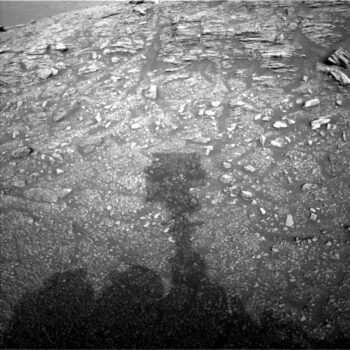
Curiosity is now parked in front of a “bench” outcrop. Taken by the rover’s Left B Navigation Camera image taken on Sol 2938, November 11, 2020.
Credit: NASA/JPL-Caltech
NASA’s Curiosity Mars rover is now performing Sol 2940 tasks.
Curiosity is now parked in front of a beautiful “bench” outcrop, reports Ashley Stroupe, a mission operations engineer at NASA’s Jet Propulsion Laboratory.
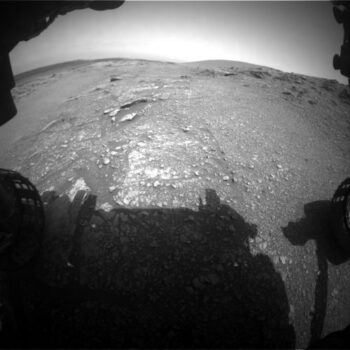
Curiosity Front Hazard Avoidance Camera Left B image acquired on Sol 2939, November 11, 2020.
Credit: NASA/JPL-Caltech
“The benches in this area are raised relative to the nearby surroundings, indicating that they are more resistant to erosion than the surrounding rock. Investigating the compositions to explain this difference is one of the current science objectives, requiring us to investigate both the bench and the flatter ground nearby to compare,” Stroupe adds.
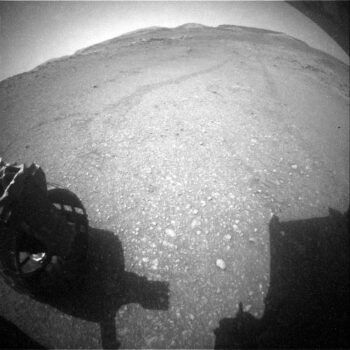
Curiosity Rear Hazard Avoidance Camera Right B image taken on Sol 2939, November 11, 2020.
Credit: NASA/JPL-Caltech
Contact science
Mars research scientists are planning an extensive menu of activities for the robot in a two sol plan: 2940-2941.
“First, we’re going to do some contact science on a target called ‘West Loch,’ which is a target on this apparently less resistant material near the base of the bench,” Stroupe notes. “While most of the workspace is fairly broken up, making most of the rocks too small for the rover planners to accurately target, this pebble is large enough to place the arm on and get good contact.”
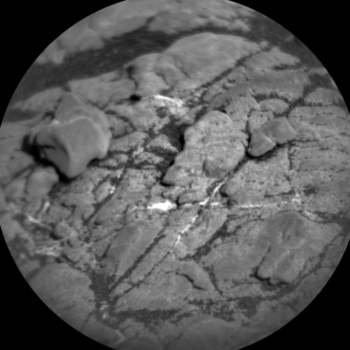
Curiosity Chemistry & Camera
Remote Micro-Imager (RMI) photo taken on Sol 2939, November 11, 2020.
Credit: NASA/JPL-Caltech/LANL
This object is still not big enough to safely or effectively brush, so Mars researchers are only making Mars Hand Lens Imager (MAHLI) and Alpha Particle X-Ray Spectrometer (APXS) observations on the dusty surface.
Short drive
Along with the APXS and MAHLI observations, also on tap is targeted science with Chemistry and Camera (ChemCam) and Mastcam at three targets (“Bood,” “Black Mire,” and “Dale”) in and near the workspace to better characterize this less resistant layer, Stroupe points out.
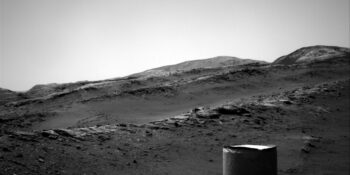
Curiosity Right B Navigation Camera image acquired on Sol 2939, November 11, 2020.
Credit: NASA/JPL-Caltech
When all the imaging is complete, the rover will do a short drive of about 20-23 feet (6-7 meters) to get the vertical surface of the bench into reach for the arm.
“After the drive, we expect to be parked on the slope of the bench. We’ll be taking lots of up-close imaging of the bench to help us target in the weekend plan,” Stroupe reports. “This will allow us to do contact and targeted science observations on the resistant layers, which can then be compared to today’s analyses.”
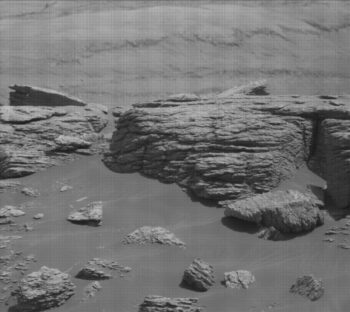
Curiosity Mast Camera Right photo taken on Sol 2938, November 10, 2020.
Credit: NASA/JPL-Caltech/MSSS
Untargeted science
The second sol of plan will be untargeted science, including a two-target ChemCam Autonomous Exploration for Gathering Increased Science (AEGIS) observation, which will allow the rover to pick its own targets to image and investigate with the Laser Induced Breakdown Spectroscopy (LIBS).
“Also included are several environmental and atmospheric observations, to continue our tracking of the dusty conditions, including a Mastcam tau sun observation and a Navcam line of site image, both to look at the amount of dust in the atmosphere, and a dust devil movie,” Stroupe concludes.

Curiosity took this selfie at a site nicknamed “Mary Anning” where the robot snagged three samples of drilled rock on its way out of the Glen Torridon region, which scientists believe preserves an ancient habitable environment.
Credit: NASA/JPL-Caltech/MSSS
 Posted in Space News

