 By
By  July 10th, 2021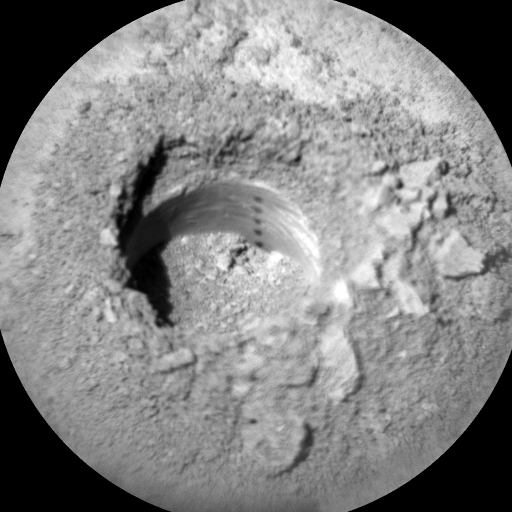
Curiosity Chemistry & Camera Remote Micro-Imager (RMI) photo acquired on Sol 3173, July 10, 2021. Laser blasts are visible inside the drill hole.
Credit: NASA/JPL-Caltech/LANL
NASA’s Curiosity Mars rover at Gale Crater is now performing Sol 3173 tasks.
The rover is working with the latest drill sample from the 32nd hole on Mars, “Pontours.”
Ken Herkenhoff, Planetary Geologist at the USGS Astrogeology Science Center in Flagstaff, Arizona, reports that the robot’s Chemistry & Mineralogy X-Ray Diffraction/X-Ray Fluorescence Instrument (CheMin) assessed some of the drill sample.
The CheMin team decided to dump the sample and clean out the cell in preparation for future mineralogical analyses, Herkenhoff adds.
Curiosity’s Sample Analysis at Mars (SAM) Instrument Suite was to undergo preconditioning to analyze the Pontours drill sample.
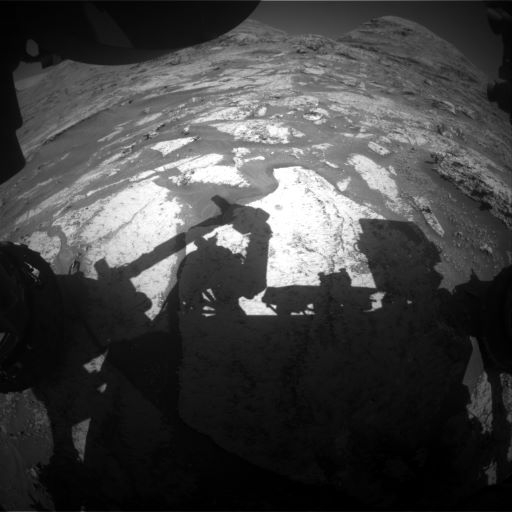
Curiosity Front Hazard Avoidance Camera Left B image taken on Sol 3173, July 10, 2021.
Credit: NASA/JPL-Caltech
Weekend workout
“Once the path forward was agreed upon and the high-priority CheMin and SAM activities scheduled, the uplink team turned to planning other activities, of which there are many,” Herkenhoff notes.
On Sol 3173, Mastcam is set to acquire multispectral images of “Chanterac,” a potential Alpha Particle X-Ray Spectrometer (APXS) target, before the robot’s Chemistry and Camera uses its laser to analyze the wall of the Pontours drill hole and acquires spectra of freshly disturbed sand at “Cendrieux.”
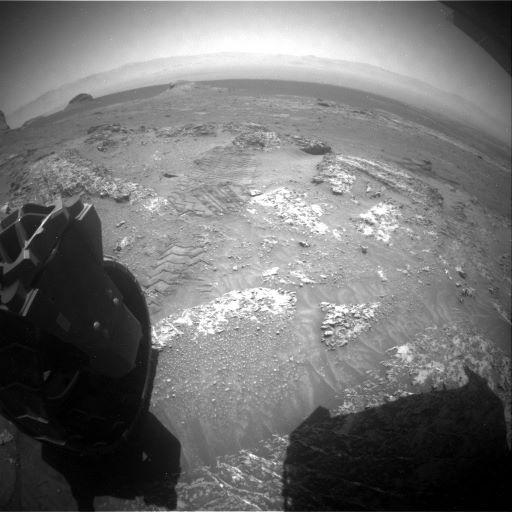
Curiosity Rear Hazard Avoidance Camera Left B image acquired on Sol 3173, July 10, 2021.
Credit: NASA/JPL-Caltech
The rover’s Mastcam is documenting the Laser Induced Breakdown Spectroscopy (LIBS) holes in Pontours, Herkenhoff reports, and take a 12×2 stereo mosaic of fractured and lineated terrain dubbed “Le Coly.”
Finally, CheMin is set to dump the drill sample.
Nodule target
Also on tap, Sol 3174 observations with Navcam searching for dust devils and measuring dust in the lower part of the atmosphere.
Then Mastcam is to acquire a 10×1 stereo mosaic of possible alteration features at “Bussac” before ChemCam uses LIBS again, this time on a bedrock block with lots of nodules called “Archignac.”
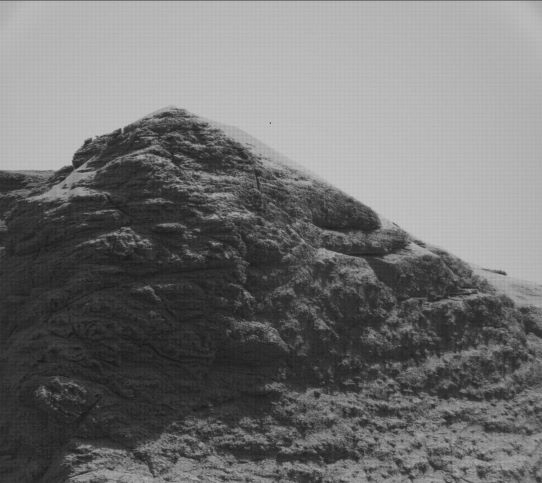
Curiosity Mast Camera Right photo taken on Sol 3172, July 9, 2021.
Credit: NASA/JPL-Caltech/MSSS
ChemCam will also acquire spectra of another nodular target called “Fergeas” and the Right Mastcam will document the LIBS spots on Archignac. The rover will then take a nap before the SAM preconditioning in the evening, Herkenhoff points out.
A Sol 3175 plan begins with a Navcam dust devil movie and Mastcam measurements of dust in the atmosphere above the rover.
ChemCam will then fire its laser again, this time at “Augignac,” another nodular bedrock target, followed by Right Mastcam documentation of the LIBS spots.
Mt. Sharp layering
Later in the afternoon, when lighting of targets east of the rover will be better, the ChemCam Remote Micro-Imager (RMI) will take a 10×1 mosaic of layering in the flank of Mt. Sharp.
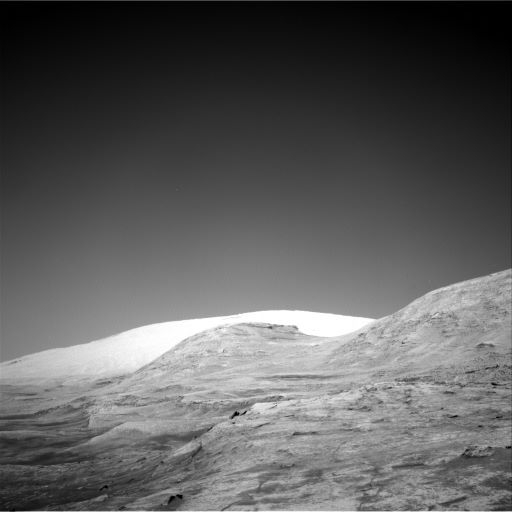
Curiosity Right B Navigation Camera image taken on Sol 3172, July 9, 2021.
Credit: NASA/JPL-Caltech
Mastcam will then acquire a 4×1 stereo mosaic of the layering, and Navcam will survey the sky.
“Early in the morning of Sol 3176, Navcam will search for clouds and again measure the dust in the lower part of the atmosphere. Finally, Mastcam will also measure dust at various levels in the atmosphere,” Herkenhoff concludes. If all goes well, Curiosity will be very busy this weekend!
 Posted in Space News

