 By
By  August 6th, 2016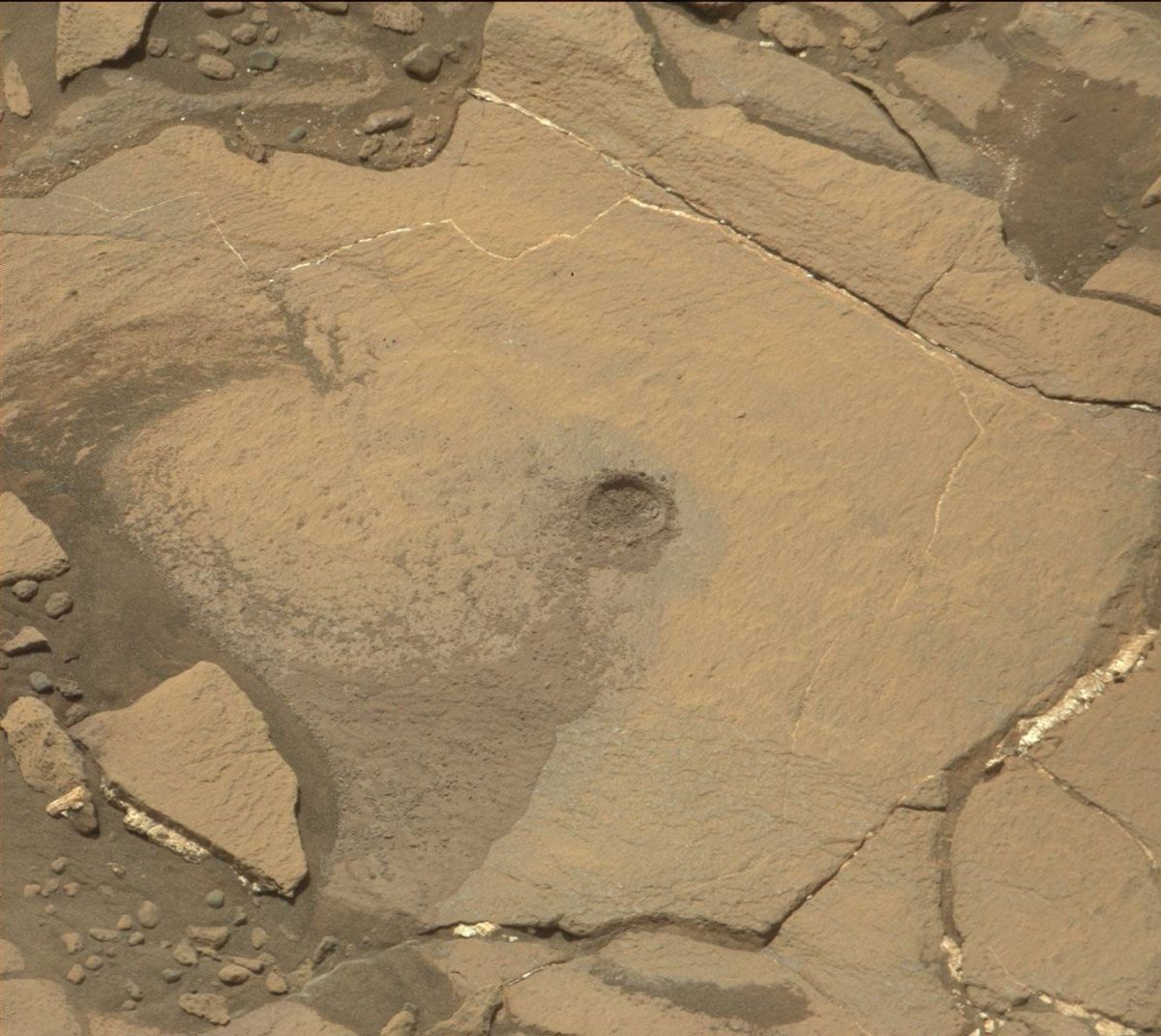
Curiosity Mastcam Right image taken on Sol 1420, August 4, 2016.
Credit: NASA/JPL-Caltech/MSSS
Now in Sol 1422 operations on Mars, NASA’s Curiosity rover has carried out drill activities at a target site dubbed “Marimba” – but the result is a bit of a mystery.
Lauren Edgar, a research geologist at the USGS Astrogeology Science Center in Flagstaff, Arizona reports:
“On Sol 1420 we planned a full drill hole on the target “Marimba” to characterize the composition of the Murray mudstone in this location. However, we came in early this morning to find that the drill hole didn’t penetrate very far into this rock target.”
Drill hole different
Using its Mars Hand Lens Imager, clearly the rover-produced drill hole is different, Edgar says. “We’re trying to evaluate why this drill hole is different, and what prevented the drill from completing as planned. The rover is healthy and all other activities completed successfully, so this might just be a harder rock target than we’ve seen before.”
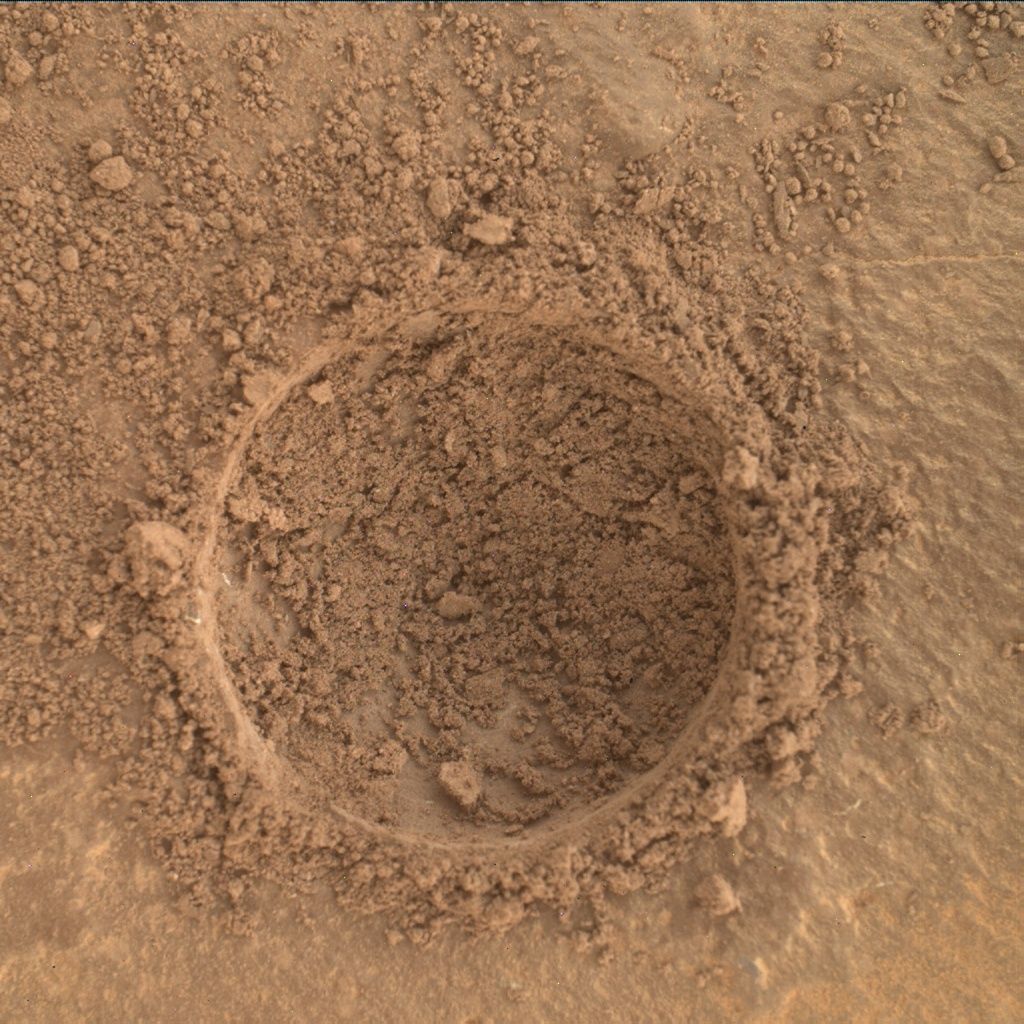
NASA’s Mars rover Curiosity acquired this image using its Mars Hand Lens Imager (MAHLI) on August 4, 2016, Sol 1420. MAHLI is located on the turret at the end of the rover’s robotic arm.
Credit: NASA/JPL-Caltech/MSSS
Rover team members are evaluating the drill activity and options for moving forward.
Chemistry with depth
A decision has been made to take advantage of the shallow drill hole “as a way to assess variations in chemistry with depth,” Edgar adds.
So the plan calls for rover Mastcam multispectral and Chemistry & Camera (ChemCam) passive observations of the drill tailings, as well as a ChemCam LIBS (laser-induced breakdown spectroscopy) observation across the drill hole.
Additionally, on the schedule is ChemCam observation of “Cabinda” to assess an alternative drill site, as well as the target “Epukiro” to investigate an interesting vein.
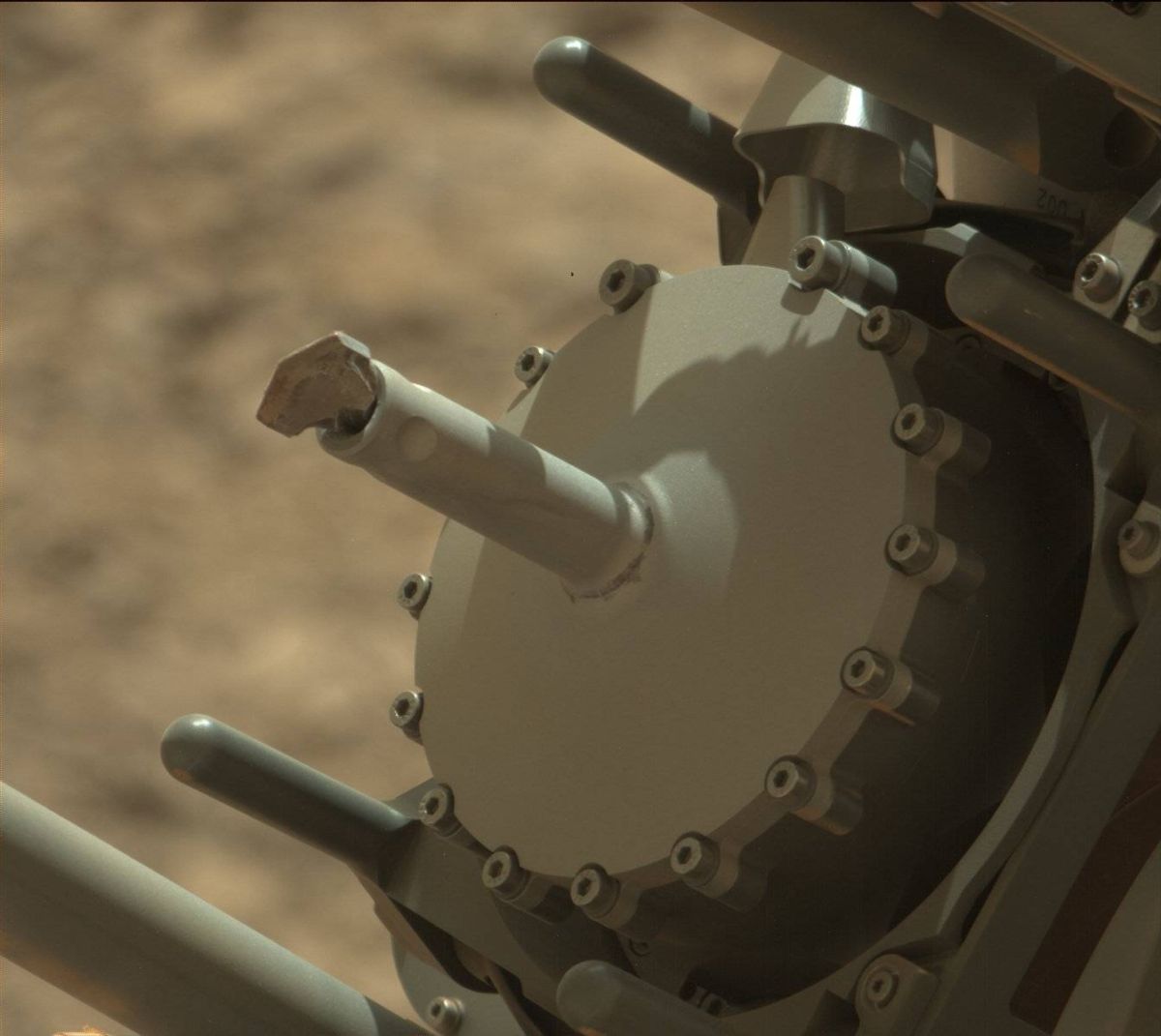
Close-up inspection of rover drilling hardware. Curiosity Mastcam Right image taken on Sol 1420, August 4, 2016.
Credit: NASA/JPL-Caltech/MSSS
Dump piles
“We’ll also use Mastcam and ChemCam to assess the post-sieve dump piles from the previous drill target “Oudam,” which we dumped on a nearby rock slab,” Edgar says.
Then Curiosity will use Mastcam and Navcam to monitor the atmosphere and search for dust devils.
Also on tap is acquisition of a 360-degree Mastcam mosaic to provide geologic context for this drill site, Edgar reports.
 Posted in Space News


Looks like very hard brittle clay.
Its more than a bit of a mystery why drilling ancient bedrock is the sole focus of Curiosity’s research. “The present is the key to the past.” – Charles Lyell. But the rover scientists are determined to find out what happened billions of years ago as their first priority. We’ve had rovers on Mars for 12 years but still don’t know anything about how how erosion works, can’t even be sure if sand saltates in the wind, and have no idea why hundreds of little slopes right in front of the rover are so active with slides.